
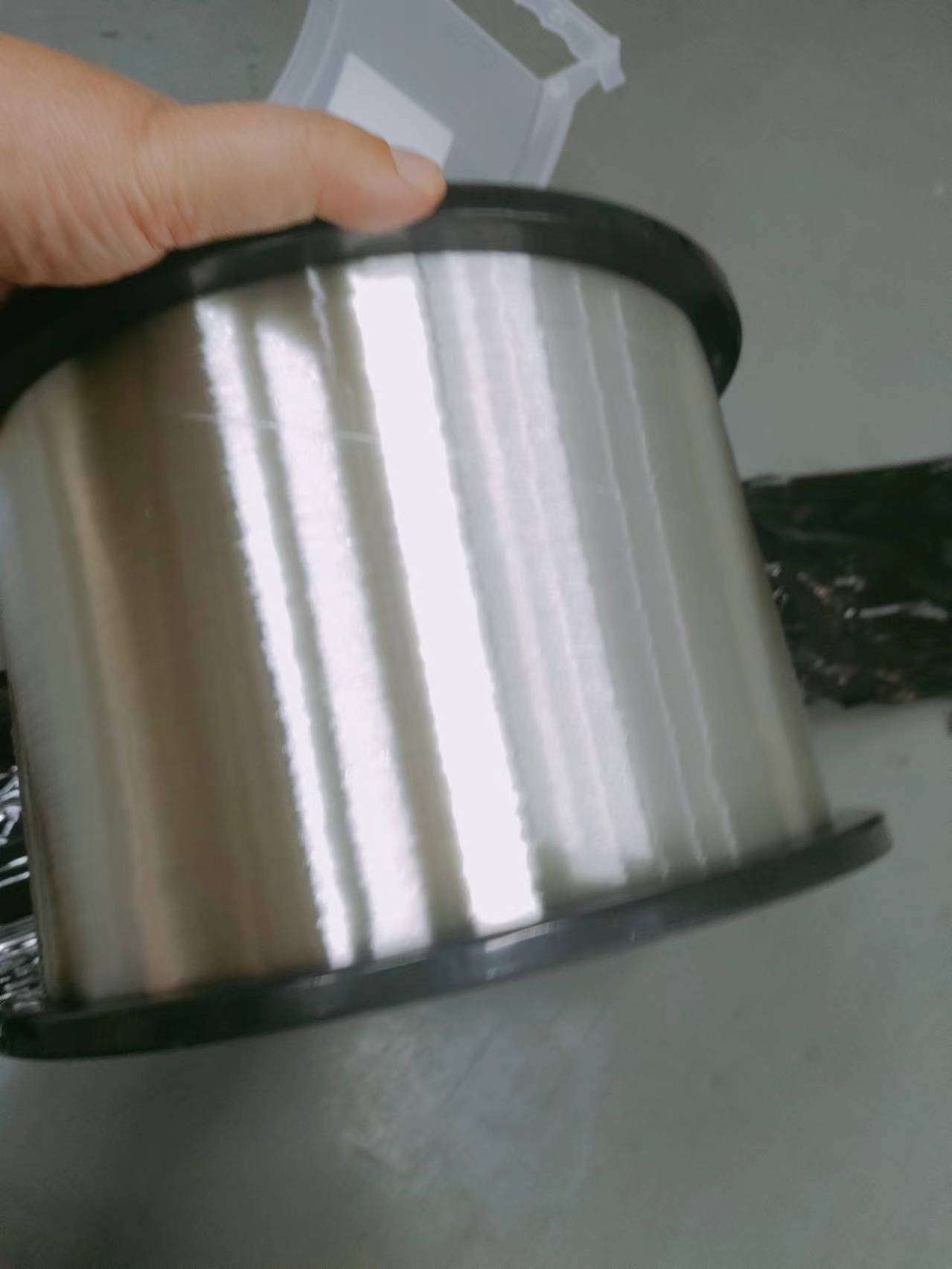
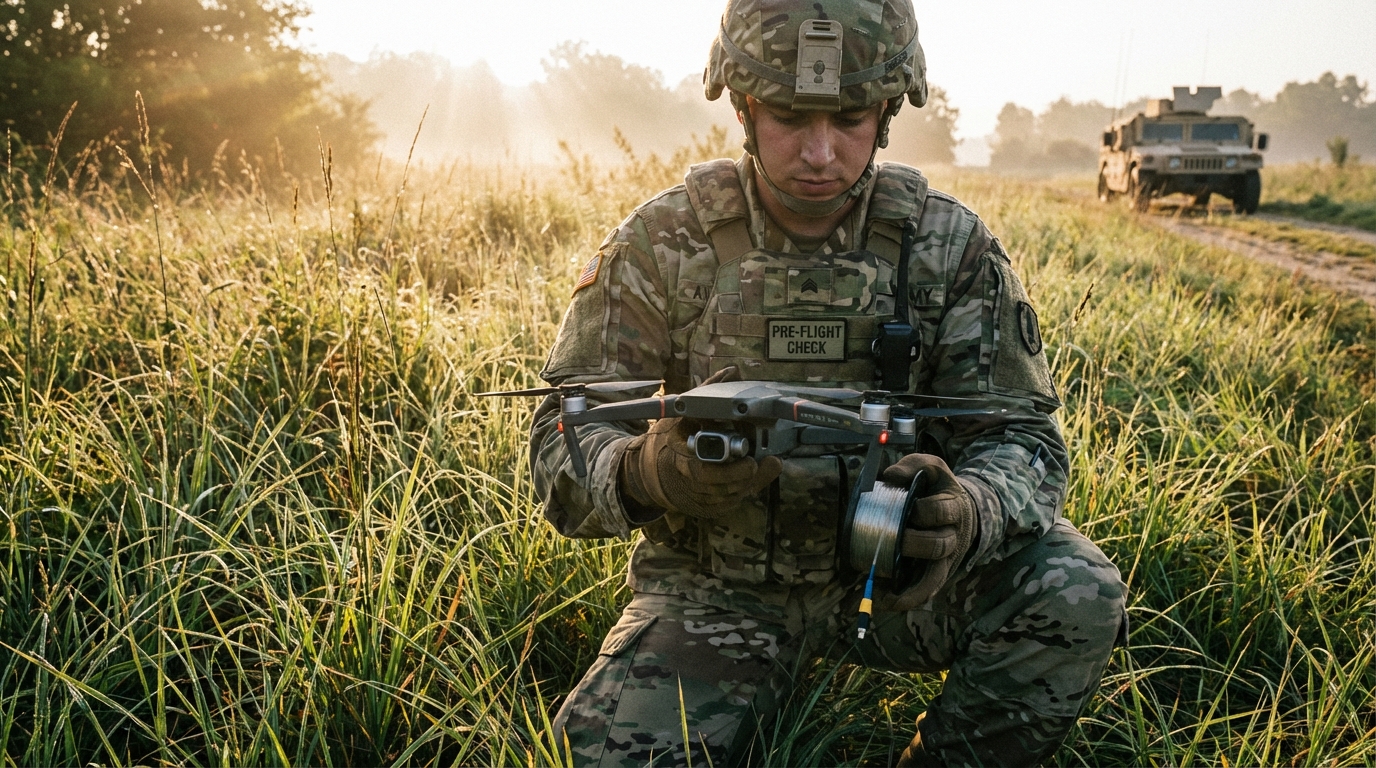
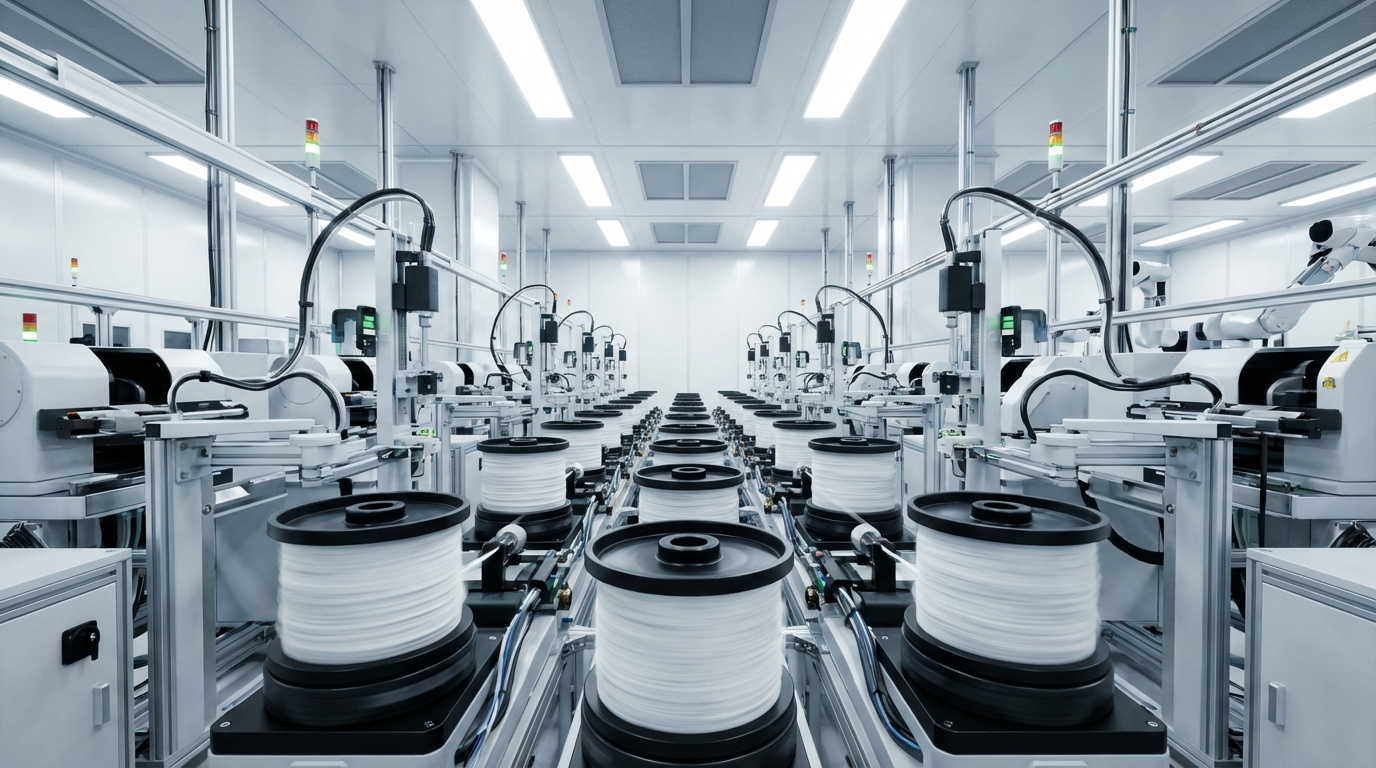
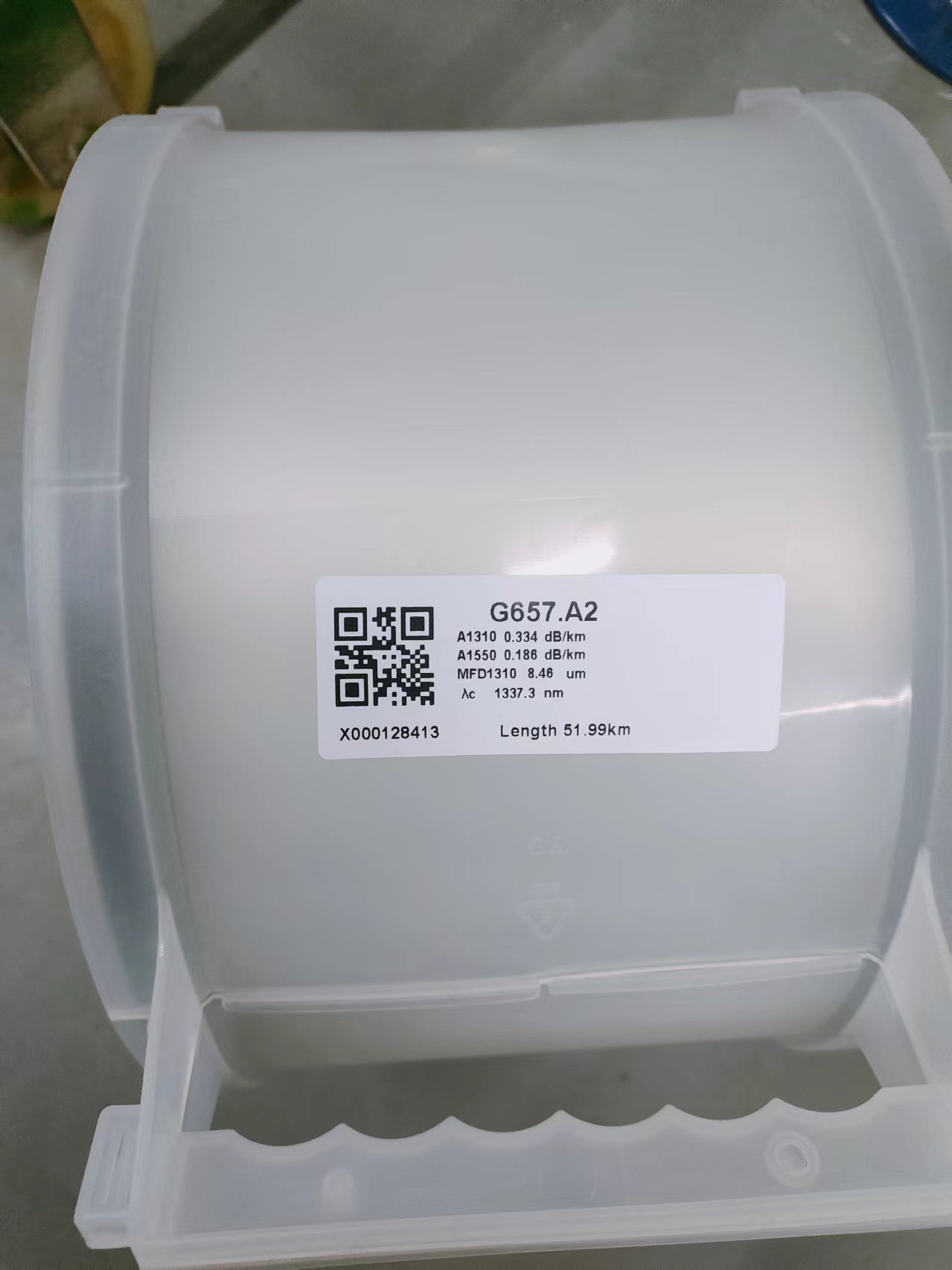
The Ultimate Authoritative Guide to Wholesale Procurement of Tactical G.657.A2 Drone Fiber
FEATURES
- Price (USD): Ask for a Quotation
- Qty (Meters): 1
- Shipping (USD): Ask for a Quotation
- Total (USD): Ask for a Quotation
- Shipping Method: DHL, FedEx, UPS, EMS, By Sea, By Air
- Payment: TT(Bank Transfer), Western Union, Paypal, Payoneer
Quick Link:
- Chapter 1: Why Jamming Fails
- Chapter 2: Physical Superiority
- Chapter 3: Full-Spectrum Scenarios
- Chapter 4: What's So Special About This Cable? (The Fiber Cable)
- Chapter 5: The Spool System - Core Technology
- Chapter 6: Photoelectric Conversion - The Signal Translator
- Chapter 7: Hardware Ecosystem - Beyond the Fiber
- Chapter 8: Deployment & Takeoff - The Critical 10 Seconds
- Chapter 9: Tactics
- Chapter 10: Troubleshooting
- Chapter 11: Hard Kill Interception
- Chapter 12: Environmental Impact & Post-War Cleanup
- Chapter 13: Supply Chain Exposed
- Chapter 14: Buyer's Guide & Anti-Scam Manual
- Chapter 15: Future Trends & Final Form
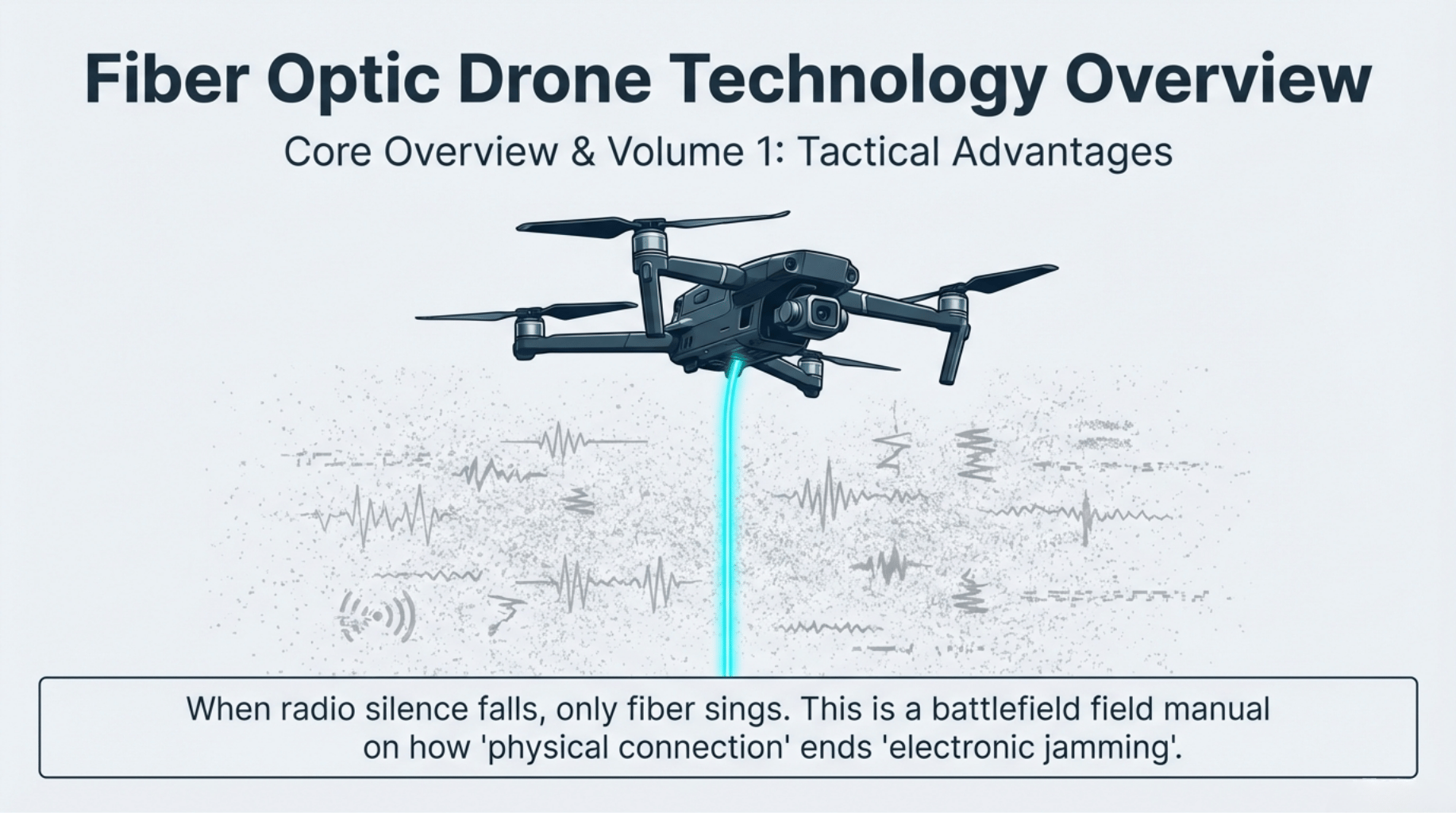
One-Sentence Summary: When radio silence falls, only fiber sings. This is a battlefield field manual on how "physical connection" ends "electronic jamming".
Why You Need This Manual (The "Why")
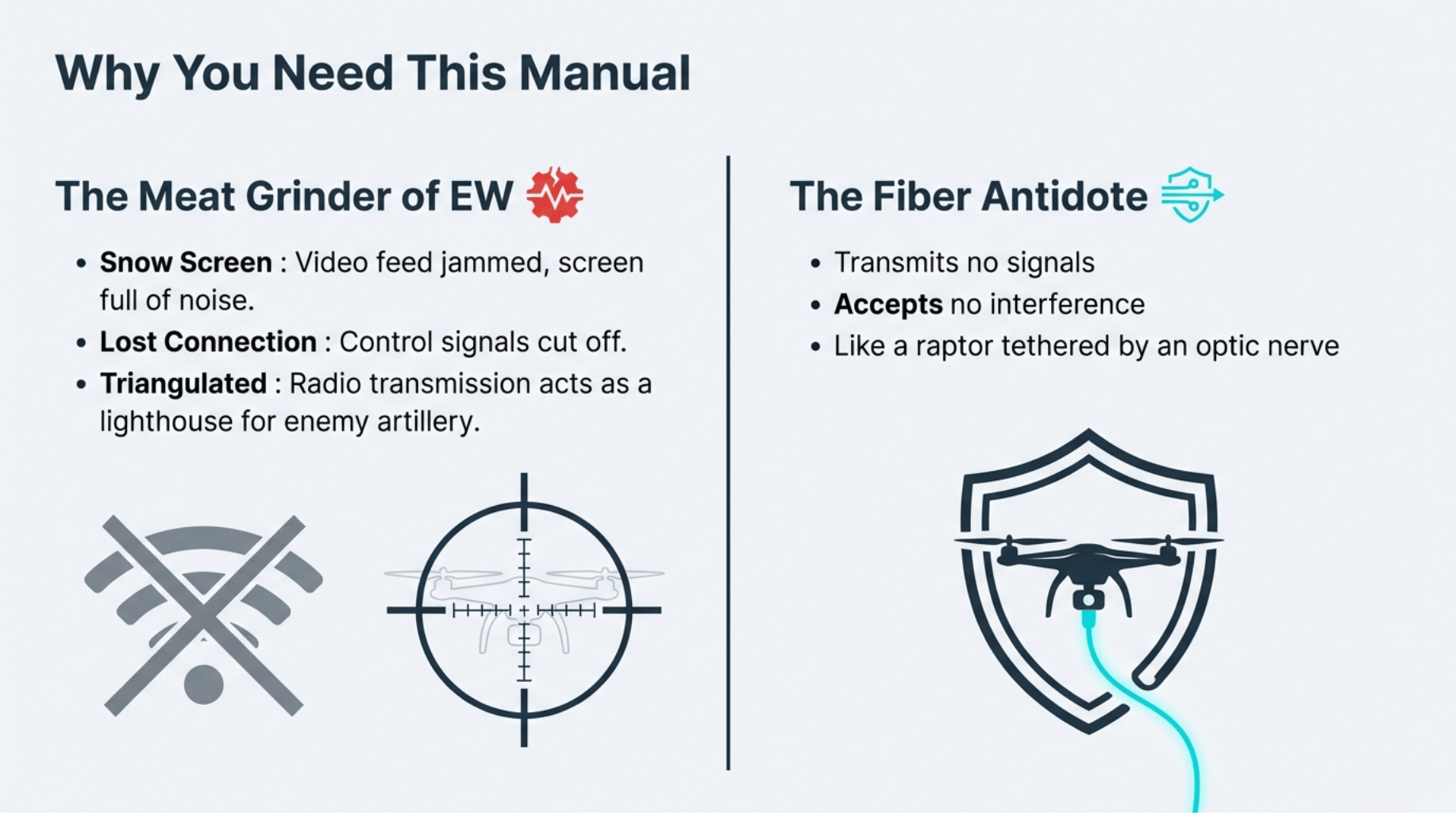
In the meat grinder of modern Electronic Warfare (EW), the survival time of ordinary Radio Drones is measured in minutes.
-
Snow Screen: Video feed jammed, screen full of noise.
-
Lost Connection: Control signals cut off, drone lands or flies away.
-
Triangulated: Your radio transmission is
-
a lighthouse for enemy artillery.
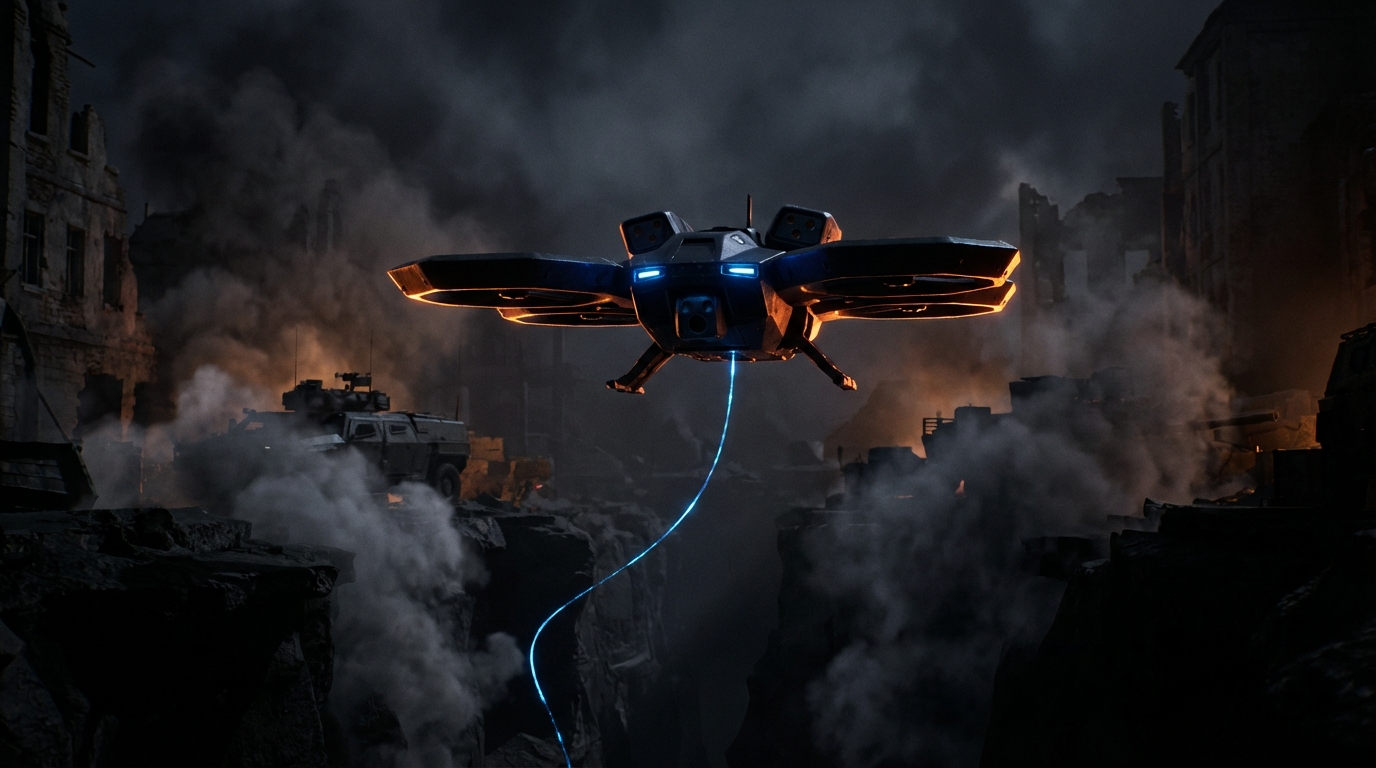
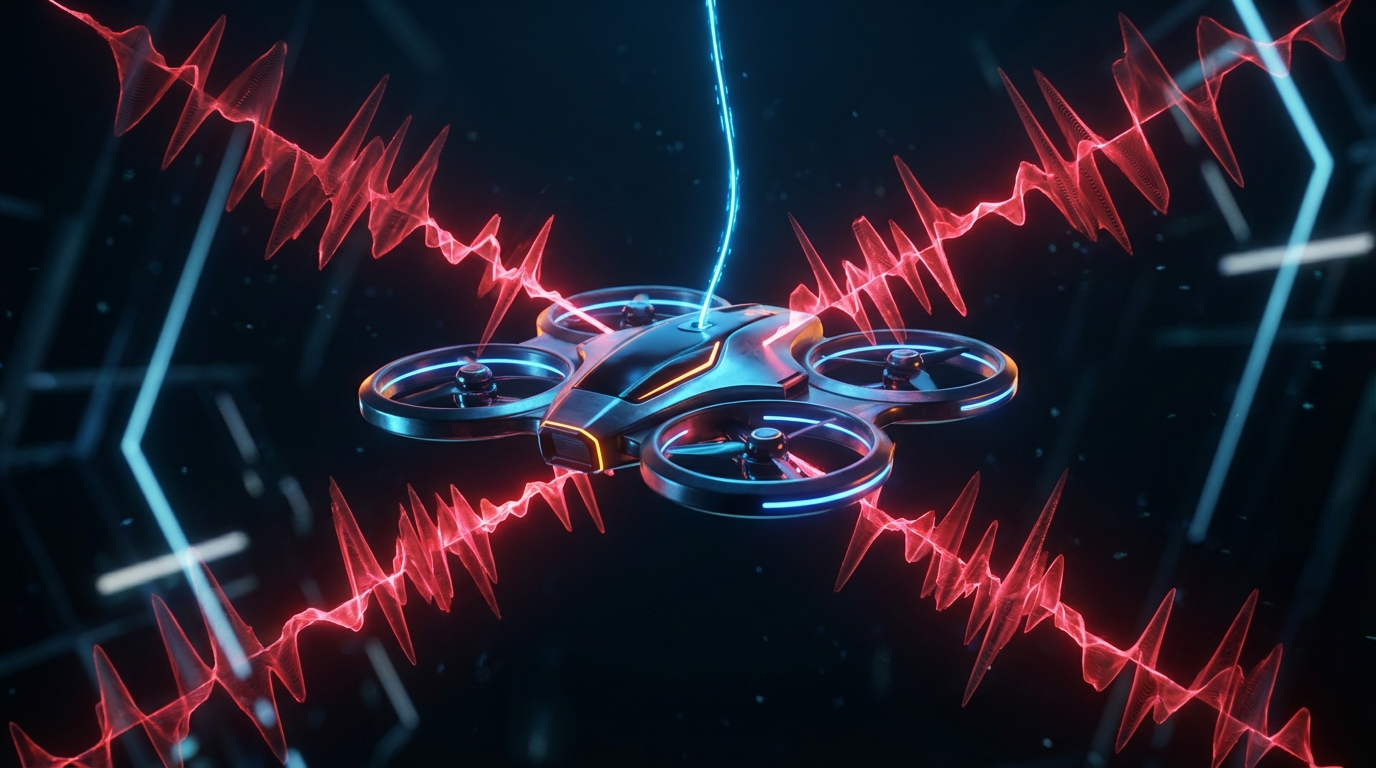
Fiber Drone is currently the only antidote. It transmits no signals and accepts no interference. It is like a raptor tethered by an optic nerve, staying absolutely lucid in the electronic fog.
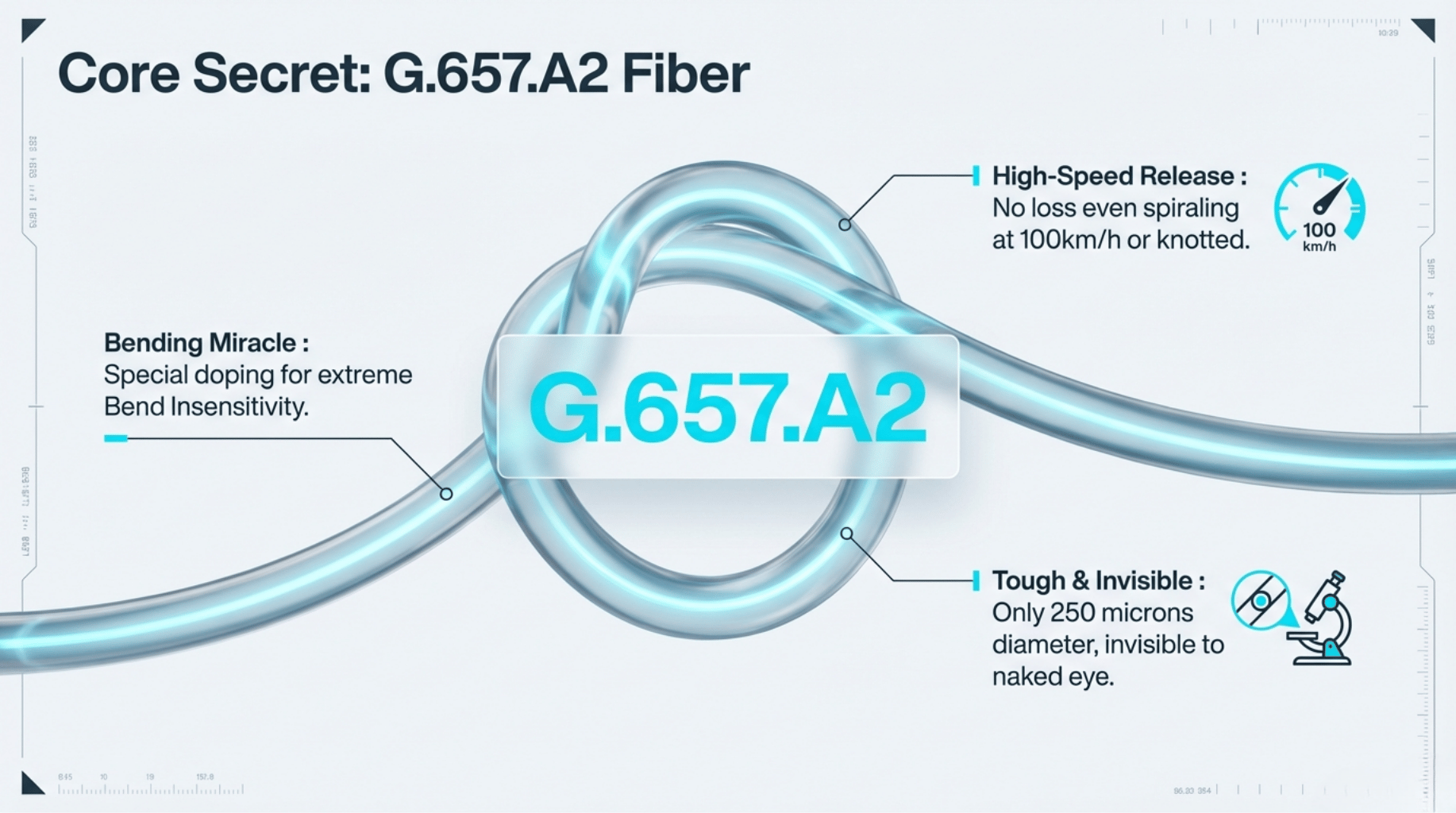
Core Secret: G.657.A2 (The Secret Weapon)
You might ask: "Dragging a wire while flying, won't it break?"
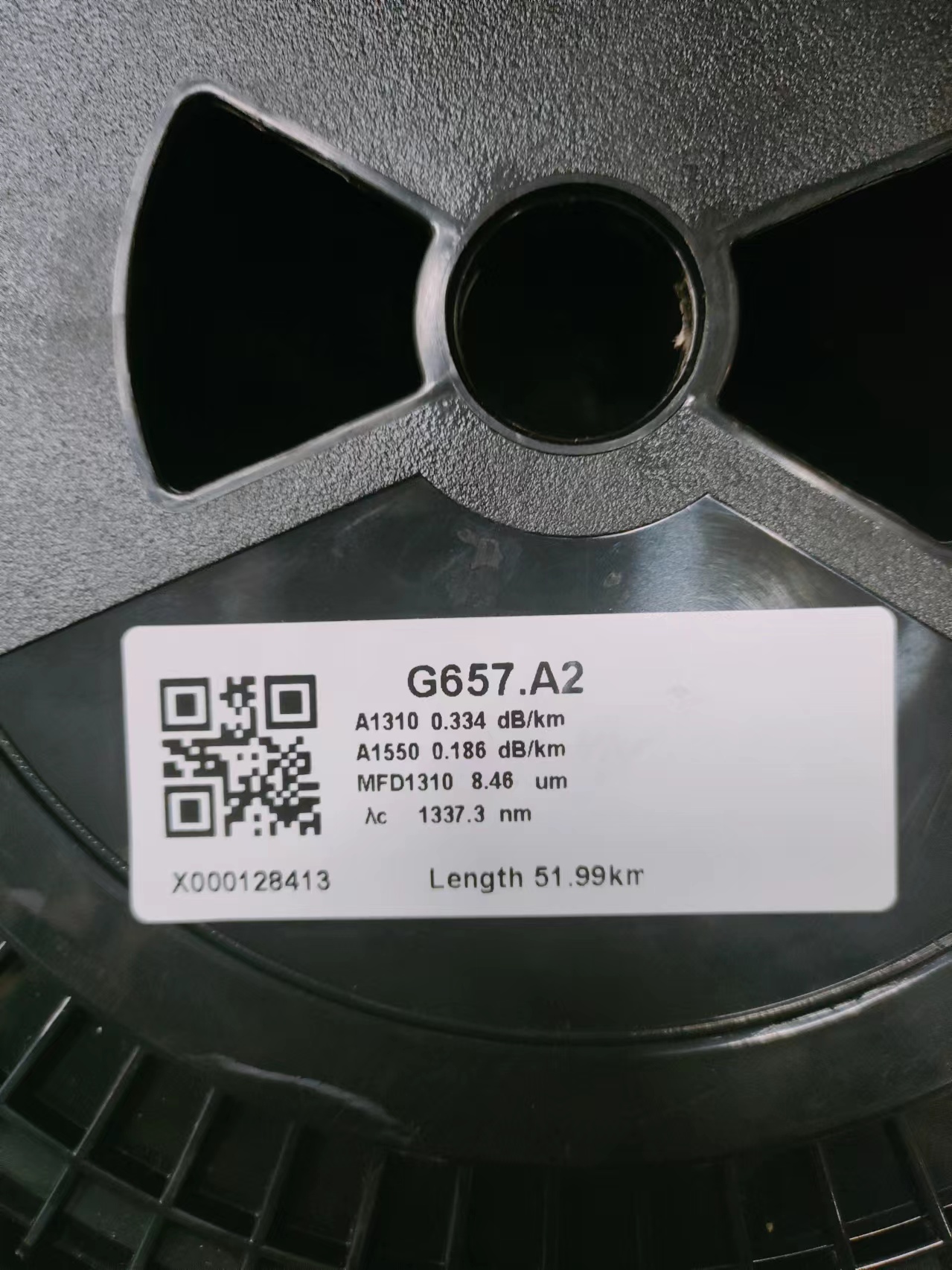
Ordinary communication fiber would indeed break. But we use G.657.A2 standard fiber. This is the heart of the fiber drone. Remember this code: G.657.A2.
-
Bending Miracle: It is not just a glass strand; it is designed with special doping processes to have extreme Bend Insensitivity.
-
High-Speed Release: Even when spiraling out of the spool at 100km/h, or even knotted, the light signal transmits without loss.
-
Tough & Invisible: Only 250 microns in diameter (with coating), invisible to the naked eye, yet withstands the tension of high-speed flight.
Without G.657.A2, a fiber drone is just an expensive kite; with it, the drone becomes a scalpel that can extend indefinitely.
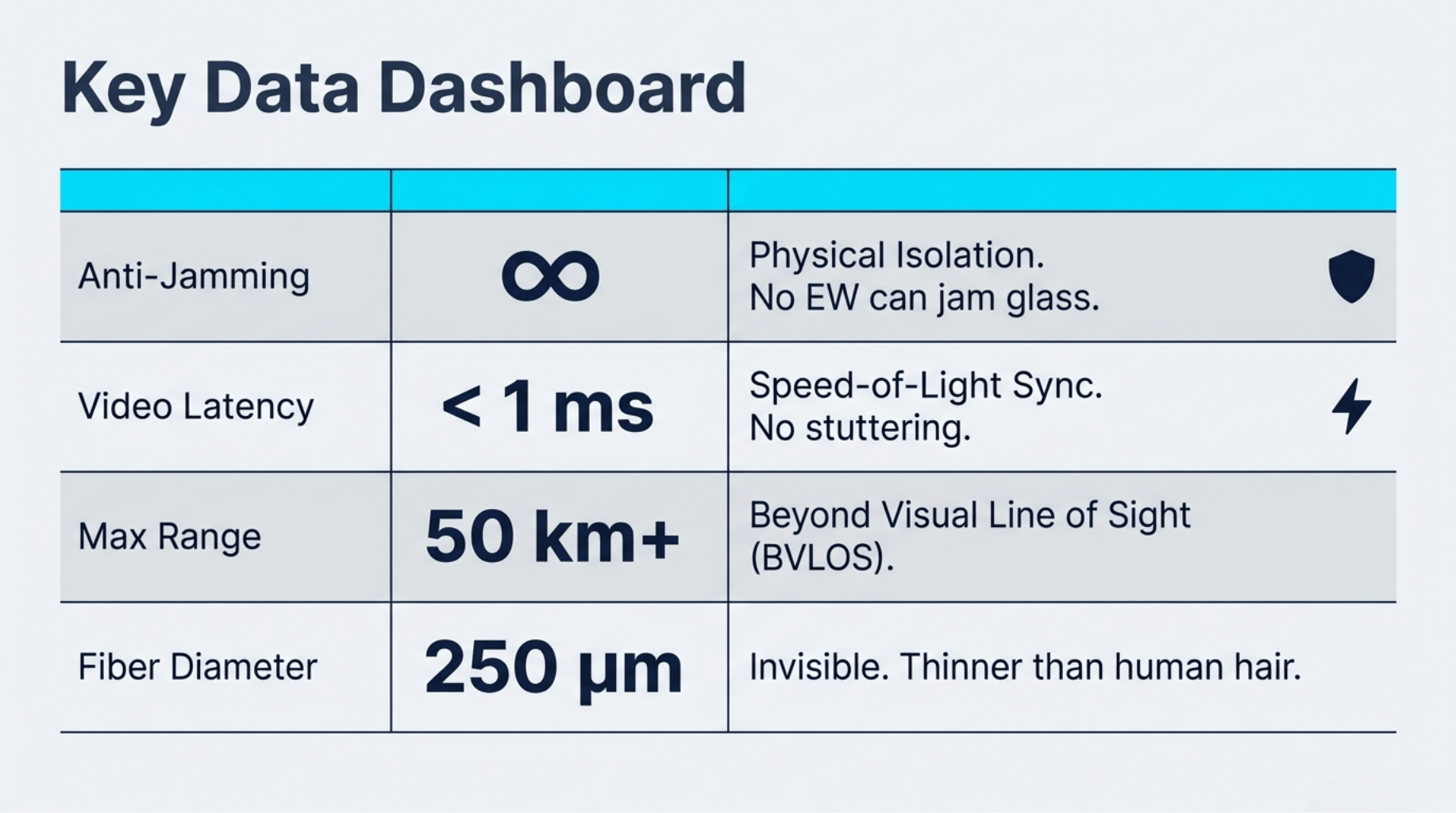
Key Data Dashboard
Don't be fooled by the word "wired". These numbers will overturn your understanding of "modern warfare":
| Metric | Value | Tactical Significance |
|---|---|---|
| Anti-Jamming | ∞ (Infinity) | Physical Isolation. No electronic warfare equipment can jam a glass fiber. Unless you physically cut it, you cannot stop it. |
| Video Latency | < 1 ms | Speed-of-Light Sync. No stuttering or pixelation typical of wireless feeds. What you see on screen is the drone's reality, millisecond-accurate. |
| Max Range | 50 km+ | Beyond Visual Line of Sight. Thanks to the low loss of G.657.A2, current spool systems support flights over 50km. |
| Fiber Diameter | 250 µm | Invisible. Slightly thicker than a human hair. In flight, this line is completely invisible to the naked eye. |
Navigation
This manual is divided into 5 Volumes, taking you from "Principles" to "Combat":
-
- Why is it the "Sniper in the Trench"? (Includes NLOS Strike details)
-
- Revealing how the spool pays off line at 150km/h without knotting.
-
- Step-by-step guide on assembly, takeoff, and threading through jungles.
-
- What to do when the enemy also uses fiber?
-
- Supply chain insights and the future of AI terminal homing.
Pro Tip: Whether you are a frontline commander seeking to break electronic blockades, or a tech geek exploring anti-jamming solutions, this G.657.A2 fiber will be the most reliable lifeline in your hands.
Volume 1: Tactical Advantages
Chapter 1: Why Jamming Fails
Core Argument: In the ocean of electronic warfare, the only safe island is physical isolation.
1.1 Physical Isolation Works
1.1.1 The Nature of EW
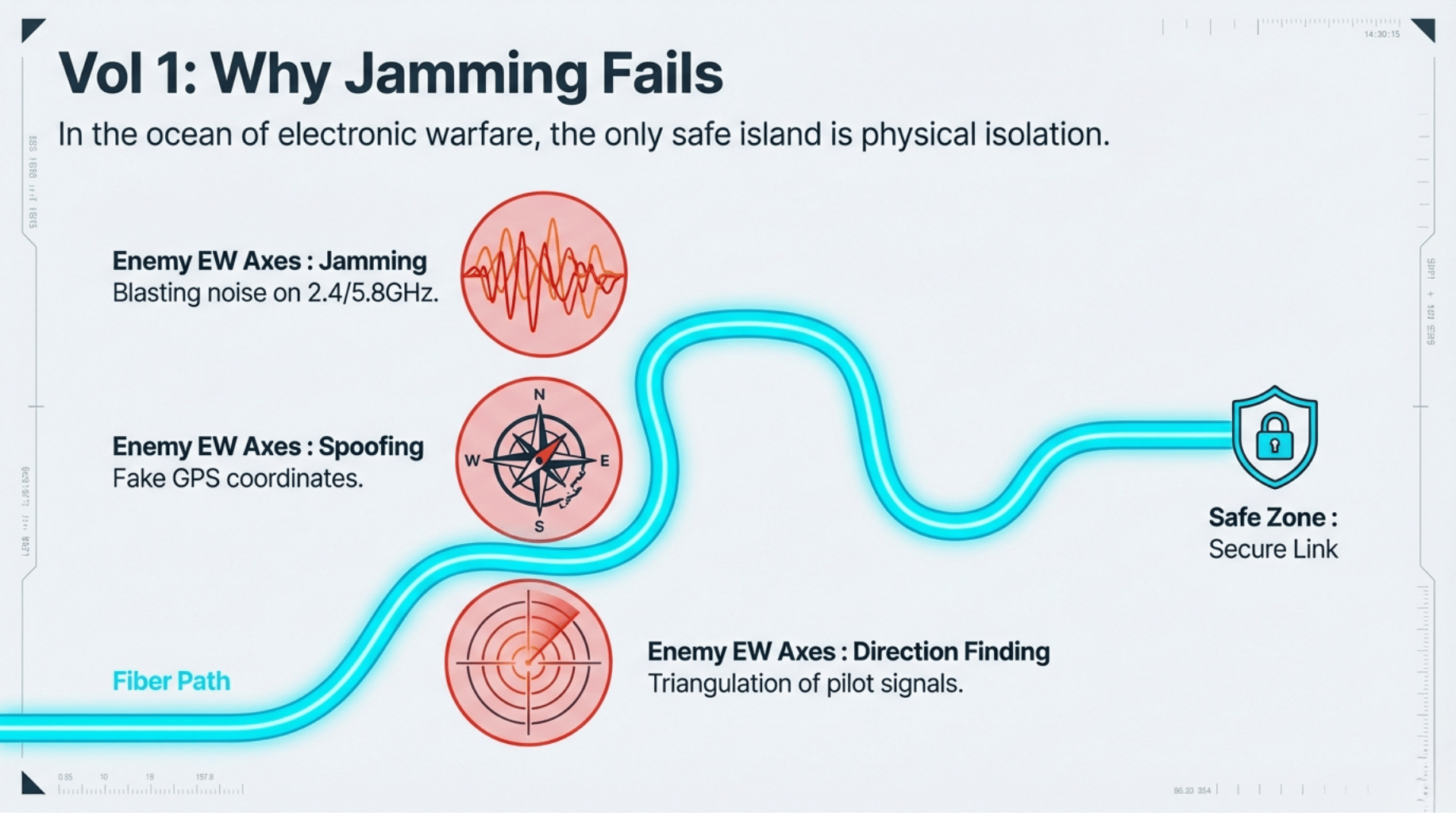
To understand why fiber drones are "invincible," you first have to understand how the enemy attacks normal drones. Modern Electronic Warfare (EW) has three main axes: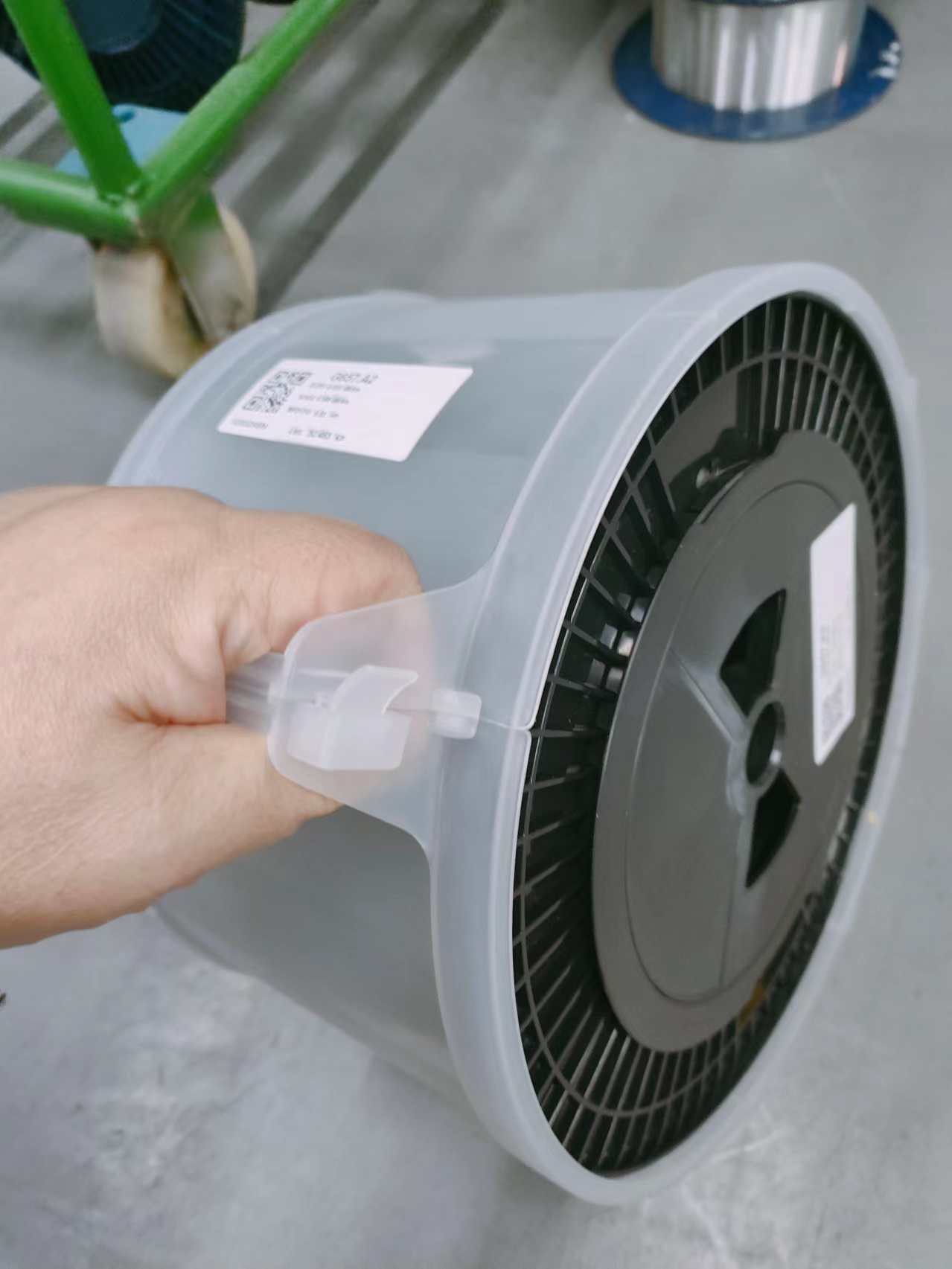
-
Jamming: Like blasting noise in a crowded room. Enemy jammers blast high-intensity nonsense on 2.4GHz and 5.8GHz bands, drowning out your control signals. The drone "can't hear" the controller and triggers failsafe (land or RTH).
-
Spoofing: Telling the drone "You are in Antarctica" when it's actually over the battlefield. The drone flies erratically to "correct" its position and crashes.
-
Direction Finding: As soon as your controller emits radio waves, enemy sensors calculate your coordinates via triangulation (accuracy to meters). Seconds later, artillery lands on the pilot's head.
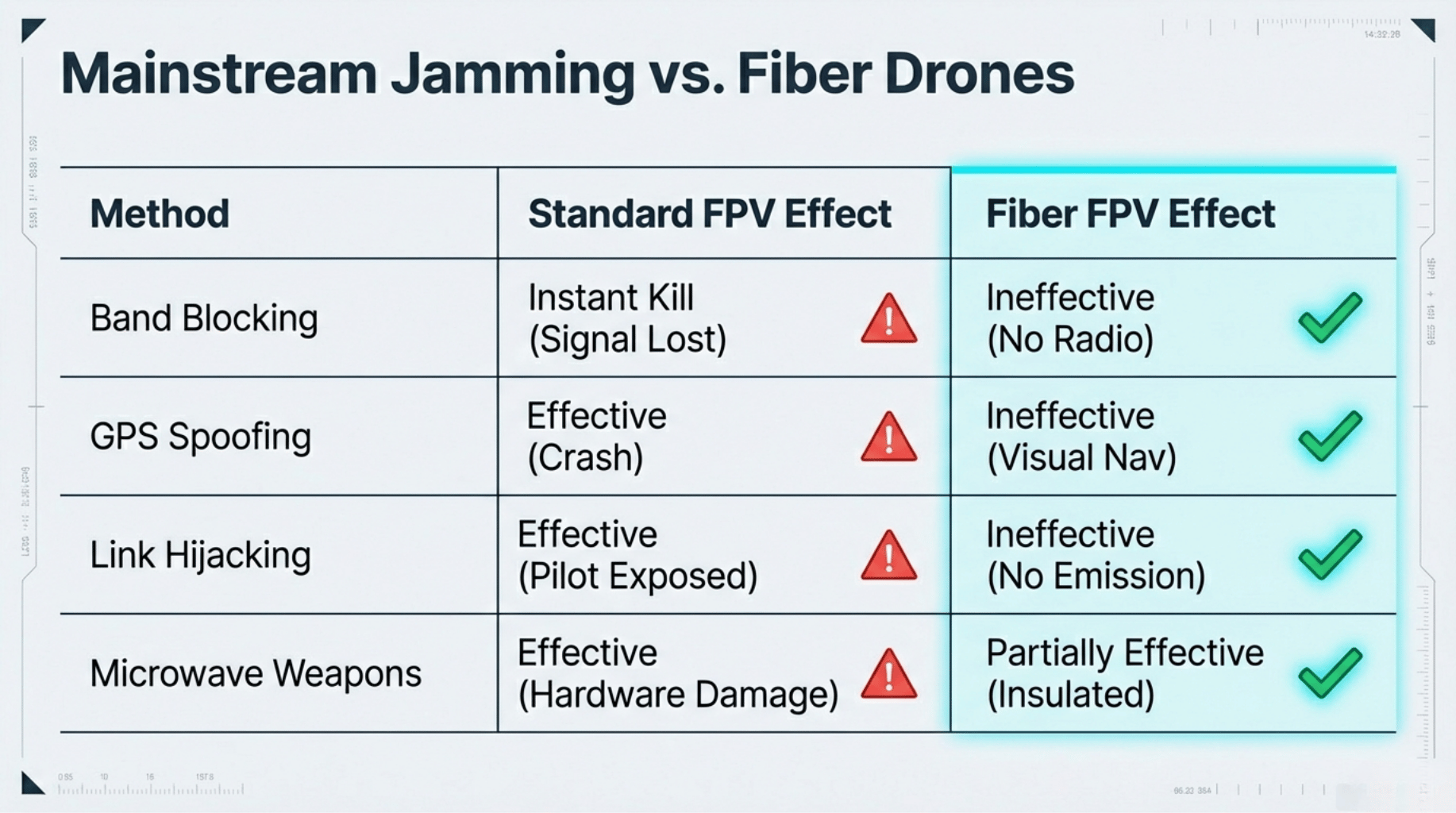
Table 1-1: Mainstream Jamming vs. Fiber Drones
| Jamming Method | Mechanism | Effect on Standard FPV | Effect on Fiber FPV |
|---|---|---|---|
| Band Blocking | High-power white noise on 900MHz/2.4GHz | Instant Kill (Signal lost) | Ineffective (No radio used) |
| GPS Spoofing | Fake satellite coordinate signals | Effective (Crash/Flyaway) | Ineffective (Visual navigation) |
| Link Hijacking | Cracking protocols (e.g., DJI Aeroscope) | Effective (Pilot exposed) | Ineffective (No air transmission) |
| Microwave Weapons | High-energy beams frying electronics | Effective (Hardware damage) | Partially Effective (Fiber is insulated) |
1.1.2 The Insulator
Fiber drones are immune to all the above. Not because of advanced firewalls, but because of basic physics.
-
Photons vs. Electrons: Radio jamming targets electromagnetic waves. Fiber transmits light signals (photons) enclosed in glass. External EM waves (whether 100W jammers or kW microwave weapons) cannot penetrate the cladding to affect the light inside.
-
Physical Closed Loop: The link is: Controller -> Transceiver -> Fiber -> Drone. It's a closed physical loop. Just as you can't hack an unplugged computer via WiFi, the enemy can't jam a drone with no radio receiver.
-
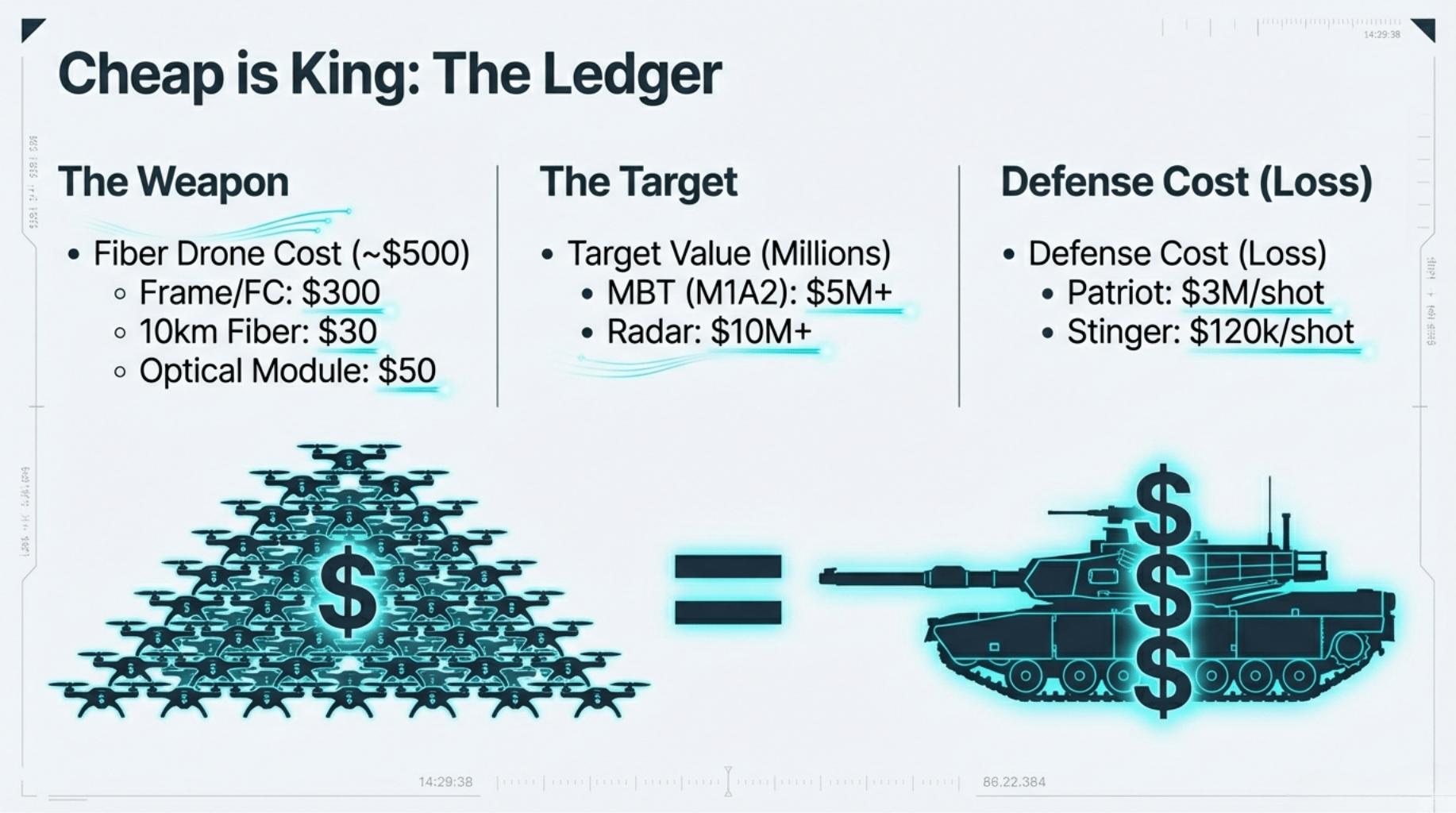
Invisible Pilot: Since no radio signals are emitted, the pilot is "silent." The enemy's spectrum analyzer shows a flat line. This massively increases operator survival rates.
1.1.3 Dimensional Strike on Spectrum Sovereignty
This is an asymmetric war.
-
Traditional Logic: EW is about "contesting spectrum sovereignty." You need higher power and complex Frequency Hopping (FHSS) to fight through the noise. It is a "mud wrestling" match.
-
Fiber Logic: Simply abandon the spectrum. I'm not fighting you. You can jam everything from 0Hz to 100GHz, and I don't care, because I'm not in that dimension.
-
Strategic Value: This isn't just anti-jamming; it's anti-reconnaissance. Since no radio is emitted, the enemy's most advanced ELINT satellites and AWACS become blind. You don't exist on their map until you impact.
Case Study: In a test, a military-grade anti-drone gun (optimized for DJI O3) was fired point-blank at a fiber drone. Result: Not a single frame dropped, control remained silky smooth. RF energy has zero effect on glass strands.
1.2 The Physics of Inevitability: Inverse Square Law vs. Total Internal Reflection
If the previous discussion was tactical, this section dives into the underlying physics to reveal why Electronic Warfare (EW) is not just "ineffective" against fiber, but "hopeless."
1.2.1 The Jammer's Nightmare: Inverse Square Law
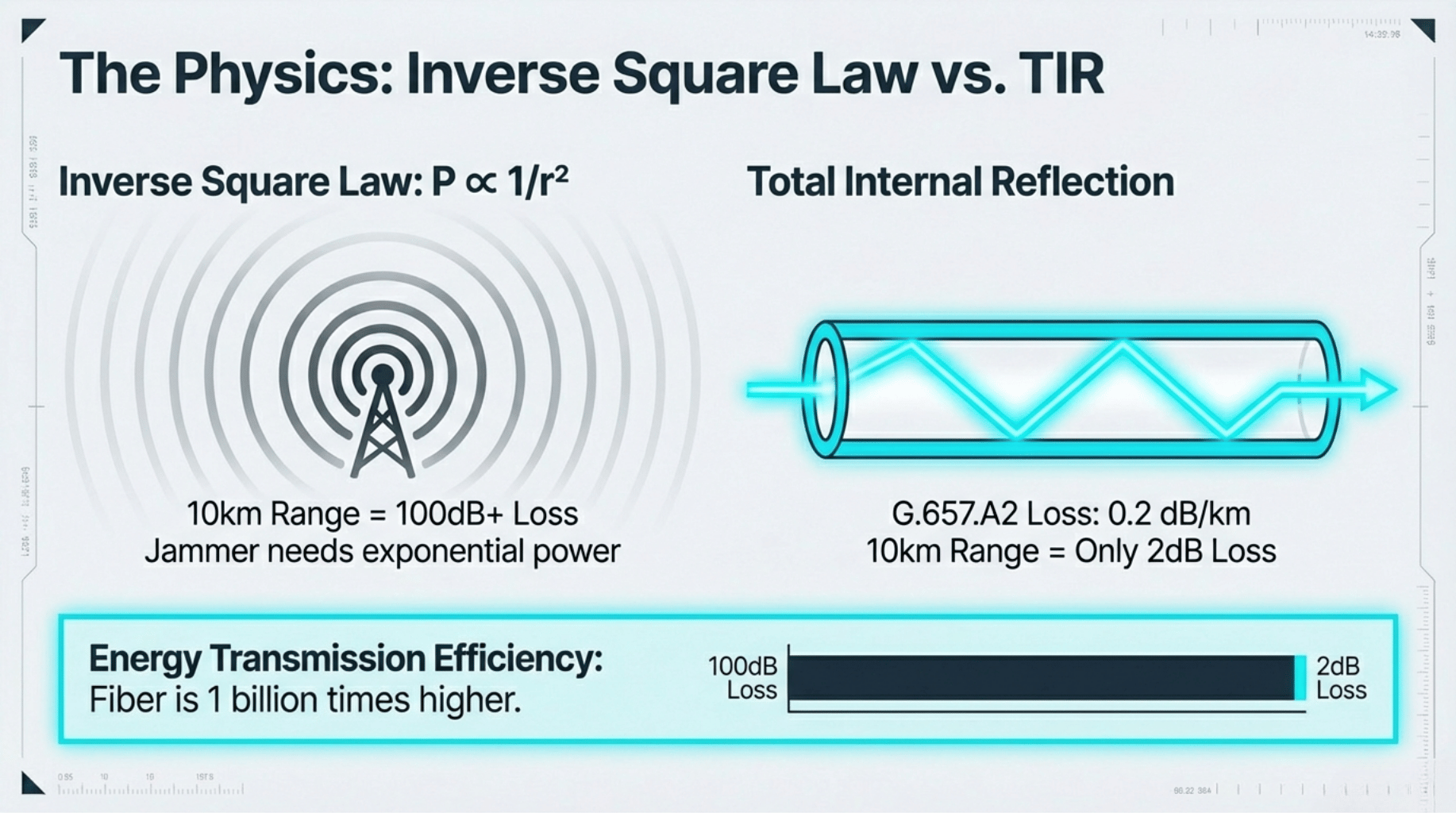
EW jamming vehicles fight not just enemy drones, but physical laws. Radio signal attenuation follows the Inverse Square Law:
P∝r21
This means:
-
Double the distance, signal strength drops to 1/4.
-
Ten times the distance, signal strength is 1/100.
Jamming-to-Signal Ratio (J/S Ratio): To successfully jam a drone, the Jamming power (J) must be significantly higher than the Pilot's Signal power (S).
-
Scenario: The drone is 5km away from the pilot, while the jammer is 10km away.
-
Dilemma: Although the jammer has massive power (e.g., 1000W), after 10km of attenuation, it arrives at the drone in milliwatts. The pilot, despite low power (1W), has a stronger signal due to proximity and high-gain antennas.
-
Burn-Through: The closer the drone is to the pilot, the stronger the pilot's signal. For a jammer to suppress the pilot at close range, the required power rises exponentially, often until the jammer fries its own circuits.
1.2.2 Fiber's Privilege: Total Internal Reflection
Fiber transmission ignores the Inverse Square Law; it uses Total Internal Reflection. Light bounces off the inner walls of the glass fiber like a pinball, with almost no energy leakage.
-
Linear Attenuation: Fiber loss is linear. G.657.A2 fiber attenuation at 1550nm is only 0.2 dB/km.
-
The Math:
-
Radio (10km): Signal may attenuate by 100dB+ (depending on frequency).
-
Fiber (10km): Signal attenuates by only 2dB.
-
-
Conclusion: At 20km, the fiber signal remains crystal clear with ultra-high Signal-to-Noise Ratio (SNR). A radio signal at that distance would be buried in background noise.
1.2.3 The True Air Gap
In cybersecurity, an "Air Gap" means a computer is physically disconnected from networks. But in the radio age, if it has a wireless card, there is no true Air Gap.
-
Fake Isolation: Traditional drones, even if offline, have receivers. A receiver is a "backdoor" open to the world.
-
True Isolation: Fiber drones have no RF Receiver module. To electromagnetic waves, it is just a rock or a stick. You cannot "hack" a rock via radio.
1.2.4 The Curse of the Fresnel Zone
Radio is limited not just by distance, but by spatial geometry.
-
Fresnel Zone: Radio waves travel in a football-shaped tunnel. If this tunnel is blocked by ground, trees, or buildings, signal quality plummets.
-
Multipath Fading: In Nap-of-the-Earth (NOE) flight, radio waves bounce off the ground. The reflected waves cancel out the direct waves (phase opposition), causing the signal to drop to zero instantly. This is the physical reason why traditional FPVs frequently lose control in jungles or urban warfare.
-
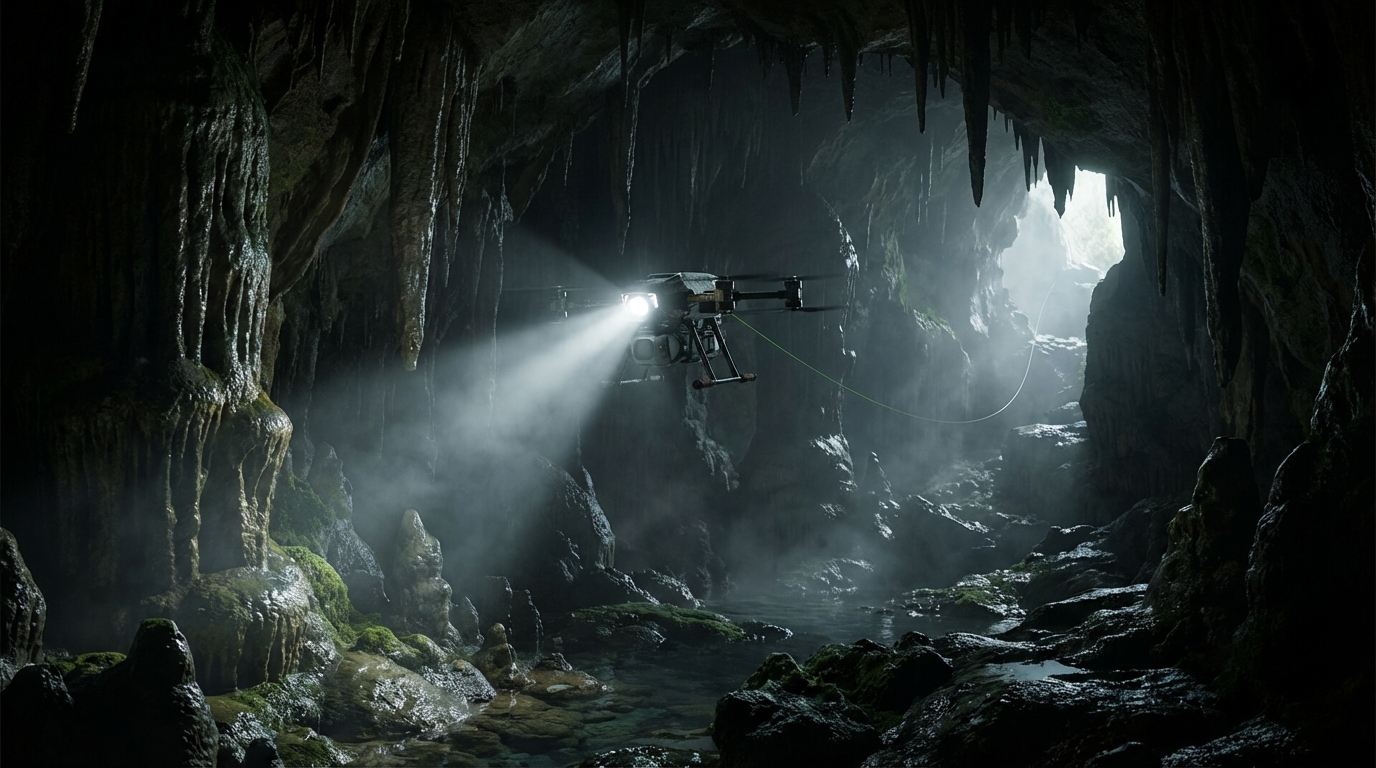
Fiber's Freedom: Fiber drags the "waveguide" physically behind it. No Line-of-Sight (LOS) needed, no Fresnel Zone needed. You can fly into sewers, around buildings, or even into caves, and the signal remains perfect.
1.2.5 Energy Density: A Dimensional Strike
-
Divergence vs. Focus: A 1000W jammer spreads energy in all directions (or a sector). At 5km, the energy per unit area is minuscule.
-
Waveguide Confinement: The fiber drone's laser power is only 1mW (0.001W). But this 0.001W is locked tightly inside the 9-micron glass core until it reaches the drone.
-
Conclusion: In terms of energy transmission efficiency, fiber is 1 billion times higher than radio. It's unfair, but that's physics.
1.3 Old Tech, New Tricks
1.3.1 A Brief History of Wire-Guidance
Actually, "flying on a wire" isn't new. Humans have been doing it for half a century.
-
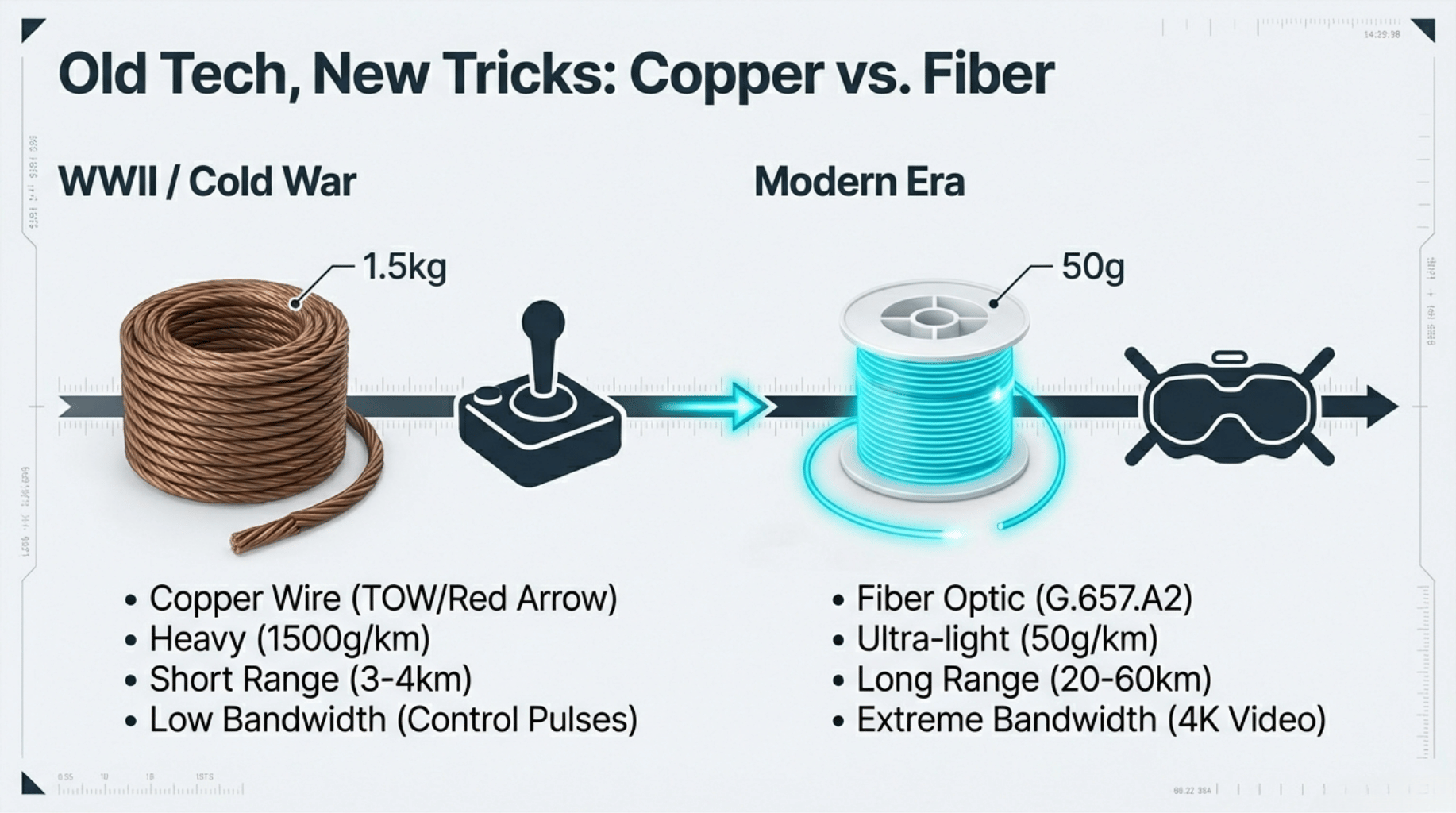
WWII: The German X-7 anti-tank missile dragged two copper wires.
-
Cold War: The famous BGM-71 TOW and Chinese Red Arrow-73 are classic "wire-guided missiles." The gunner tracks the target, and commands go through copper wires.
-
Torpedoes: Modern heavy torpedoes (like the US Mk48) still keep wire guidance because underwater wireless is unreliable.
1.3.2 The Fiber Revolution
Table 1-2: Traditional Copper vs. Modern Fiber
| Feature | Traditional Copper (e.g., TOW) | Modern Fiber (G.657.A2) | Revolution |
|---|---|---|---|
| Material | Copper Metal (Conductive) | Silica Glass (Insulating) | Total EM Immunity |
| Weight | Heavy (~1500g/km) | Ultra-light (~50g/km) | 10x Range Increase |
| Range Limit | 3-4 km (Too heavy to drag) | 20-60 km (Easy payload) | Tactical -> Operational |
| Bandwidth | Low (Control pulses only) | Extreme (4K Video/Data) | Enables FPV |
| Tensile Strength | Average (Snaps easily) | High (Stronger than steel) | High-G Maneuvers |
1.3.2.1 The Payload Paradox
Traditional wire-guided missiles (like TOW) are trapped in a physical loop: The further you want to shoot, the longer the wire you need; the longer the wire, the heavier the missile; the heavier the missile, the shorter the range.
-
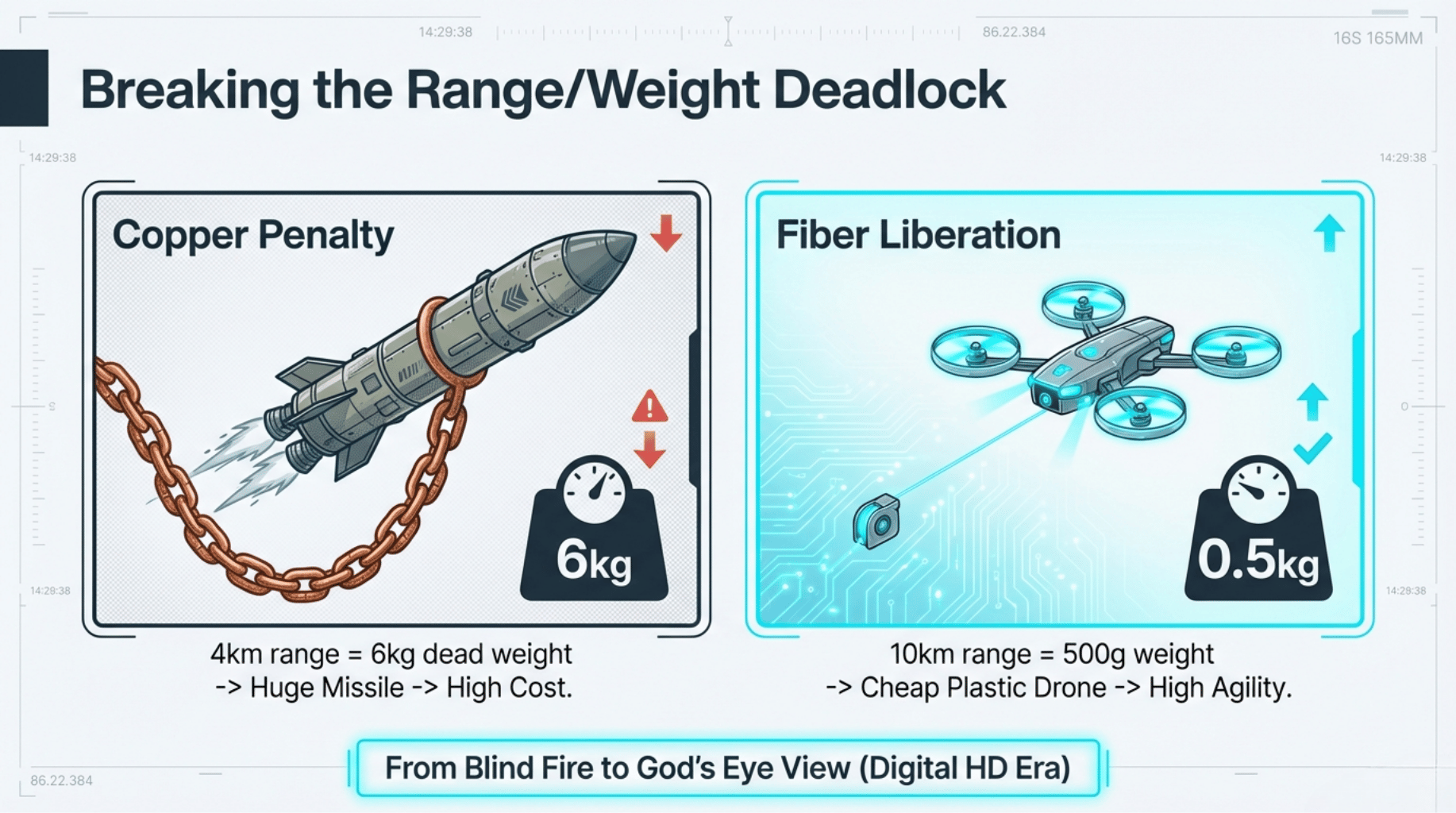
The Copper Penalty: Copper wire weighs about 1.5 kg per km. If you want a 4km range, the missile must carry 6kg of dead weight. This means the missile must be huge and the engine powerful, driving costs up (a TOW missile costs ~$50k-$100k).
-
Fiber's Liberation: Fiber weighs only about 50 grams per km. 10km of fiber weighs just 500g, about the weight of a water bottle. This allows cheap plastic drones to easily carry 10-20km of "ammo", breaking the deadlock between range and weight.
1.3.2.2 From Blind Fire to God's Eye View
Copper represents the "Analog Era", while fiber opens the "Digital HD Era".
-
Blind Men Touching an Elephant: Copper could only transmit simple voltage pulses (Up, Down, Left, Right). The shooter had to stare at the infrared light on the missile's tail through a sight (SACLOS guidance). If the target hid behind a hill or wall, the shooter couldn't see it, and the missile was useless.
-
Immersive Experience: Fiber is a "Digital Superhighway". It transmits 1080p or even 4K HD video in real-time with zero latency. The pilot is no longer remotely "controlling" the missile but "sitting" inside it via FPV goggles. You can fly over hills, around buildings, through windows, and even see the terror on the enemy's face.
1.3.2.3 The Invisible Red Thread
-
Visual Stealth: Old anti-tank missile copper wires were thick and could reflect sunlight or even be detected by radar. Fiber is only 250 microns in diameter (coating included), barely thicker than a hair, and is transparent glass. In the air, it is completely invisible to radar and the naked eye.
-
Insulation Advantage: Copper conducts electricity. If a missile flew over high-voltage lines, the copper wire would short out or snap if it touched them. Fiber is glass (insulator) and can safely traverse complex urban power grids.
1.3.3 Democratization of Tech
Previously, fiber guidance technology belonged exclusively to expensive military missiles (like the German Polynege or Israeli Spike). Now, thanks to the explosion of the civilian optical communication industry, this elite technology has become accessible to everyone.
1.3.3.1 Byproduct of Broadband
We have the massive global (especially Chinese) FTTH (Fiber to the Home) infrastructure to thank.
-
Scale Effect: To bring gigabit internet to every home, factories produce hundreds of millions of kilometers of single-mode fiber annually. This astronomical production volume has driven costs down to rock bottom—cheaper than fishing line.
-
Universal Standards: G.652.D and G.657.A2 have become absolute universal standards. You don't need custom "military fiber"; the civilian fiber you buy on Amazon has physical properties sufficient for the battlefield.
1.3.3.2 Revenge of the Geeks
The fiber drone was not born in a Lockheed Martin lab, but in garages and Telegram groups.
-
Open Source Spirit: Geeks in Ukraine and Russia didn't reinvent the wheel. They took off-the-shelf FPV racing drones, off-the-shelf optical transceivers, and 3D-printed spools.
-
Rapid Iteration: The R&D cycle for defense contractors is 5-10 years. For geeks, it's 5-10 days. Fiber breaking this week? New winding method next week. This "wild growth" speed is unmatched by traditional industry.
1.3.3.3 Lego-style Assembly
-
Modularity: The core component (photoelectric conversion board) is now a standard PCB module that stacks directly onto the FPV flight controller.
-
Zero Barrier: Previously, you needed to understand missile guidance theory. Now, if you can solder and tune PID, you can assemble a "fiber loitering munition" in a trench.
1.4 Cheap is King
1.4.1 The Ledger
Warfare ultimately comes down to attrition. Let's do the math:
-
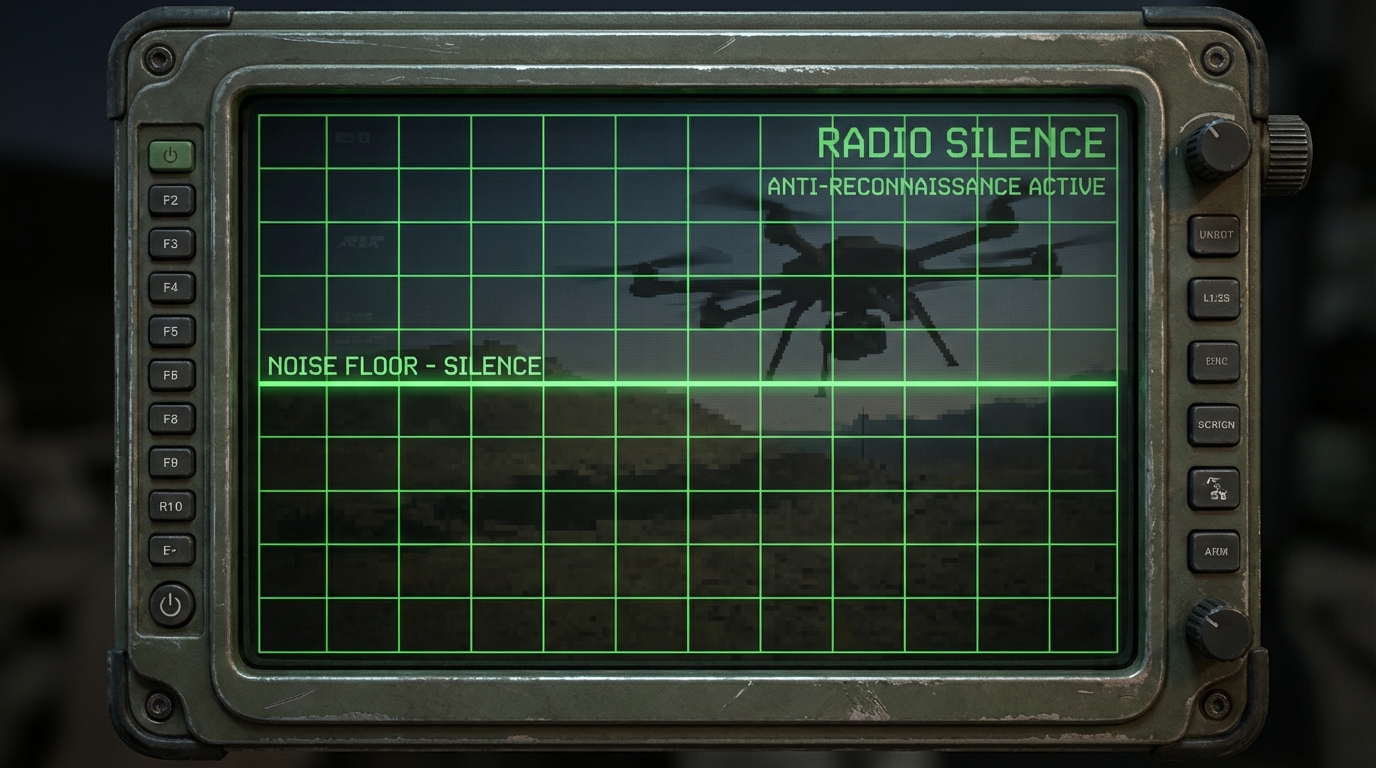
Fiber Drone Cost:
-
Frame + Motors + Flight Controller: ~$300
-
10km Fiber Spool: ~$30 ($3/km)
-
Optical Transceiver Module: ~$50
-
Total: Less than $500.
-
-
Target Value:
-
Main Battle Tank (e.g., M1A2 or T-90): $5,000,000+
-
Self-Propelled Howitzer: $3,000,000+
-
Air Defense Radar: $10,000,000+
-
-
Defense Cost:
-
Patriot Missile: $3,000,000/shot (a massive loss to hit a drone).
-
Stinger Missile: $120,000/shot (still a loss to hit a $500 drone).
-
Electronic Warfare Vehicle: Useless.
-
1.4.2 Attrition Logic
In the Ukraine war, both sides are looking for a precision-guided weapon that can be "consumed like bullets."
-
Switchblade 600: The US loitering munition. Good performance, but too expensive to use casually.
-
Fiber FPV: Cheap enough to issue several to every infantry squad. See a suspicious bush? Fly one over to check. See a bunker? Fly one in to blow it up.
-
Error Tolerance: Because it's cheap, pilots can boldly attempt high-risk maneuvers (like flying into narrow windows). Even if it crashes, you lose a few hundred bucks. Pick it up, cut the line, swap in a new spool, and it flies again (if the drone didn't explode).
1.5 Battlefield Slang
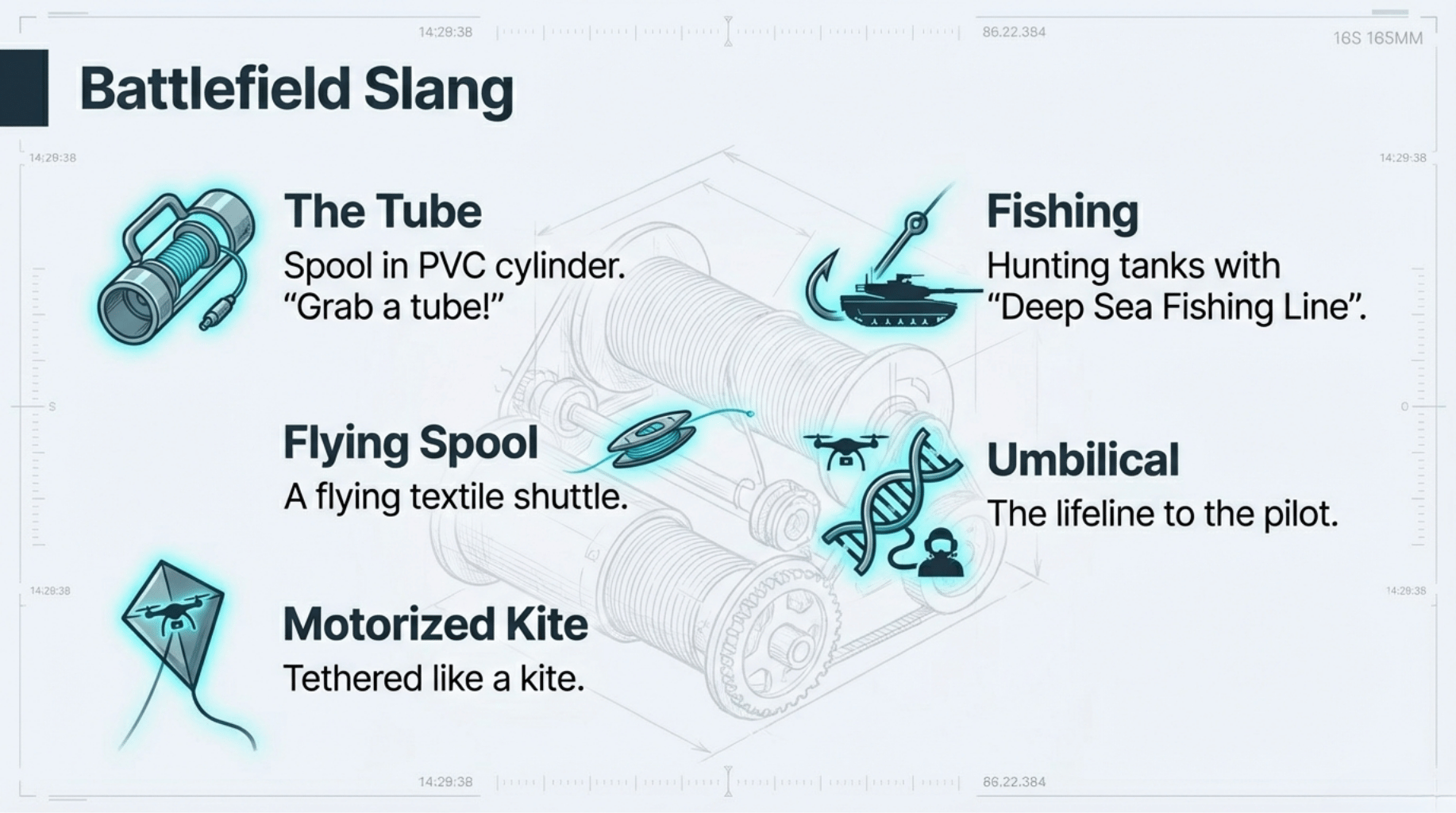
The birth of a new weapon inevitably leads to the formation of a subculture. Frontline soldiers and the pilot community have created a unique set of terms:
-
"The Tube":
-
Origin: The fiber spool is usually encased in a PVC or carbon fiber cylinder hanging under the drone's tail.
-
Context: "Grab a tube!" refers to grabbing a drone with a spool attached.
-
-
"Flying Spool":
-
Origin: A very visual description. Essentially, it is a flying textile shuttle.
-
Context: Used to tease this seemingly crude but deadly device.
-
-
"Motorized Kite":
-
Origin: Because it is always tethered by a line, just like a kite.
-
Context: Usually carries a derogatory or self-deprecating tone. "My kite got stuck in a tree."
-
-
"Fishing":
-
Origin: Some fiber looks a lot like fishing line (especially with transparent jackets). Also, smugglers often label fiber reels as "Deep Sea Fishing Line" to bypass customs.
-
Context: "Let's go fishing." Means going on a mission to hunt tanks.
-
-
"Umbilical":
-
Origin: Refers to the fiber connecting the drone and the control station.
-
Context: "Cut the umbilical." Usually means cutting the fiber manually when the mission is complete or aborted.
-
Cultural Observation: These slang terms reflect the complex feelings soldiers have toward this weapon—it is both cheap and crude (like a tube or kite), yet deadly and efficient (hunting like fishing). This contrast is exactly the charm of the fiber optic drone.
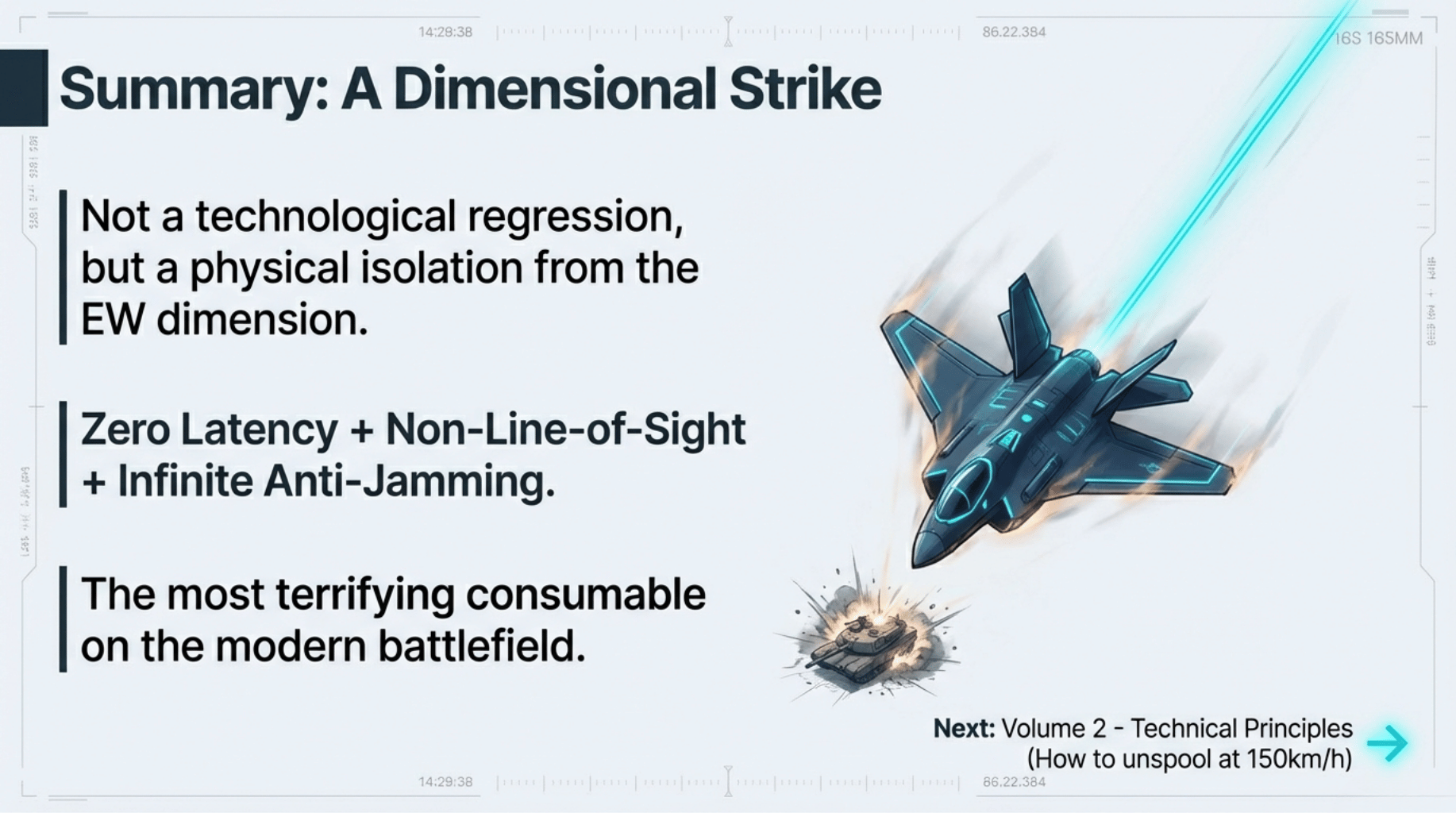
Chapter Summary: The fiber optic drone is not a technological regression, but a "dimensional strike" against the electronic warfare environment. It uses the most primitive physical connection to nullify the enemy's most advanced electronic jamming systems. And its extremely low cost makes it the most terrifying consumable on the modern battlefield.
Next Chapter Preview: Since it's tethered, how can it fly fast? Why doesn't the line break? How can it even fly around obstacles? We will enter the hall of physics to explore the mysteries of "Zero Latency" and "Non-Line-of-Sight Strikes."
Volume 1: Tactical Advantages
Contact Now to Buy G.657.A2 Fiber
Chapter 2: Physical Superiority
Core Argument: Light speed > Radio waves. This is not just a victory of speed, but a total liberation from tactical limits by the laws of physics.
2.1 True Zero-Latency
2.1.1 The Curse of Latency
In FPV (First Person View) flying, latency is life. Anyone who has flown a racing drone knows that even 50ms of latency at 150 km/h means a 2-meter error.
Table 2-1: The Latency Stack
| Stage | Analog FPV | Digital FPV (DJI O3/Avatar) | Fiber FPV |
|---|---|---|---|
| Camera Capture | ~10ms (CCD/CMOS) | ~20ms (4K Processing) | ~20ms (4K Processing) |
| Encoding | 0ms (Raw) | ~15-30ms (H.265) | <1ms (Optical Conv.) |
| Transmission | <1ms (Light Speed) | <5-10ms (Retries) | <0.1ms (Light Speed) |
| Decoding | 0ms (Raw) | ~15-30ms (H.265) | <1ms (Optical Conv.) |
| Display | ~5ms | ~5-10ms | ~5ms |
| Total Latency | ~15-20ms | ~60-100ms | ~25-30ms |
| Image Quality | Terrible (Static/480P) | Excellent (1080P/4K) | Excellent (4K Raw) |
-
Wireless Pain Points:
-
Analog: Fast, but looks like 1980s TV static. You can't see camouflaged enemies.
-
Digital: Good picture, high latency. By the time you see the branch, you've already hit it. And if jammed, latency spikes to 500ms+ (stutter).
-
-
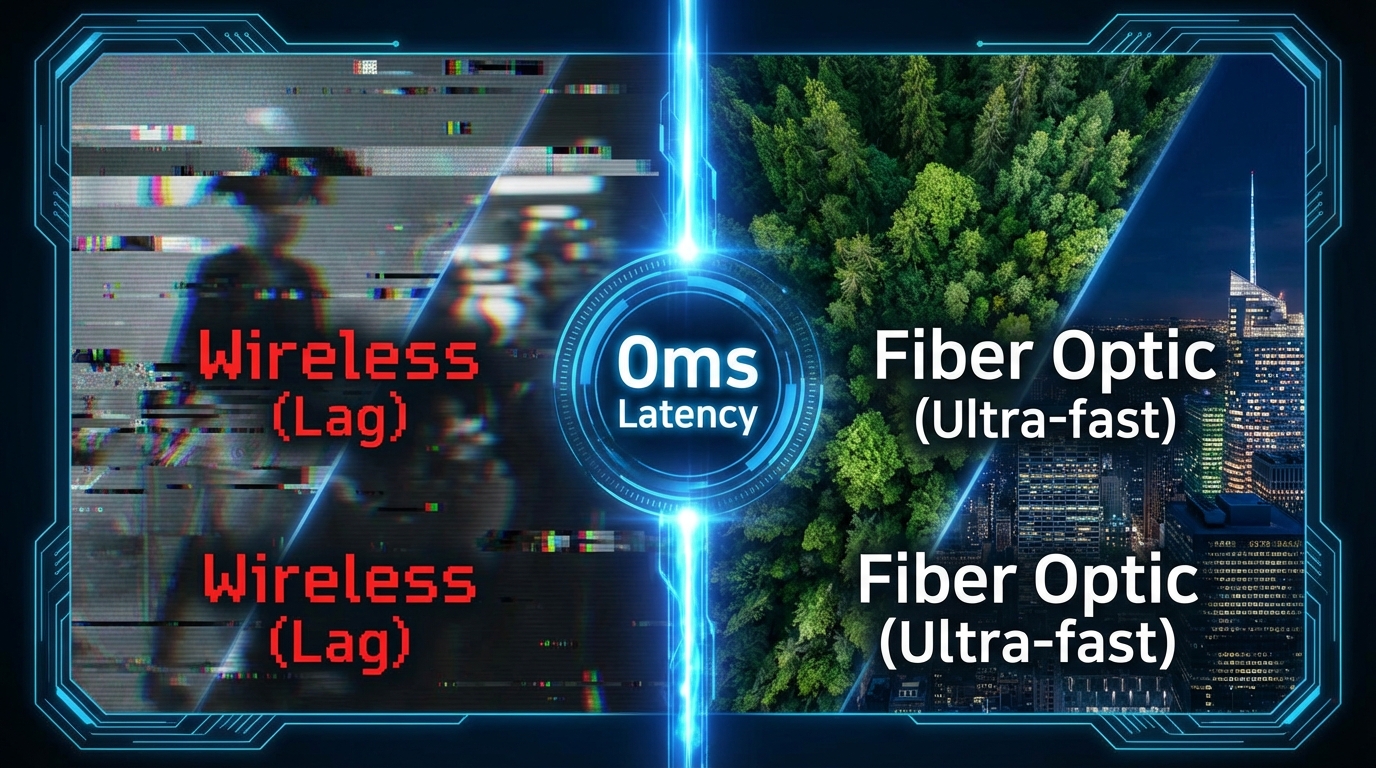
The Fiber Miracle: It combines the speed of Analog with the quality of Digital.
-
Physical Direct: No complex error correction, no retries. Data in, data out.
-
Consistency: The scariest thing isn't high latency, it's "jitter." Wireless latency fluctuates. Fiber is rock solid, allowing pilots to develop "muscle memory" for threading needles.
-
2.1.2 Dynamic Hunting: Don't Predict, Just React
-
The Nightmare of Moving Targets: Imagine chasing a buggy moving at 80 km/h (22 m/s).
-
Wireless FPV: 100ms latency = 2.2 meters of displacement. You aim at the car, but you hit the dust behind it. The pilot must rely on experience to "lead" the target, which is incredibly hard in complex terrain.
-
Fiber FPV: Latency is practically zero. Where the car is, that's where you shoot. "What You See Is What You Get." No prediction needed, just instinct.
-
-
Helicopter Interception: The ultimate test. Hitting a spinning tail rotor or an engine intake requires millisecond precision. Fiber gives the pilot this "scalpel-like" dynamic tracking capability.
2.1.3 Static Micro-Control: Drone as a Bullet
-
Threading the Needle: Many battlefield targets are hardened, with only a small firing port or vent (maybe 40cm wide). Wireless jitter makes attempting this a "gamble." Fiber stability empowers pilots to sprint from 500m out and drill right in.
-
The Double Tap: The first drone blasts open the reactive armor or bunker door; the second drone follows immediately, flying through the smoke, and detonates inside.
-
Note: In enclosed spaces (like inside a bunker), radio waves suffer severe multipath reflection, causing instant signal loss. Fiber is immune, making it the only guidance method capable of "indoor clearing."
-
2.1.4 Cognitive Liberation
-
Brain CPU Usage: When flying wireless FPV, 30% of the pilot's brain is processing: "Will the signal cut?" "What's the latency now?" "Was that stutter jamming?"
-
Flow State: Fiber pilots don't worry about signal. This psychological safety allows them to enter a "Flow State," focusing 100% on tactical maneuvering. This is why even rookies can fly like veterans with fiber.
2.1.5 Eagle Eye: Tactical Dividend of Lossless Image
-
Positive ID: Uncompressed 4K lets you read arm patches at 500m or see fresh mud on tank tracks, preventing friendly fire.
-
Night Ops: Noise in night vision/thermal is smoothed out by wireless compression, losing detail. Fiber keeps every grain of thermal data, revealing enemies in the grass.
2.2 NLOS Strike (Non-Line-of-Sight)
2.2.1 The Invisible Wall: Fresnel Zone
Radio waves do not travel in a straight laser line; they travel in a football-shaped bubble called the Fresnel Zone.
-
The 60% Rule: If just 60% of this "football" is blocked by obstacles (trees, hills), signal strength drops off a cliff. This means you don't just need Line-of-Sight; you need "clearance" around that line.
-
Tyranny of the Horizon: The Earth is round. For a drone flying 5 meters off the ground, the horizon cuts off the signal from a ground station just 8km away. This is why low-flying radio FPVs often disconnect abruptly—not because of jamming, but because the Earth got in the way.
2.2.2 The Breadcrumb Trail
Flying a fiber drone is like Hansel and Gretel leaving a trail of breadcrumbs.
-
Zero-Tension Release: The fiber isn't "pulled" out; it's unspooled (or "pushed") out. It lays gently on the path the drone has flown.
-
Terrain Conformance: Fly over a ridge, the fiber drapes over the rocks. Fly through a forest, it hangs on branches.
-
Advantage: Once the fiber is on the ground, it is static. No matter how far the drone flies, the signal travels inside the glass strand, completely indifferent to the terrain blocking the direct line of sight.
-
2.2.3 The End of Reverse Slope Defense
Since WWI, the "Reverse Slope" (the side of the hill facing away from the enemy) has been a safe haven for artillery and logistics, safe from direct fire and radio line-of-sight.
-
Dimensional Strike: A fiber drone can climb to the peak and then dive-hug the terrain down the reverse slope. To the enemy hiding behind the mountain, this attack violates common physics.
-
Psychological Impact: When soldiers realize that even the safest "dead angle" is no longer safe, morale collapses faster than physical defenses.
2.2.4 Conquering the Faraday Cage
Modern battlefields are full of reinforced concrete (bridges, tunnels, bunkers). These structures are filled with steel rebar, creating natural "Faraday Cages" that block radio signals.
-
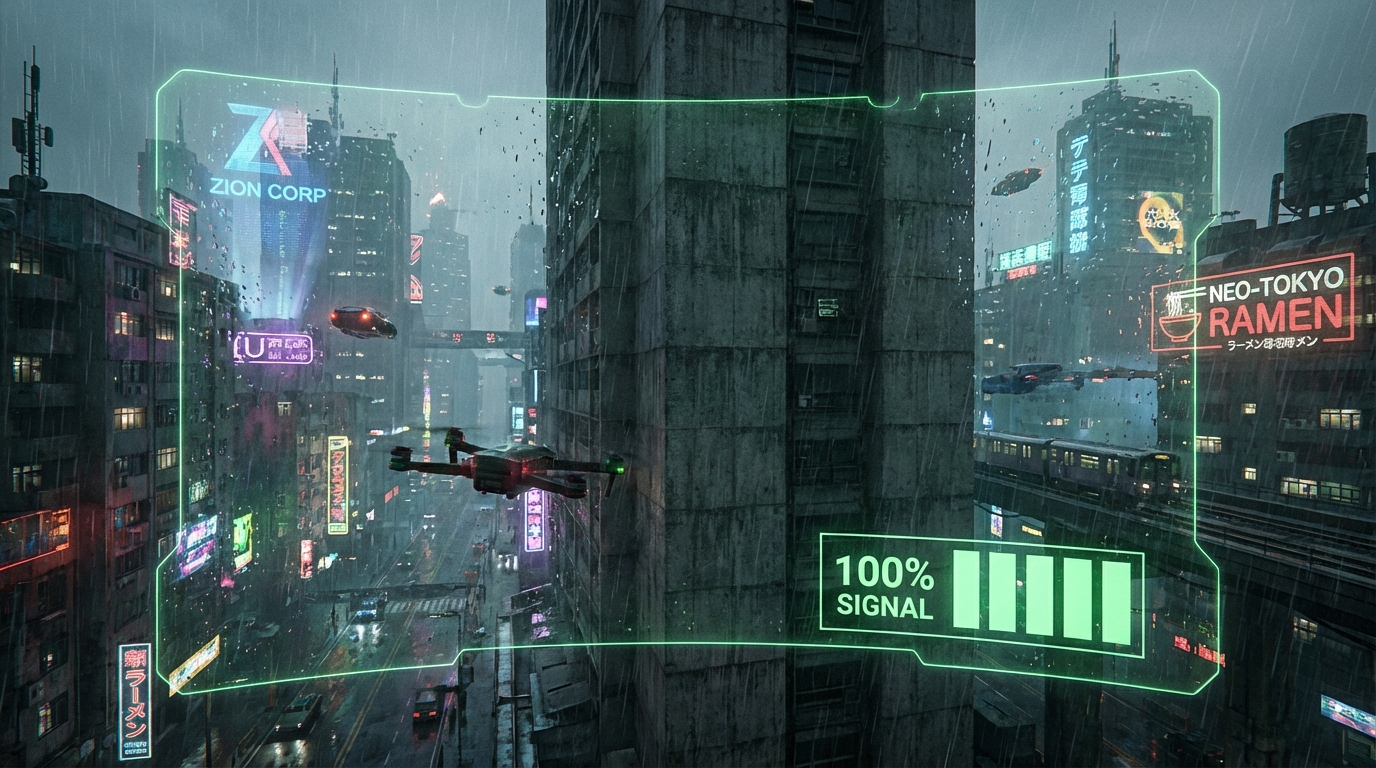
The Bridge Killer: Russian KVN drones demonstrated attacking targets under highway overpasses. Radio waves go crazy inside tunnels due to multipath reflection, causing crashes. Fiber drones can fly in like bats and detonate.
-
Underground Warfare: In tunnel networks (like Gaza or Avdiivka), radio drones die in 50 meters. Fiber drones can travel kilometers deep, becoming true "subterranean loitering munitions."

2.3 Thermodynamic Stealth: Why IR Missiles Fail?
On the modern battlefield, it's not just eyes watching the sky, but countless "thermal eyes." Fiber drones reveal an unexpected physical advantage here: They are Cold.
2.3.1 The Missing "Second Sun"
A standard radio drone has two heat sources; a fiber drone has only one (and a half).
-
The Physics of RF Heat: To punch through jamming, a video transmitter (VTX) must run in "Beast Mode" (2W or 4W). Due to inefficiency, transmitting 2W of RF signal might consume 8W of power, with the remaining 6W turning into pure heat. This is like strapping a miniature soldering iron to the drone. Surface temps hit 95°C - 110°C in seconds.
-
Optical Coolness: An optical transceiver works with laser diodes in the milliwatt range. In flight, it runs just 5-10°C above ambient temperature. In a thermal scope, it looks black (cold).
2.3.2 Denying Lock-on
MANPADS seekers (like Igla or Stinger) hunt for strong thermal contrast.
-
The Threshold Trap: Seekers have a radiation threshold to filter out birds and background clutter.
-
Radio FPV: Motor Heat + VTX Heat = Massive IR signature, easily triggering the threshold.
-
Fiber FPV: Only has a motor, which is being aggressively cooled by the propeller wash. Its IR signature is often too weak to trigger a lock tone, even if the operator is pointing right at it.
-
2.3.3 Blending into the Earth
Thermal stealth isn't just about how cold you are; it's about how hot your background is.
-
Delta T (Temperature Difference):
-
If flying high (background is cold sky, -20°C), even a weak heat source stands out.
-
But fiber drones fly Nap-of-the-Earth. The background is sun-baked ground, rocks, or concrete (summer surface temps can hit 40°C+).
-
-
Chameleon Effect: Against this warm background, a 45°C fiber drone effectively disappears. An anti-drone spotter scanning with a thermal camera sees a sea of red/orange heat and cannot distinguish the drone from a hot rock.
2.4 Hybrid Tactics
Since fiber is one-way (can't retract), smart tacticians use "Hybrid Mode."
2.4.1 Radio Takeoff, Fiber Sprint
-
Phase 1: Radio Cruise
-
Take off using radio control.
-
Goal: Fly to the combat edge to save fiber length, or loiter high to spot targets.
-
-
Phase 2: Cut & Activate
-
Upon spotting a target or getting a jamming warning, the pilot flips a switch.
-
Radio cuts off, fiber activates (spool starts paying out).
-
-
Phase 3: Silent Kill
-
Enter the final attack run in "Invincible Mode" (Jam-proof, HD, Zero Latency).
-
2.5 The Myth: Why not just cut the wire? (The Uncuttable Link)
Common question: "Can't I shoot the wire or fly a drone into it?" Answer: Almost impossible.
-
Too Thin: 250 microns. You can't see it 5m away. Shooting a drifting, invisible "hair" with a rifle is harder than winning the lottery.
-
It Floats: The fiber isn't a tight string; it's laid loosely in the air. Bullets or shrapnel usually push it aside or pass through the slack rather than cutting it.
-
Aerial Scissors?: Some try to use drones to snag it. But you have to find it first. In combat chaos, this is not viable.
The only effective physical counter is the "Meat Grinder" (Rotary Barbed Wire), discussed in Vol 4. But in the wild, the link is unsolvable.
Chapter Summary: Fiber optics bring not just anti-jamming, but a qualitative leap in flight performance. Zero latency gives pilots surgical precision, and NLOS capabilities remove all blind spots from the battlefield. When physical connection replaces unstable radio waves, the drone transforms from a "best-effort" toy into a "guaranteed delivery" weapon.
Next Chapter Preview: We've talked about the benefits, but how is this thing actually used? We will enter Chapter 3: Full-Spectrum Scenarios to see how fiber drones are changing the shape of warfare, from the snowfields of Russia to the urban combat of the Middle East.
Volume 1: Tactical Advantages
Contact Now to Buy G.657.A2 Fiber
Chapter 3: Full-Spectrum Scenarios
Core Argument: From the frozen plains of Eastern Europe to radiation-filled nuclear plants, fiber drones are taking over places where "humans shouldn't go" and "radio can't go."
3.1 Military: The Game Changer
Fiber drones are no longer just a "specialty" of the Russia-Ukraine battlefield; major military powers globally are accelerating their adoption.
3.1.1 Russia: Quantity is Quality (KVN)
The Russian military is the largest user, epitomized by the KVN (Prince Vandal Novgorod).
-
Design Philosophy: Extreme pragmatism. Cheapest agricultural drone frame + civilian fiber spool.
-
Tactical Role: An "aerial anti-tank mine." Not advanced, but abundant.
-
Classic Case: In the Kursk region, a KVN rammed and destroyed a Ukrainian Mi-8 helicopter. This was the first time a "wired" drone downed a manned aircraft.
3.1.2 Ukraine: Precision Strike (Chereshnya)
Ukraine's Chereshnya system focuses on software integration.
-
Features: Integrated into anti-tank missile squads. Uses Starlink for backhaul and the fiber drone as the "front-end tentacle," enabling long-range "Man-in-the-Loop" strikes.
3.1.3 USA & Germany: Precision Tools for Special Ops
-
USA (Neros Archer): A modular favorite of Special Forces. The fiber spool is detachable—use it for silent recon, drop it for fast wireless flight. Despite being American, they use cost-effective chips to compete with Chinese supply chains.
-
Germany (Highcat HCX): Industrial-grade precision. Uses specialized glass spools for ultra-smooth payout, designed for reconnaissance in extreme environments like Berlin's sewers and subways.
3.1.4 The Mothership Tactic
A tactic perfected by Russia to solve the "short legs" problem of fiber.
-
Configuration: A gas-powered Orlan-10 fixed-wing drone (Mothership) carries two fiber FPVs (Daughters) under its wings.
-
Process:
-
Mothership flies 40-50km behind enemy lines.
-
Releases Daughters.
-
Mothership loiters high, acting as a signal relay.
-
Daughters use their 10-20km fiber to strike high-value targets (Patriot batteries, HIMARS).
-
-
Significance: Instantly boosts strike radius from 20km to 60-70km, covering operational depths.
3.1.5 CQB & Urban Warfare
Cities are a nightmare for radio, but a paradise for fiber.
-
House Clearing:
-
Traditional micro-drones (like Black Hornet) lose signal instantly when entering heavy concrete buildings or basements.
-
Fiber drones can fly in through a window, spiral up the stairwell, and check every room. The cable acts like "Ariadne's Thread," maintaining a perfect 4K link to the commander outside.
-
-
See Through Walls: Commanders don't need to risk breaching a door blindly. Send the drone in first. Booby traps? Hostages? All clear in 4K.
3.2 Public Safety: More Than Just Killing
In peacetime, fiber drones are tools for saving lives.
3.2.1 EOD (Explosive Ordnance Disposal)
Traditional EOD robots are heavy, slow, and lose signal inside complex buildings.
-
Fiber Advantage: An EOD tech can fly a fiber drone into a room with a suspected bomb.
-
Inspect: 4K camera right in the face of the bomb (zero latency allows fine inspection).
-
Disrupt: Use a robotic arm to cut wires or drop a small charge to detonate it.
-
Safety: If it blows, you lose a cheap drone, not an expensive robot or a human life.
-
3.2.2 SWAT Raids
In hostage rescues or counter-terror ops, the biggest fear is the unknown.
-
Silent Recon: Propellers make noise, but fiber makes no "EM Noise." Terrorist radio scanners pick up nothing. They don't know they are being watched.
-
Deep Penetration: No matter how many reinforced concrete walls, the fiber pipes the signal out perfectly.
3.3 Industrial: Where Radio Goes to Die
Some environments are hostile to radio waves.
3.3.1 Nuclear & High-Magnetic Environments: The Ghost of Chernobyl
In scenarios like Fukushima or inside the Chernobyl Sarcophagus, radiation doesn't just mean cancer; for electronics, it means "lobotomy."
-
Bit Flips: High-energy particles strike chip transistors, flipping a stored 0 to a 1. For digital radio video transmitters, this means glitching or freezing.
-
Ionization Shielding: Extremely high radiation ionizes the air, creating a plasma layer that severely disrupts radio wave propagation.
-
Fiber's Natural Immunity:
-
Photons have no charge: Light signals are completely unaffected by electromagnetic fields or ionized air.
-
Physical Isolation: Operators can stand kilometers away in a lead-shielded vehicle while piloting the drone into the reactor core. Even if the drone electronics get "fried" by radiation, the data (the final HD images) has already been transmitted back.
-
3.3.2 Immunity to HPM: When Microwaves Burn Everything
The ultimate weapon in modern electronic warfare isn't jamming; it's "frying."
-
High Power Microwave (HPM): Think of it as an invisible, giant flashbulb releasing megawatt-class (MW) microwave pulses. Any device with an antenna or circuit board induces thousands of volts in microseconds, causing chip breakdown and circuit burnout.
-
The "Photon Bunker":
-
Fiber doesn't conduct: When HPM sweeps the battlefield, radio drone antennas act like "lightning rods," inviting destruction. Fiber is a glass insulator; it induces zero microwave energy.
-
Control Station Survival: HPM attacks often trace radio signals back to the source. Since fiber drones emit no radio radiation, the enemy can't find the pilot. The HPM is blind.
-
Tactical Value: In a desperate scenario where the enemy activates full-spectrum EM suppression (or even indiscriminate microwave burnout mode), the fiber drone might be the only aircraft capable of taking off.
-
3.3.3 UHV Substations (Ultra-High Voltage)
-
Corona Discharge: Near 1000kV power lines, the air is filled with broadband electromagnetic noise from corona discharge. Ordinary 2.4GHz/5.8GHz drones lose control (compass spin, GPS loss) instantly.
-
All-Fiber Operation: Fiber drones don't need GPS or magnetic compasses (pure visual flight), and their control signals are immune to EM noise, allowing them to fly inches from high-voltage lines to inspect insulator cracks.
3.3.4 Bridge & Tank Inspection
-
Box Girders: Inside the steel box girders of large bridges is a perfect Faraday Cage. Radio dies instantly. Fiber drones can fly kilometers inside to check welds and corrosion.
-
Oil Tanks: Inspecting inside giant metal oil tanks requires explosion-proof safety (no sparks) and signal penetration through metal walls. Fiber is the only solution.
3.4 The Forbidden Zone: Water & Metal
3.4.1 Water Warfare: Beating Multipath
Flying low over water is a headache due to the Multipath Effect. Radio waves reflect off the water, interfering with the direct signal, causing dropouts.
-
Naval Strike: Fiber drones can perform "Sea Skimming" attacks, flying <1 meter above the waves. The signal remains perfect until the moment it impacts the ship's waterline armor.
3.4.2 Extreme Environments
-
Under Ice: Radio decays rapidly in ice. Fiber ROVs are just "underwater fiber drones."
-
Underground Mines: Complex rock tunnels shield all wireless signals. Rescuers at the surface can fly a drone kilometers down to find trapped miners, using the fiber to even deliver a hardwired phone line for comms.
Chapter Summary: Fiber optic drones have proven themselves to be "all-rounders." They are not just ghost killers on the battlefield but guardian angels in the ruins. Whether for killing or saving, the certainty provided by "connection" is their greatest ace card.
Next Chapter Preview: We have covered "why it works" and "where it works." Starting from the next volume, we will enter the hardcore technical section. Volume 2: Technical Principles will reveal the amazing materials science and engineering miracles hidden behind that thin strand of glass.
Volume 2: Technical Principles
Contact Now to Buy G.657.A2 Fiber
Chapter 4: What's So Special About This Cable? (The Fiber Cable)
Core Argument: This isn't the fiber you use for home internet. This is a specialized glass strand born to "roll in the mud" of the battlefield. Its core secret lies in a code: G.657.A2.
4.1 Why G.657.A2? (The Chosen Standard)
If you strip open a home patch cord, you'll usually find G.652.D standard fiber. If you wrap it around your finger, the network cuts out immediately. But with the G.657.A2 used in fiber drones, you can tie it in a knot, and the signal remains full strength.
4.1.1 Bending Loss
Fiber optic communication relies on "Total Internal Reflection." Light bounces around inside the glass core like a pinball.
-
Standard Fiber (G.652): Once the bending angle is too steep, light "leaks" out and stops reflecting.
-
Bend-Insensitive Fiber (G.657): By changing the refractive index distribution (e.g., depressed cladding structure), it "grabs" the escaping light back.
Data Comparison: Bend Radius vs. Loss (1550nm)
| Bend Radius | G.652.D (Standard) | G.657.A2 (Military) | G.657.B3 (Special) |
|---|---|---|---|
| 10mm (Pencil) | > 0.5 dB (Risk) | < 0.1 dB (Tiny) | < 0.03 dB |
| 7.5mm (Cigarette) | Fail (Break) | ≤ 0.5 dB (Working) | < 0.08 dB |
| 5.0mm (Extreme) | N/A | N/A | < 0.15 dB |
Why not just use B3? Although G.657.B3 has better bend resistance, its Mode Field Diameter (MFD) is often smaller, causing high splice loss with existing equipment. G.657.A2 (MFD 8.6–9.2 µm) is fully compatible with standard fiber, representing the best balance of performance and cost.
Battlefield Insight: When a drone makes sharp turns in the air, or when fiber is pulled out of the spool at high speed (forming a helix), the fiber undergoes countless micro-bends. Only G.657.A2 can withstand this torture.
4.2 Strength: Harder than Steel, Thinner than Hair
Many think glass is brittle and shatters easily. But when glass is drawn to the micron level and the surface is flawless, its strength is astonishing.
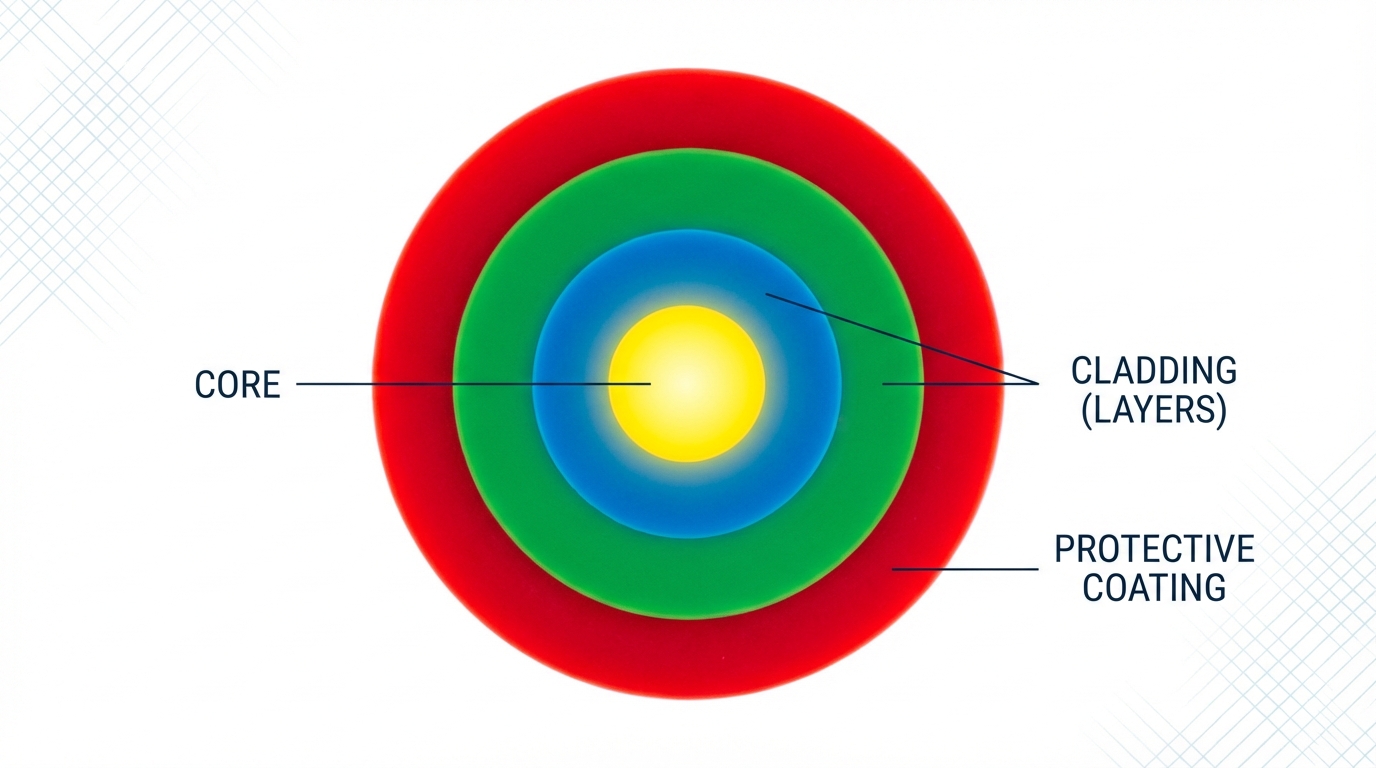
4.2.1 Anatomy of Dimensions
The bare fiber used in drones is typically 250 microns (µm) in diameter.
-
Core: 9 µm. Where the light travels.
-
Cladding: 125 µm. Keeps the light in the core.
-
Coating: 250 µm. The protective layer, usually UV Cured Acrylate.
-
Comparison: Human hair diameter is about 60-100 µm. This fiber is only 2-3 times thicker than a hair.
-
4.2.2 Proof Test
Every kilometer of fiber leaving the factory must undergo a 100 kpsi (~0.7 GPa) tension screening test.
-
Actual Strength: Good fiber can reach tensile strengths of 5.5 GPa or higher.
-
Vs. Steel: High-quality piano wire is about 2-3 GPa.
-
Conclusion: In terms of strength per unit cross-sectional area, fiber is tougher than steel wire.
Why does it break then? Fiber doesn't fear "pulling," it fears "shearing" and "folding." Its shear resistance is terrible. If force is applied from the side (like catching a branch or being hit by a propeller), it snaps instantly. But in longitudinal tension, it can easily drag thousands of times its own weight.
4.3 Physics of Invisibility: The Unseen Ghost
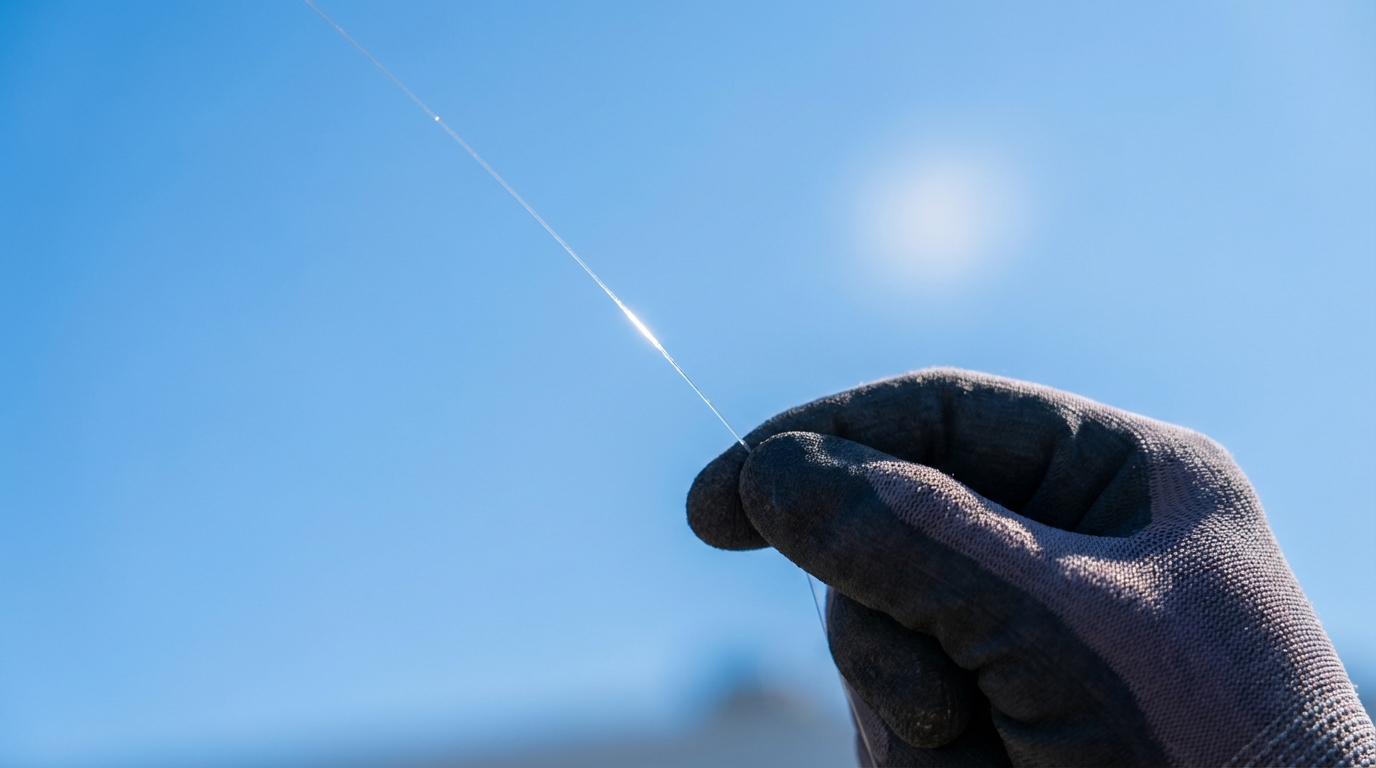
In combat footage, you often see the drone flying, but almost never see the line. Why?
4.3.1 Rayleigh Scattering & Diameter
The fiber is too thin (0.25mm).
-
Visual Limit: The human naked eye struggles to see such a thin object beyond 5-10 meters, especially against cluttered backgrounds (woods, ruins).
-
Radar Stealth: Fiber is made of glass (silica) and plastic, completely non-metallic.
-
Radar waves pass right through it, just like air.
-
Radar Cross Section (RCS) is effectively zero.
-
4.3.2 The Art of Coating Color
Although standard coatings are transparent, military-grade fiber often gets special treatment:
-
Clear: Most common. Almost invisible against the sky.
-
Matte Green/Grey: Used for low-altitude jungle ops to reduce sunlight glint (reflection is the only way fiber gets exposed).
-
Coloring Process: Not painted on the surface, but dye mixed directly into the curing resin, ensuring diameter doesn't increase.
4.4 Weight Engineering: Every Gram Counts
For drones, every gram of weight eats battery life.
4.4.1 Amazing Lightness
-
Weight per km: ~50 grams.
-
10km Weight: 500 grams (fiber only).
-
Spool System Total: Including the canister, housing, and glue, a 10km spool pack weighs about 2.3 - 2.5 kg.
4.4.2 The Size Game: 200µm vs 80µm
Since lightness is key, why not make it even thinner?
-
200µm (Advanced): Reduced diameter fibers like Prysmian's BendBright XS and Corning's SMF-28 Ultra 200 (180-200µm) are gaining popularity. They reduce spool volume by 30%-50%, making them the top choice for 20km long-range drones.
-
80µm (Hell Mode): Some specialty fibers go down to 80µm. But this brings nightmares:
-
Handling: Extremely hard to splice, requiring lab-grade equipment.
-
Fragility: More prone to snapping under 100km/h tension.
-
Conclusion: Currently, 250µm is the King of Value, while 200µm is the King of Performance.
-
4.5 Manufacturing Secrets: From Sand to Superweapon
You think this is just drawing wire? It's a precision chemical process.
4.5.1 The Preform
It all starts with a "Preform," a glass rod as thick as an arm. It is the mother of the fiber.
-
CVD: Inside a high-purity quartz tube, layers of germanium-doped silica are deposited. The thickness and refractive index of each layer are calculated at the atomic level.
-
G.657 Secret Recipe: During this deposition, engineers design a special "Refractive Index Trench," acting like a "guard rail" for light, preventing it from escaping during bends.
4.5.2 The Draw Tower
The preform is fed into a 2000°C furnace.
-
Gravity Draw: Molten glass drips like honey and is pulled into a filament by precision machinery at kilometers per minute.
-
Inline Monitoring: Laser calipers measure diameter thousands of times per second, keeping error within ±1 micron.
-
Instant Curing: Bare glass absorbs dust and becomes brittle if exposed to air for even 0.1 seconds. So it is immediately sprayed with two layers of resin and cured instantly with UV light.
4.6 Invisible Armor: Chemical & Salt Spray Resistance
Fiber must not only resist tension but also "poison." In naval warfare (high salt spray) or industrial reconnaissance (corrosive gases), standard fiber might last only hours.
4.6.1 The Chemical War of Coatings
The glass core (silica) is extremely stable against acid and alkali. Its "Achilles' heel" is the protective Coating.
-
Standard Acrylate: The common "soft glue." Upon long-term exposure to salt spray or diesel fumes (common battlefield environments), it swells or hardens, causing the fiber to lose protection and snap.
-
Polyimide: The "Body Armor" for specialty fiber.
-
Heat Resistance: Standard coatings soften at 85°C; Polyimide withstands 300°C.
-
Corrosion Resistance: No degradation after 720 hours of continuous acidic salt spray testing.
-
4.6.2 Defense Against "Hydrogen Darkening"
Fiber has another invisible killer—Hydrogen. In damp or sealed environments, hydrogen molecules permeate the glass structure, causing drastic signal loss (at specific wavelengths).
-
The Solution: Military-grade fiber undergoes special "Deuterium Loading" or carbon coating sealing during the preform stage, completely blocking hydrogen permeation. This ensures the signal doesn't "rust" even in deep sea or underground tunnels.
4.7 Field Test Data
Based on feedback from the front lines (especially Ukraine), we've summarized G.657.A2's limit conditions:
-
Extreme Cold: In the -20°C Donbas winter, ordinary plastic coatings harden and become brittle, leading to snaps. Military-grade coatings must remain elastic.
-
Extreme Speed: Max payout speed is 160 km/h (~45 m/s). Faster than that, the centrifugal force of the fiber leaving the spool exceeds the coating's peel force, causing "spool explosion."
-
Wet Conditions: Wet fiber adds weight and viscosity. While fiber itself doesn't fear water, droplets change payout drag.
Chapter Summary: G.657.A2 fiber is a masterpiece of human materials science. It turns "brittle" glass into a "tough" lifeline. It is invisible, jam-proof, stronger than steel, and thinner than hair. This unassuming strand supports the entire tactical system of "wired drones."
Thought Question: Since the wire is so strong, why does it still break? The answer usually isn't the wire, but the Spool. If the wire isn't wound perfectly, or the glue is wrong, the wire will knot the instant it's pulled out.
Next Chapter Preview: Chapter 5 will decode that plastic-tube-looking but high-tech core component—The Spool System. How does it let fiber "flow" out at 100 km/h?
Volume 2: Technical Principles
Contact Now to Buy G.657.A2 Fiber
Chapter 5: The Spool System - Core Technology
Core Argument: The heart of a fiber drone is not the fiber itself, but the humble "spool." It is a masterpiece of fluid dynamics, materials science, and precision manufacturing. If you think it's just a simple fishing reel, you haven't even scratched the surface.
5.1 It Paves, It Doesn't Pull (Internal Pay-off)
When people first see a fiber drone, they instinctively think of a fishing rod reel. This is a fatal misunderstanding of physics.
5.1.1 External vs. Internal Pay-off
-
External Pay-off:
-
Mechanism: Like a toilet paper roll or fishing reel, the entire spool rotates to release the line.
-
Physical Limit: Assume a drone speed of 20m/s (72km/h) and a spool circumference of 20cm. The spool must spin at 6000 RPM.
-
Disaster: Such high RPM creates massive Moment of Inertia. When the drone slows down or turns, the spool can't stop, causing the line to explode outward ("Bird's Nesting"). Also, centrifugal force would snap the fiber instantly.
-
-
Internal Pay-off:
-
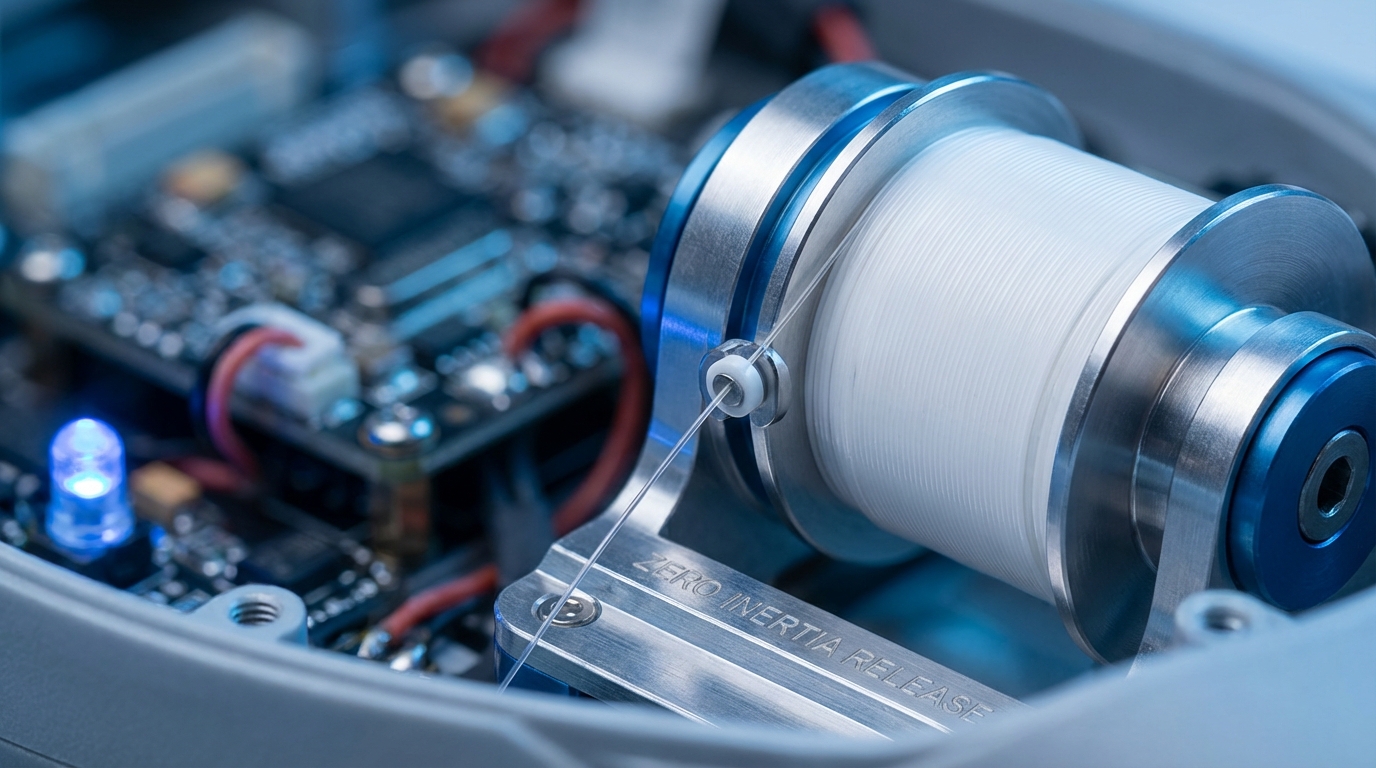
Mechanism: This is technology trickle-down from the TOW Anti-Tank Missile. The spool itself is mounted on the drone tail and is completely static.
-
Principle: The fiber is "peeled" from the inner wall of the spool, loop by loop. Since the spool doesn't spin, there is almost zero drag.
-
Zero Inertia: No matter how fast the drone flies, the spool remains stationary. Sudden stops or sharp turns cause no inertial overshoot.
-
5.1.2 Pre-Twist: The Invisible Math Magic
You might ask: If fiber is peeled loop by loop from a static spool, doesn't it twist 360 degrees for every loop?
-
The Problem: Geometrically, yes. Flying 10km means tens of thousands of twists.
-
The Solution (Pre-Twist): We apply a reverse twist during the winding process.
-
Reverse Torsion: For every loop wound, the machine twists the fiber backward once.
-
Net Zero Torque: When the drone pulls the fiber out, the release twist cancels out the pre-twist.
-
-
Result: The fiber flies in a Zero Torque relaxed state. This requires algorithmic precision, which is why you cannot wind this by hand.
Table 5-1: Pay-off Method Comparison
| Feature | External Pay-off (Fishing Reel) | Internal Pay-off (Missile/Drone) |
|---|---|---|
| Spool Motion | High Speed Rotation (Thousands RPM) | Completely Static (0 RPM) |
| Drag Source | Inertia + Bearing Friction | Air Resistance + Binder Viscosity |
| Fiber Tension | > 500g (Exponential with speed) | < 10g (Constant & Tiny) |
| Max Speed | < 15 m/s | > 300 m/s (Supersonic Capable) |
| Maneuverability | Slow acceleration only, NO sudden stops | Unlimited G-force, Instant Stops |
| Typical Use | Fishing, Kite Flying, Towing | Anti-Tank Missiles, Torpedoes, FPV |
5.2 The Art of Relative Stationarity
It sounds counter-intuitive: The drone is flying at high speed, but for the fiber, it is stationary.
5.2.1 Velocity Vector Analysis
Imagine driving a convertible at 100km/h and throwing a noodle backward at 100km/h relative to the car. To an observer on the roadside, the noodle's horizontal velocity is zero.
-
Drone = Car.
-
Fiber = Noodle.
-
Pay-off Speed = Flight Speed.
5.2.2 The "Dead Snake" State
Because the fiber's horizontal velocity relative to the ground is near zero, it assumes a "Dead Snake" state in the air:
-
No Tension: It doesn't stretch tight like a kite string; it floats loosely.
-
Terrain Conforming: If it hits a tree branch, it drapes over it. If it hits a roof, it lays on the roof.
-
Safety: Since it has no lateral cutting force, even if it falls on a person, it just rests there lightly, unlike a tensioned kite string that can slice skin.
5.3 The Ballooning Effect
When fiber peels off the inner wall at 30m/s, things get complicated.
5.3.1 The Helix
The fiber leaves the spool not as a straight line, but retaining its helical shape. Under high-speed airflow, this helix expands rapidly into a large conical whipping zone.
-
Phenomenon: In fluid dynamics, this is called the "Ballooning Effect."
-
Risk: If the balloon expands too much, the fiber will whip into the drone arms, motors, or props. If it hits a prop, it's game over.
5.3.2 The Solution: Nozzle & Cowling
To tame this wild helix, physical constraints are mandatory:
-
The Nozzle:
-
A small ring located 5-10cm behind the spool's center axis.
-
Material: Must be ultra-smooth Zirconia Ceramic or PTFE, with friction coefficient < 0.05.
-
Function: Forces the spiraling fiber into a straight line, suppressing the balloon expansion.
-
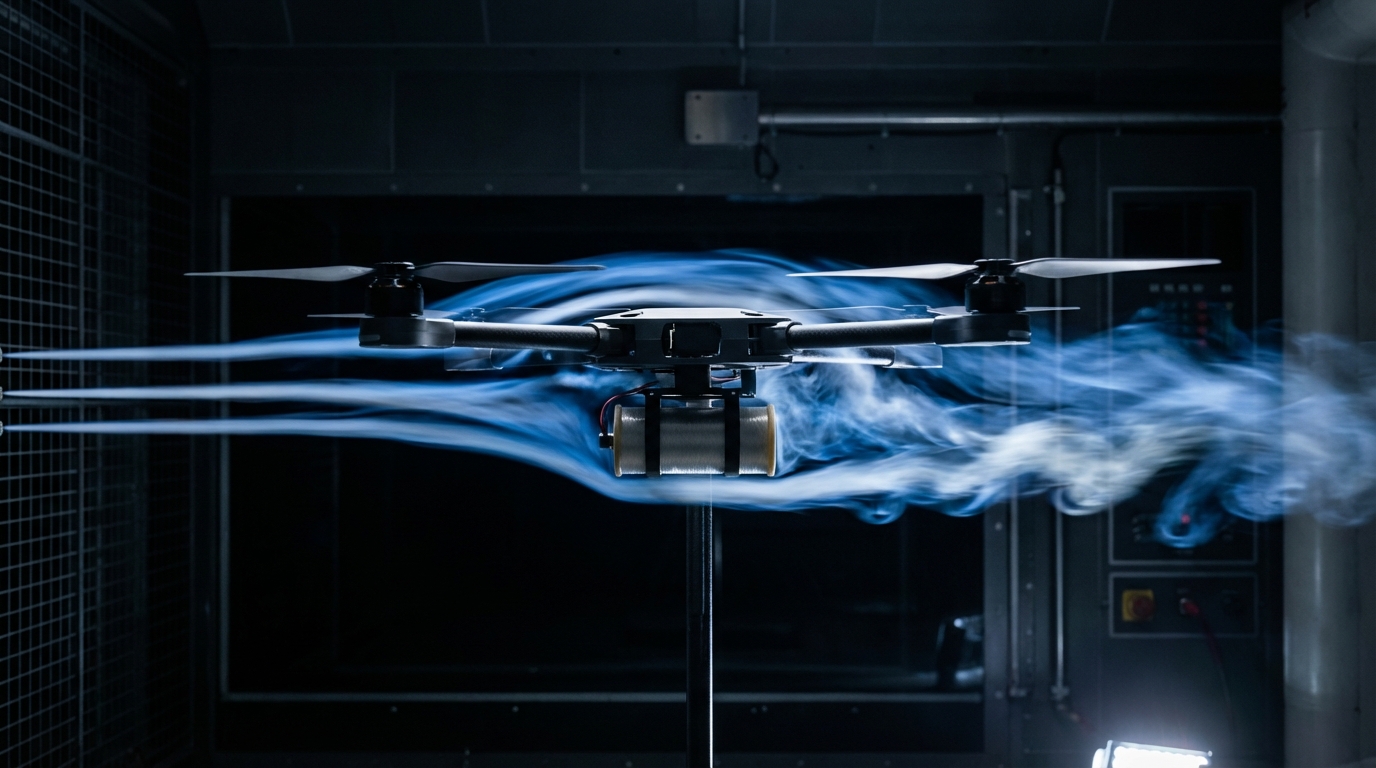
The Cowling:
-
A plastic shell covering the spool to prevent crosswinds from disrupting the pay-off trajectory.
-
5.3.3 High-Speed Dynamics: Euler-Eytelwein & The Whip Effect
When drone speed breaches 100km/h, fiber tension is no longer linear but enters the realm of complex non-linear dynamics. Two physical curses must be broken here.
-
The Euler-Eytelwein Formula (The Capstan Equation) The moment fiber peels off the spool's inner wall, it slides along the glue surface. Tension evolution follows the classic rope friction equation:
- : The drag force felt by the drone.
- : Viscous resistance of the binder (glue).
- : Friction coefficient (Fiber coating vs. Cured binder).
- : Peel-off angle (Cumulative wrap angle).
The Crisis: As speed increases, fluctuates violently due to the ballooning effect. If spikes (e.g., fiber forms a micro-loop at the nozzle), explodes exponentially. This is why cheap spools snap randomly at high speeds—they aren’t pulled apart; they are “locked” by friction.
-
The Whip Effect Just like cracking a whip, the tip speed can breach the sound barrier.
-
During high-speed pay-out, if the nozzle constraint fails, the fiber tip enters a high-frequency micro-oscillation.
-
At this microscopic scale, the instantaneous lateral acceleration of the fiber tip can exceed 5000G.
-
Consequence: This violent shaking shatters the glass lattice inside the fiber directly. Result: "Photo-fracture"—the plastic jacket is intact, but the glass core is dust. Signal lost. FMUSER Solution: By optimizing the nozzle's geometric curvature, we physically lock the peel-off angle $\theta$ within a safe range of $<15^\circ$, mathematically strangling any chance of tension spikes.
-
5.4 Manufacturing Secrets
You cannot wind this by hand at home. Even standard industrial winders won't work. This is precision manufacturing.
5.4.1 Variable Tension Profile
The spool is not wound with uniform tension.
-
Inner Layer: High tension to form a solid core foundation.
-
Outer Layer: Lower tension.
-
Reason: If the outer layer is too tight, it will crush the inner layers, causing micro-bending loss or pulling inner loops out prematurely (the dreaded "Double Pay-off," which guarantees a jam).
5.4.2 Cross-Winding
The fiber is never wound parallel like sewing thread.
-
Cross Angle: Each layer crosses the previous one at a slight angle (usually 2-5 degrees).
-
Purpose: Prevents "Embedding." If wound parallel, the top wire would sink into the grooves of the bottom wire, locking it in place. Cross-winding creates a "bridge" structure so the fiber lifts off easily.
5.4.3 The Secret Sauce: The Binder
The fibers are coated with a special wax or silicone-based adhesive.
-
Solid State: During storage, it's solid, making the spool distinctively brick-like and shock-resistant.
-
Liquid State: During high-speed pay-off, the friction heat momentarily softens the wax, acting as a lubricant.
-
Thermal Challenge:
-
Ukraine Winter (-20°C): Binder must not freeze hard, or tension will snap the fiber.
-
Middle East Summer (+40°C): Binder must not melt, or loops will stick together ("Blocking").
-
5.5 Detailed Specifications
Table 5-2: Spool Grades & Specs
| Parameter | Tactical Short | Standard Mid | Long Range | Operational Grade |
|---|---|---|---|---|
| Fiber Length | 1,000 m | 5,000 m | 10,000 m | 20,000 m |
| Weight (w/ Fiber) | ~80 g | ~350 g | ~650 g | ~1.3 kg |
| Dimensions (DxH) | 50 x 40 mm | 80 x 80 mm | 100 x 120 mm | 120 x 180 mm |
| Fiber Type | G.657.A2 | G.657.A2 | G.657.B3 | G.652.D |
| Platform | 3" Whoop / Indoor | 7" FPV / Kamikaze | 9-10" Heavy Lift | Fixed Wing |
| Est. Price | $30 | $80 | $150 | $300+ |
5.6 Challenges & Failure Modes
Making a working spool is hard. Making a 99.9% reliable one is excruciating.
-
Moisture Attack:
-
Issue: Spools stored in damp trenches absorb moisture into the binder.
-
Result: Inconsistent pay-off tension causing fiber flutter and breakage.
-
Fix: Vacuum seal. Use within 24h of opening.
-
-
Cold Brittle Fracture:
-
Issue: Sub-zero temps make the fiber coating brittle.
-
Result: Snaps immediately upon takeoff jerk.
-
Fix: Low-temp aerospace grade coatings.
-
-
Impact Damage:
-
Issue: Dropping a spool on concrete.
-
Result: Internal winding structure shifts (slumping). Fiber snags on the slump mid-flight.
-
Rule: If you drop it, trash it. Never fly a dropped spool.
-
5.7 The Twist Problem: A Physics Ghost
A deep physics issue rarely discussed.
-
Principle: Taking one loop off the side of a static spool adds 360 degrees of twist to the fiber.
-
Math: 10km of fiber on a 10cm spool = ~31,800 loops. That means the fiber is twisted 30,000 times during flight.
-
Impact: If the fiber isn't resilient, this accumulated torque will kink it, causing signal loss.
-
Solution: G.657.A2 fiber is twist-tolerant. High-end military spools even use Pre-twist winding (twisting the fiber backwards during manufacturing) to cancel out the flight twist.
Chapter Summary: The spool system is the "fuel tank" of a fiber drone. It dictates range and speed. It is a perfect balance of mechanics, chemistry, and physics. A failure in any variable (binder, tension, even a speck of dust) breaks the 10km link instantly.
Volume 2: Technical Principles
Contact Now to Buy G.657.A2 Fiber
Chapter 6: Photoelectric Conversion - The Signal Translator
Core Argument: The fiber is just a pipe. The performance is defined by the "translators" at both ends—the photoelectric conversion modules. They must deliver telecom-grade standards on a chip weighing only a few grams. It's not just about "turning Ethernet into light"; it's a microscopic war of wavelengths, heat, and signal-to-noise ratios.
6.1 Bi-Directional (BiDi) Technology
You might ask: How does one fiber carry "drone video" and "control commands" at the same time? Do the light beams crash into each other? The answer is BiDi (Bi-Directional) Technology.
6.1.1 Two Lanes (Two Wavelengths)
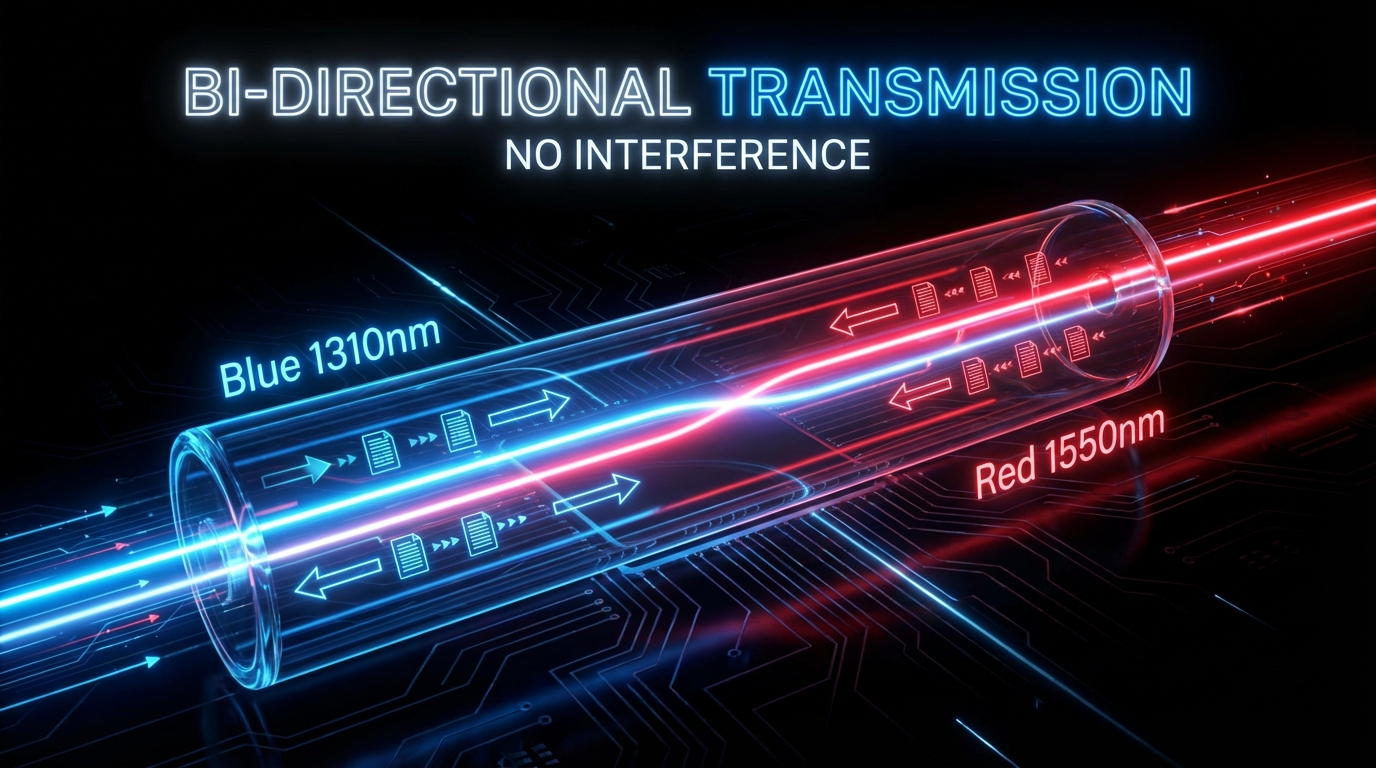
We use two different colors of light (wavelengths) in the same fiber. It's like a single-lane road where planes fly above and cars drive below. They share the same physical space but occupy different dimensions, never interfering.
-
Upstream (1310nm): Ground Station -> Drone.
-
Payload: Control commands (throttle, yaw, gimbal).
-
Characteristic: 1310nm lasers have extremely low chromatic dispersion, making them ideal for latency-sensitive control signals.
-
-
Downstream (1490nm/1550nm): Drone -> Ground Station.
-
Payload: 4K video stream and telemetry (voltage, altitude).
-
Characteristic: 1550nm is the "minimum loss window" of silica fiber (only 0.2dB/km), perfect for carrying high-bandwidth HD video back to the ground.
-
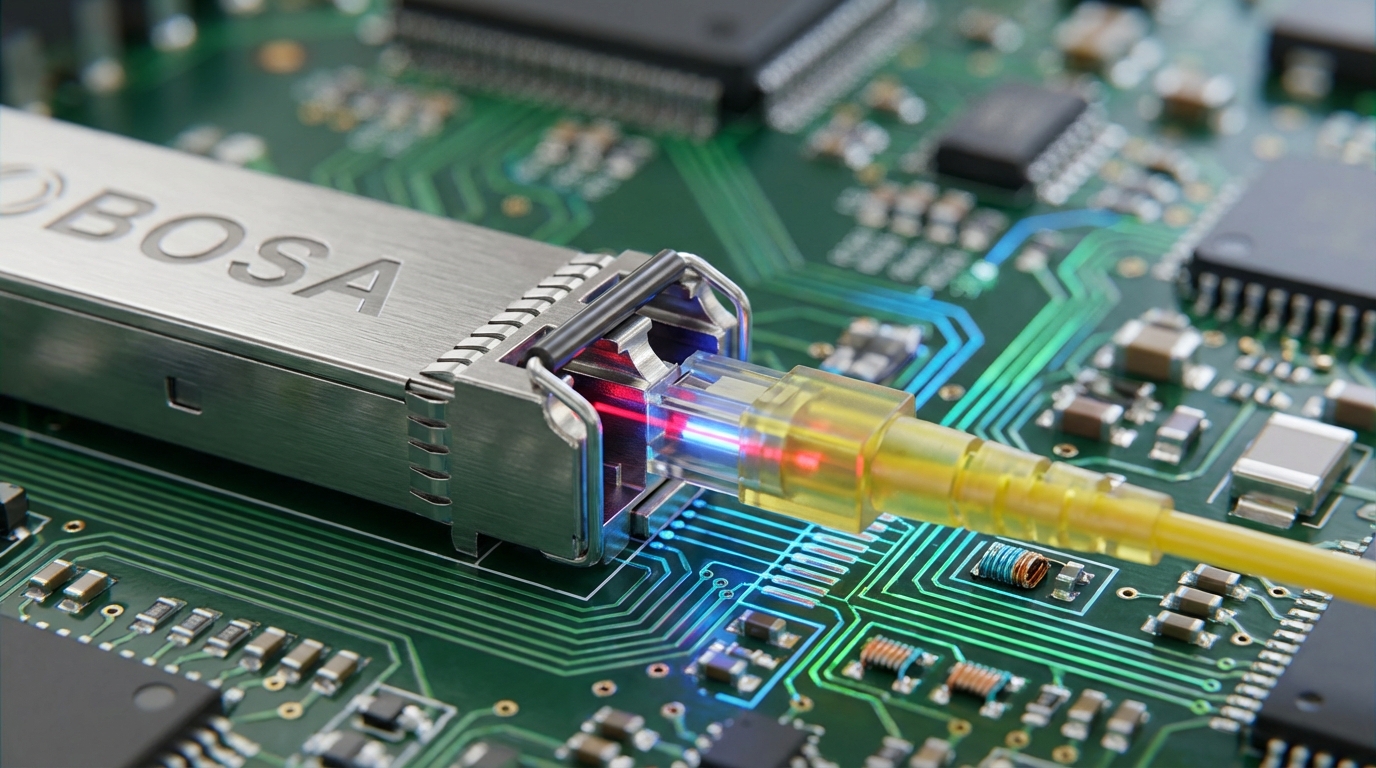
6.1.2 BOSA: The Optical Interchange
Inside the optical module, there is a tiny component called the BOSA (Bi-Directional Optical Sub-Assembly). It houses a micro-prism (filter):
-
It acts like a one-way mirror: Letting 1310nm light pass through to launch.
-
It acts like a reflector: Bouncing incoming 1550nm light to the detector. This sesame-sized prism shoulders the critical task of separating upstream and downstream signals. If the BOSA quality is poor (bad filter coating), signals will bleed into each other, causing "self-jamming."
Table 6-1: Typical Wavelength Allocation
| Link Direction | Wavelength | Signal Type | Bandwidth Need | Critical Metric |
|---|---|---|---|---|
| Upstream | 1310 nm | SBUS/CRSF (Control) | Tiny (<100 kbps) | Zero Packet Loss (Loss = Crash) |
| Downstream | 1490/1550 nm | HDMI/MIPI (Video) | Huge (20-50 Mbps) | Low Latency (Latency = Crash) |
6.2 Why is it Faster than Radio? (The Physics of Latency)
Many assume: Radio is light speed, fiber is light speed, so why is fiber latency lower? Actually, transmission speed (speed of light) isn't the bottleneck—processing speed is.
6.2.1 The Encoding Burden
-
Radio Video: To transmit video over crowded, noisy radio bands, we must compress it heavily (H.265) and add massive Error Correction Codes (FEC) and retransmission mechanisms. This is like stuffing an elephant into a fridge and reassembling it at the destination. It takes time (100-200ms).
-
Fiber Video: Fiber bandwidth is effectively infinite (for drone needs). We can transmit raw or lightly compressed data. No complex FEC, no retransmission.
-
Result: The image from the camera is "piped" directly to the screen. Total latency is usually under 30ms (mostly camera exposure and HDMI conversion; fiber travel time is 0.05ms/10km, negligible).
-
6.3 Signal Integrity: Re-clocking & Eye Diagram
In fiber transmission, light isn't just "on" or "off." When video signals sprint through 20km of glass at 1.5Gbps, Jitter becomes the arch-enemy.
6.3.1 Why Direct HDMI-to-Fiber Conversion Fails
Many DIYers try to modify cheap commercial "HDMI Fiber Extenders" for drones. The result is often: perfect on the ground, but flickering or green screens at 5km.
-
The Cause: Cheap extenders usually use Transparent Transmission. They ignore the quality of the HDMI clock and directly convert the electrical signal to light.
-
Clock Jitter: The drone's flight controller and motors generate massive Electromagnetic Interference (EMI), causing micro-jitter in the HDMI TMDS clock. Over short fiber (a few hundred meters), this is fine. But after 20km of dispersion accumulation, this jitter is amplified, making the receiver unable to lock onto the signal.
6.3.2 FMUSER's Secret Weapon: CDR Technology
Our military-grade optical modules embed a CDR (Clock and Data Recovery) chip at the transmitter end.
-
Principle: It doesn't just "relay" the signal. It first "shreds" the messy HDMI signal, extracts the core data, and then regenerates a perfect clock signal using a high-precision local crystal oscillator before modulating it onto the laser.
-
Effect: It's like taking a scribbled manuscript (noisy signal) and re-printing it in perfect typography (Re-clocking). No matter how much interference is inside the drone, the outgoing light signal is always standard and pure.
6.3.3 The Verdict: Eye Diagram Test
How do you tell if an optical module is "usable" or "excellent"? We don't look at ads; we look at the Eye Diagram.
-
What is it: An oscilloscope overlay of thousands of optical pulse signals.
-
Open Eye: Clear lines, with the "eye" in the middle wide open. Indicates distinct 0/1 boundaries and strong interference immunity.
-
Closed Eye: Messy lines, with the "eye" squinted shut. Indicates signal full of noise and jitter.
-
-
FMUSER Standard: Even under weak light conditions of -20dBm (simulating 20km limit), we demand an eye opening ratio of > 80%. This means even if the signal is as weak as a gossamer thread, the ground station can still clearly read every frame—zero mosaic.
6.4 Air Unit Evolution: From SFP to SoC
The history of fiber drones is a history of "slimming down" the Air Unit.
6.4.1 Gen 1: Hacked SFP (The SFP Era)
Early DIYers pulled standard telecom SFP modules (the metal sticks used in routers) and plugged them into giant adapter boards.
-
Cons: Heavy (25g+ with case), massive heat, vibration caused contact failures.
6.4.2 Gen 2: Decasing
To save weight, engineers stripped the metal shell off SFP modules, keeping only the PCB wrapped in heat shrink.
-
Progress: Weight dropped to ~10g.
-
Risk: Loss of EMI shielding and heatsinking caused lasers to age rapidly in high temperatures.
6.4.3 Gen 3: Integrated SoC
Modern military-grade fiber drones use custom integrated PCBs.
-
Design: The Transceiver, Video Encoder, and Flight Controller Interface are all on one credit-card-sized board.
-
Weight: < 15 grams.
-
Interfaces: Direct MIPI for cameras (skipping HDMI adapters), direct UART for flight controllers.
-
Advantage: Vibration resistance is vastly improved; no more modules shaking loose during a crash.
6.5 Thermal Management: Suffocation in a Vacuum
The optical module is the second hottest component on the drone (after the motors, since there is no VTX).
6.5.1 Wavelength Drift
Lasers are extremely temperature-sensitive. For every 1°C rise, the wavelength drifts about 0.1nm.
-
Consequence: If it gets too hot, the transmission wavelength drifts outside the BOSA filter's passband, and the light gets blocked. Signal Cut.
-
Symptom: Flying along, the video suddenly darkens or cuts out, but the drone still has power.
6.5.2 The Enclosed Fuselage Dilemma
Standard FPV drones are open-frame; wind cools everything. Fiber drones have aerodynamic shells to protect the spool.
-
Solutions:
-
Thermal Bridge: Use thick thermal pads to conduct heat from the module directly to the carbon fiber frame (carbon is a good conductor).
-
Air Ducts: Design specific intake ducts in the nose to blow air over the module heatsink.
-
6.6 The Photon's Revolving Door: Physical Limits of Slip Rings
The spool spins at high speed to pay out fiber, but the flight controller and camera on the drone are stationary (relative to the frame). How does a light signal travel from an object spinning at 5000 rpm to a static one? This requires a critical component: the Fiber Optic Rotary Joint (FORJ), commonly known as an "Optical Slip Ring."
6.6.1 Why Not Electric Slip Rings?
Traditional drone gimbals use Electric Slip Rings (brushes rubbing against metal rings). Fiber drones cannot use these.
-
Short Lifespan: Metal friction causes wear; contact fails after a few million revolutions.
-
Spark Interference: Micro-sparks from brush bouncing are massive sources of EMI.
-
Physical Isolation: Photons are not electrons; they cannot travel through metal rings.
6.6.2 Fresnel Reflection & Return Loss
Inside a FORJ, there are essentially two precision-aligned lenses separated by a layer of air (or index-matching fluid).
-
Fresnel Reflection: When light exits the fiber into air and enters another fiber, the refractive index change causes ~4% of the light to reflect back.
-
Vibration Impact: Under 5000 rpm rotation and airframe vibration, the alignment of these lenses shifts by microns. This causes drastic fluctuations in Return Loss.
-
Consequence: This fluctuation manifests as dropped frames or mosaic artifacts in the video feed.
6.6.3 The Countdown to Failure
The FORJ is the only mechanical wear part in the fiber transmission system.
-
Bearing Life: While the optical path is non-contact, the mechanical bearings supporting it have a finite life.
-
Scrap Criteria: When Insertion Loss exceeds 2dB, or the rotational loss variation (WOW, Wow and Flutter) exceeds 0.5dB, the slip ring must be scrapped.
-
Tactical Advice: Perform an Insertion Loss test every 50 flight hours. Don't wait until the signal stutters on the battlefield to find out it's worn out.
-
Low Power Firmware: Reduce laser power in standby (on the ground), only ramping up when throttle is detected.
-
6.7 Link Budget: How Far Can Light Go?
This is the math of fiber drone design. We must account for every decibel of loss.
-
Tx Power: Standard modules are -5 ~ 0 dBm.
-
Rx Sensitivity: Typically -24 ~ -28 dBm.
-
Total Budget: ~24 dB.
6.7.1 Loss Inventory
-
Fiber Loss: G.657.A2 fiber at 1550nm loses ~0.25 dB/km.
-
20km = 5 dB.
-
-
Connector Loss: Each FC/APC connector is ~0.3 dB.
-
System has 2-3 connectors (Ground patch, Slip Ring, Air Pigtail) = 1 dB.
-
-
Slip Ring: The heavy hitter. Coupling light across a rotating joint requires lenses.
-
Dynamic loss ~2-3 dB.
-
-
Bending Loss: Fiber arcing in the wind during flight.
-
Reserve 3 dB margin.
-
6.7.2 Conclusion
Total Loss = 5 + 1 + 3 + 3 = 12 dB. Remaining Margin = 24 - 12 = 12 dB. This means, optically speaking, flying 50 km is easy. The limit is battery life, not fiber signal.
6.8 Ground Unit Interfaces
The Ground Unit has no weight limit; the focus is Compatibility and Durability.
6.8.1 Analog vs Digital Conversion
-
HDMI Output: The universal standard. Converts light directly to HDMI for DJI Goggles V2 (AV IN mode) or portable monitors.
-
Ethernet (RJ45): Advanced play.
-
Remote Command: Stream video via Ethernet to a command center server. The commander can sit in a bunker 100km away, watching the feed via Starlink.
-
AI Processing: Feed the video into an edge compute box (like Jetson Orin) for real-time target recognition (auto-bounding tanks).
-
6.8.2 Power Management
Ground units usually need external power (2S-6S LiPo).
-
Design Trap: Many DIYers forget a voltage display on the ground unit. Result: The ground unit dies mid-flight. Black screen. Crash.
-
Mandatory Standard: Ground units MUST have independent voltage displays and low-voltage buzzers.
6.9 Procurement Guide: Avoiding Traps
Vendors on AliExpress or Amazon won't tell you these details.
6.9.1 The "Commercial Grade" Lie
-
The Trap: Buying cheap $5 SFP modules.
-
The Reality: These are usually "Commercial Grade" (0°C ~ 70°C). At 500m altitude in winter, temps drop below zero. Commercial chips fail (wavelength drift) at -10°C.
-
The Rule: Must buy Industrial Grade, rated -40°C ~ 85°C.
6.9.2 The A/B Side Rule (BiDi Pairing)
-
The Trap: Buying two identical modules and they don't link up.
-
The Science: BiDi technology requires matched pairs. If Side A TXs at 1310nm/RX 1550nm, Side B MUST TX at 1550nm/RX 1310nm.
-
The Tip: Always order "One Pair", not "Two Pieces". Look for different colored latch handles (e.g., Blue pairs with Yellow).
6.9.3 The Color Secret (UPC vs APC)
-
The Trap: Using green connectors (APC) on blue modules (UPC).
-
The Consequence: The 8-degree angle mismatch creates an air gap, causing 3-5dB loss. This instantly kills half your range.
-
The Rule: Modules are almost always Blue (UPC). NEVER use Green (APC) fiber patch cords unless specified.
6.9.4 The Burnout Risk (Over-specing)
-
The Trap: Buying an 80km module for a 100m bench test to ensure "strong signal".
-
The Disaster: High-power lasers on short fibers cause receiver saturation and permanent sensor burnout.
-
The Fix: If testing 40km+ modules in the lab, you MUST use a 5dB Attenuator.
Next Chapter Preview: We've covered the translator. Now, Chapter 7: Hardware Ecosystem. What flight controller do you need for "wired flight"? Why are standard FPV frames useless?
Volume 2: Technical Principles
Contact Now to Buy G.657.A2 Fiber
Chapter 7: Hardware Ecosystem - Beyond the Fiber
Core Argument: A fiber drone is not an isolated component; it requires a complete hardware ecosystem. From cheap Chinese parts to expensive Western systems, we see two vastly different design philosophies.
7.1 The Big Four Global Players
There are four main factions in the fiber drone battlefield, representing different tactical needs and supply chain capabilities.

7.1.1 Russia: The KVN System
-
Characteristics: Simple, brutal, high volume.
-
Design: Based on generic Chinese 7-10 inch drone frames, strapped with a massive fiber spool (usually 10km).
-
Advantage: Heavily reliant on the Chinese supply chain, ultra-low cost ($500-$800 per unit), affordable for mass attrition.
-
Tactic: Like the T-34 tank in WWII—overwhelm quality with quantity.
7.1.2 Ukraine/West: Neros Archer
-
Characteristics: Attempting to balance cost and performance.
-
Design: Designed by US/Swiss company Neros Technologies, assembled in Ukraine.
-
Anecdote: To cut costs and reduce reliance on Chinese electronics, Neros engineers reportedly repurposed "Parking Meter Chips" for their flight controllers. This illustrates the Western struggle to innovate around supply chain constraints.
7.1.3 Germany: Highcat HCX
-
Characteristics: Precision, expensive, special ops.
-
Design: Uses unique glass fiber winding technology and even attempts to address spool recovery.
-
Positioning: Not for mass attrition warfare, but for surgical strikes by special forces.
7.1.4 Ukraine Domestic: Chereshnya ("Cherry")
-
Characteristics: Extremely crude "Garage Made" style.
-
Design: Often consists of optical modules duct-taped to standard FPVs, with homemade spools. Ugly, but field-repairable in a trench.
7.2 Core Components: FC, Powertrain, and Frame
If you want to build a fiber drone yourself, the optical module alone is not enough.
7.2.1 Flight Controller (FC)
Since fiber does not transmit radio waves, the FC must support direct control input via UART Protocol.
-
Recommendation: SpeedyBee F405 V3 or V4.
-
Reason: Cheap (<$40), rich interfaces, high noise immunity. It is the most common "brain" on the battlefield.
-
Setup: In Betaflight, set the receiver protocol to SBUS and disable all radio-related Failsafes (since fiber has no concept of "signal loss"—it's either connected or cut).
-
7.2.2 PID Tuning for Tethered Flight
Many pilots find their drone flies like a drunkard after strapping on a fiber spool. This is because "tethered flight" fundamentally changes the physics model.
-
The Physics Pain Points:
-
Dynamic CG: As fiber pays out, the tail weight decreases (wire leaving), but the tail drag increases (wire length trailing behind grows, creating exponential drag).
-
High-Frequency Vibration: The "micro-tremors" of the fiber unwinding from the spool transmit high-frequency noise to the frame, confusing the gyro.
-
-
Tuning Secrets:
-
Adaptive Feedforward: Standard PID is static. Enable Betaflight's Adaptive Feedforward to help the FC predict drag changes based on motor load.
-
Dynamic Notch Filter: To kill the "Jello Effect" from spool vibrations, you MUST set notch filters targeting 150Hz-200Hz (common spool resonance frequencies). Otherwise, motors will overheat.
-
Boost I-Term: Increase the I (Integral) term. The I-term handles long-term error correction (like the constant pull of the fiber drag), which is critical for keeping the drone flying straight.
-
7.2.3 Powertrain
Dragging a line requires different power characteristics than a standard drone.
-
Motors: Recommend 2806.5 or 2810 size (1300KV).
-
Reason: Torque. Although the fiber is light, wind drag on a long fiber creates lateral pull. High torque is needed to maintain stability.
-
-
ESC: At least 50A, recommend 60A BLHeli_32.
-
Reason: To handle current spikes if the spool snags momentarily.
-
7.2.4 Thermodynamics of Disposable Motors
This is a hugely overlooked area for physical optimization.
-
Life Cycle Mismatch: Industrial motors are designed to last 1000+ hours. A kamikaze drone lives for 15-30 minutes. This is a massive waste of potential.
-
Overclocking Physics:
-
Melting Point: Motors burn out when the insulation varnish on copper wires melts (usually > 180°C) causing a short circuit.
-
The 31-Minute Rule: If we know the flight takes 30 minutes, we can push the current to the limit, designing the motor to burn out at minute 31.
-
-
Extreme Weight Reduction:
-
Remove all cooling fan structures (save 5g).
-
Downsize the stator. Use a 2507 motor to do a 2810's job. Heat will spike, but as long as it doesn't melt for 30 minutes, we gain an incredible Thrust-to-Weight Ratio.
-
7.2.5 Battery: Disposable Energy
-
Choice: 6S2P 21700 Li-ion pack (e.g., Molicel P42A).
-
Reason:
-
Energy Density: Li-ion is 30% denser than LiPo. Same weight, longer range.
-
Discharge Rate: While burst power is lower than LiPo, fiber drones cruise mostly. Li-ion discharge is sufficient.
-
Cost: DIY Li-ion packs are half the price of commercial LiPos. Critical for one-way missions.
-
7.2.6 Frame: Reject the "Dead Cat"
-
Avoid: "Dead Cat" geometry frames.
-
Reason: Dead Cat frames have wide front arms to clear the camera view, shifting CG back. Adding a heavy spool to the tail creates severe Tail Heavy issues.
-
-
Recommendation: True X or Long X.
-
Advantage: Center CG, even load distribution, best for carrying heavy payloads.
-
Rigidity: Must be stiff. Flexible frames cause jello video and can snap fiber connections.
-
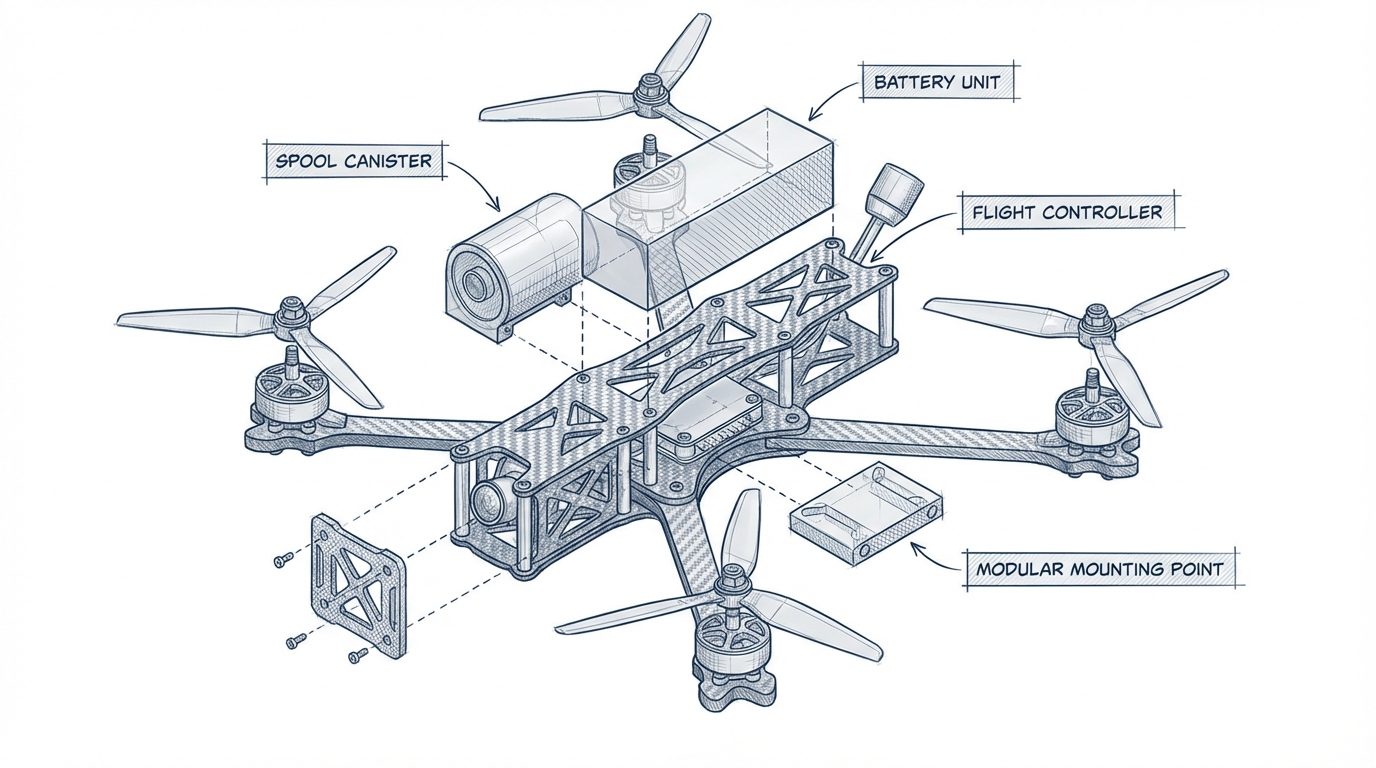
7.3 The Supply Chain War
Behind the drone war is a supply chain war.
-
China's Advantage: In Shenzhen's Huaqiangbei, you can buy a full production line for $2,000 and produce 500 fiber drones a day.
-
Western Dilemma: To build the same capacity in Europe takes 6 months and 10x the capital. This is why companies like Neros are forced to find non-mainstream solutions like "Parking Meter Chips"—because mainstream high-performance chips are either monopolized by the Chinese market or too expensive.
-
Price Arbitrage: A fiber drone with identical specs might leave a Chinese factory at $400, but once branded by a Western defense contractor, it sells to governments for $17,000. This massive markup is a snapshot of war economics.
7.4 Standard BOM (Bill of Materials)
Here is a battle-tested configuration list for a 10km Fiber Drone. This setup balances cost, reliability, and supply chain availability.
| Component | Recommended Model | Est. Price (USD) | Notes |
|---|---|---|---|
| Frame | 10-inch Long Range Frame (Carbon) | $60 | Tail must be reinforced for spool mounting. |
| Motors | 2810 1100KV (x4) | $80 | High torque required for drag resistance. |
| FC/ESC | SpeedyBee F405 V4 + 55A ESC | $70 | The "King of Cost-Performance". |
| Fiber Kit | 10km Spool + Air Unit + Ground Unit | $300 | The core component. |
| Camera | Runcam Phoenix 2 (HDMI Ver) | $40 | Low latency is prioritized over 4K. |
| Battery | 6S2P 8400mAh Li-ion | $60 | DIY pack using 21700 cells. |
| Total | ~$610 | Excludes ground monitor/VR goggles. |
Warning: Do not use "Toothpick" or lightweight frames. The fiber spool adds significant leverage to the tail, changing the center of gravity (CG). You need a "Bus", not a "Sports Car".
7.5 Hardware Evolution: What's Next?
Current fiber drones are in their "Early T-34" phase—crude and effective, but with massive room for improvement.
7.5.1 Automatic Spool Winder
The biggest bottleneck is winding. A skilled worker needs 2 hours to wind a 10km spool.
-
Trend: Desktop automatic winders are becoming common. Like 3D printers, they control tension and layering automatically, boosting yield rates from 70% to 99%.
7.5.2 Biodegradable Fiber
Battlefields are littered with cut fiber. This is not just an environmental disaster but a nightmare for friendly infantry (tripping hazard).
-
Trend: Fibers with PLA-based coatings are in development. Under UV exposure, they become brittle and decompose within 3 months, eliminating the physical threat.
7.5.3 VTOL Integration
Multirotors are slow (60km/h) and short-ranged (battery limit).
-
Trend: Integrating fiber systems into VTOL fixed-wings. Although the minimum flight speed of fixed-wings complicates the fiber release logic (must fly faster than the fiber drops), once solved, this enables 50km+ Beyond Visual Line of Sight (BVLOS) strikes.
Next Chapter Preview: The machine is built. How do you use it? Chapter 8: Deployment & Takeoff will enter the field manual, teaching you how not to snap the line in a trench.
Volume 3: Operational Field Manual
Contact Now to Buy G.657.A2 Fiber
Chapter 8: Deployment & Takeoff - The Critical 10 Seconds
Core Argument: The most dangerous moment for a fiber drone is not over enemy territory, but during the first 10 seconds after takeoff. A wrong takeoff procedure will slice the fiber instantly like scissors. This chapter is written in the blood of countless failed missions.
8.1 The Field Checklist
In a muddy trench, memory is unreliable. You must execute a strict checklist protocol.
Table 8-1: Pre-flight Core Checklist
| Check Item | Operation Detail | Fatal Error (Mission Failure) |
|---|---|---|
| 1. Connector Cleaning | Wipe the FC/APC connector face with 99% Isopropyl Alcohol pads. | Wiping with shirt/finger (Oil and fibers kill optical signals). |
| 2. Light Path Test | Insert VFL (Red Light Pen). Verify the entire spool glows faintly red. | Ignoring bright spots (A bright spot means a break at that exact point). |
| 3. Spool Lock | Ensure the spool latch clicks into place. Shake the drone hard to verify. | Loose Latch (Spool ejects during high-G maneuvers). |
| 4. Pigtail Strain Relief | Ensure the pigtail exiting the spool has a strain relief loop. | Straight connection (One trip over the cable rips the HDMI port out). |
| 5. Propeller Check | Check prop edges for nicks or burrs. | Using damaged props (A burr acts like a saw blade if it touches the fiber). |
8.2 The Core Move: The Pre-Pull
This is the step most rookies skip, and it causes 90% of takeoff failures.
8.2.1 The Physics: Start-up Jerk
-
Static vs. Dynamic Friction: The fiber is glued inside the spool. Pulling it out requires overcoming "Peel Force."
-
Acceleration Disaster: A drone accelerating from 0 to 10m/s takes only 0.5s. If the fiber takes this load directly, the massive Jerk (Change in acceleration) plus the binder viscosity will exceed the fiber's tensile strength (10-20N) instantly.
8.2.2 Operational Standard
-
Action: Before takeoff, manually pull out 3-5 meters of fiber from the spool.
-
Layout: Lay this loose fiber on the ground directly behind the drone.
-
Pro Tip: Lay it in a Figure-8 pattern, not a circle. A circle creates twists (kinks) when pulled up, while a Figure-8 cancels them out.
-
-
The Buffer Pool: This 5m of fiber is your "Takeoff Buffer." For the first 1-2 seconds of flight, the drone consumes this loose line with zero drag. By the time it runs out, the drone has initial velocity, transitioning smoothly to pulling from the spool.
8.3 Takeoff Ballistics
The flight profile of a fiber drone is radically different from a standard quadcopter.
8.3.1 Launchpad Aerodynamics: The Ground Effect Trap
This is a zone cursed by physics: The Ground Effect Zone.
-
Tail-Heavy Torque & The 15° Pitch:
-
Scenario: With a 1.5kg spool, the drone is severely Tail Heavy. To lift off, the Flight Controller demands maximum thrust from rear motors, forcing a 10-15° Pitch Up angle.
-
The Turbulence Loop: This angle directs prop wash downwards and backwards. Upon hitting the ground, it forms a Recirculation Vortex that curls back up—lifting your 5m loose fiber buffer and throwing it directly into the rear props.
-
-
The Vacuum Cleaner Effect:
-
Low pressure beneath the hull acts like a vacuum. If the fiber is too close, it gets sucked up into the blades instantly.
-
Solutions
-
Coanda Effect Deflector:
-
Install a curved shield on the launchpad to guide downwash outward, creating an "Air Wall" that pushes the fiber away.
-
-
45-Degree Catapult Launch:
-
Concept: Use a catapult rail to give the drone 10m/s initial velocity.
-
Advantage: The fiber is pulled straight back by drag, completely bypassing the turbulent wash under the drone.
-
-
Inverted Takeoff / Drop Launch:
-
Tactic: An expert maneuver. Hang the drone upside down (or hand-drop inverted) from a platform or branch.
-
Timing: Allow it to freefall 2-3 meters to clear the Ground Effect zone, then punch the throttle to level out.
-
Risk: Ace pilots only. One mistake means a crash.
-
8.3.2 The Elevator Ascent
-
Wrong Way: Punching out at a 45-degree angle like a racing drone.
-
Result: The fiber smacks into the ground, weeds, or rocks, causing snagging and breakage.
-
-
Right Way: Vertical Ascent.
-
Arm motors.
-
Throttle to 60%, climb vertically to 10-15 meters (approx. 3 stories high).
-
At this point, the fiber hangs vertically, clearing all ground obstacles.
-
Pitch forward and go.
-
8.3.3 Flight Taboos
Once tethered, your freedom is limited. Memorize these three taboos:
-
NO Yaw Spins
-
Physics: You spin, the line doesn't. One spin = one twist. Ten spins = the fiber wrings itself out like a wet towel and snaps.
-
Technique: Use Coordinated Turns (Roll + Yaw) to fly large arcs. Never spin in place.
-
-
NO Reverse Flight
-
Physics: The fiber comes out of your tail. If you fly backward, the fiber drifts into your propellers.
-
Result: Instant tangle. Prop guards help, but don't risk it.
-
-
NO Sharp Dives
-
Physics: Fiber has air resistance and falls slower than a rock (it floats). If you dive faster than the fiber's natural terminal velocity, you will overtake your own line and tangle with it.
-
Rule: Keep descent rate under 3m/s, or maintain forward speed while descending slowly.
-
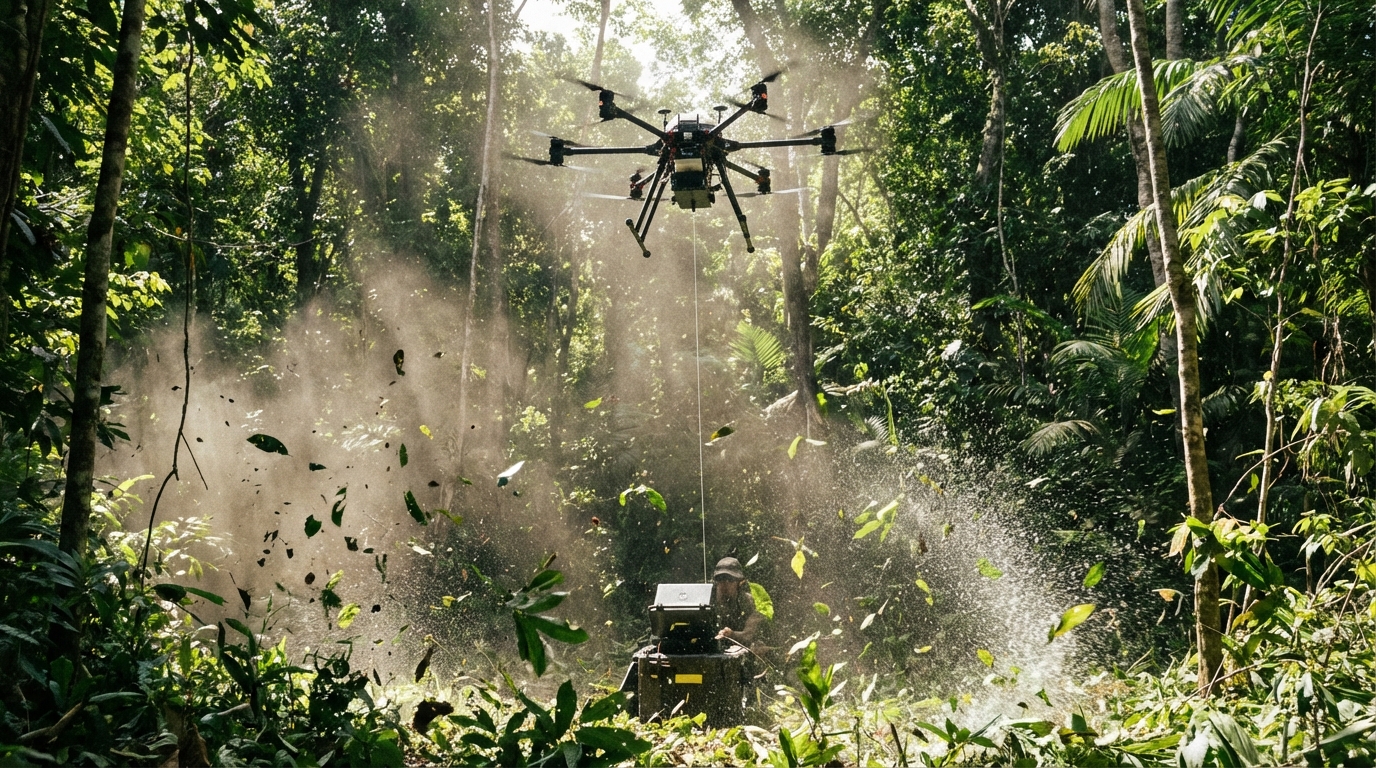
8.4 Obstacle Crossing & The Dead Line
8.4.1 The Dead Line Trap
Once the fiber drapes over an object (tree branch, power line, roof edge), that contact point becomes a new "Anchor."
-
Friction Angle: If you keep flying forward, the fiber forms a sharp angle at the branch. Friction increases exponentially.
-
Irreversible: Once snagged, you CANNOT save it by flying back or yanking sideways.
-
Tactical Decision: Snagged? Ignore it and punch it.
-
Fiber is cheap. Don't hesitate to waste it.
-
The only chance of survival is to keep flying forward and pray the fiber slides over the obstacle. Stopping guarantees a break.
-
8.4.2 Tunnels & Power Lines
-
Power Lines: The most dangerous enemy. The thin fiber slices into the high-voltage insulation like a cheese wire, or triggers an arc flash. Fly at least 5m ABOVE power lines.
-
Bridges/Windows: Once you fly in, you cannot fly out. It's a one-way ticket.
8.5 Site Layout
How you set up your ground station determines if you come back alive.
8.5.1 Downwind Takeoff
-
Wind Direction: Always try to take off downwind.
-
Reason: In a downwind takeoff, the wind blows the hanging fiber away from the drone. In an upwind takeoff, the wind blows the fiber into the rear propellers.
8.5.2 Patch Cord Management
There is usually a 3-10m yellow patch cord connecting your Ground Station to the takeoff point.
-
Strain Relief: Tape the cable to a heavy object (brick, ammo crate) at both the station end and the drone end.
-
Purpose: Prevents a soldier running in the trench from tripping on the cable and ripping the expensive HDMI converter out of the socket, or flipping the drone over.
8.5.3 The Spotter
Fiber ops are best done as a two-man team.
-
Pilot: Eyes on screen, focused on flying.
-
Spotter:
-
Pre-flight: Handles the pre-pull and cable management.
-
Takeoff: Watches the spool. If the fiber knots up, yells "STOP!" immediately.
-
In-flight: Guards the ground cable from being stepped on.
-
Chapter Summary: Taking off a fiber drone is a ritual. It doesn't need to be fast; it needs to be smooth. Remember: Pre-pull 5 meters, climb vertically, and never look back. Survive the first 10 seconds, and the sky is yours.
Volume 3: Operational Field Manual
Contact Now to Buy G.657.A2 Fiber
Chapter 9: Tactics
Core Argument: Fiber drones are not just about "jamming immunity." The combination of Zero Latency, HD Clarity, and Radio Silence fundamentally changes FPV tactical logic. It's no longer just a drone; it's a "flying, maneuverable, eye-equipped missile."
9.1 Absolute Immunity via Physics
In today's intense Electronic Warfare (EW) environment, radio drones face an existential crisis. Frequency scanning, full-band jamming, GPS spoofing—none of these countermeasures work against fiber drones.
9.1.1 The Fundamental Difference Between Light and Electricity
Radio jamming works by "shouting louder than the speaker." As long as the jammer's power is high enough, it can drown out the drone's video signal. But in fiber, the transmission is light pulses confined within a 125-micron glass strand.
-
Un-jammable: External radio waves (no matter how powerful) cannot enter the fiber. It's like singing in a soundproof booth; you can't hear the thunder outside.
-
Undetectable: Radio video transmitters are like loud speakers, easily located by enemy Direction Finders. Fiber drones are electromagnetically transparent (black holes). The enemy won't know you're there until they hear the propellers.
9.1.2 Piercing the Faraday Cage
Metal mesh, reinforced concrete bunkers, and tank armor act as natural "Faraday Cages" that block radio signals.
-
Tactical Scenario: Enemies hiding in deep concrete bunkers or tanks under metal sheds.
-
Fiber Advantage: Fiber is an insulator and physically penetrates shielding. As long as the drone can fly in, the signal can get out. This makes fiber drones the ultimate weapon for clearing underground fortifications, tunnels, and bunkers.
9.2 The Power of Zero Latency
With traditional radio FPV, what you see is always 100-200 milliseconds in the past. It’s like driving a car with your eyes closed for half a second. By the time you see the obstacle, you've already hit it. Fiber reduces latency to under 30ms.
9.2.1 Nap-of-the-Earth Flight
-
Radio Limitation: When flying low, ground clutter and Fresnel Zone obstruction cause severe signal degradation and video breakup. Pilots dare not fly too low.
-
Fiber Tactic: You can fly at full speed just 0.5 meters above the grass. Because there is no signal anxiety and latency is negligible, pilots can react like video gamers, pulling up to dodge a bush at the very last second. This ultra-low penetration makes detection by radar or eye extremely difficult.
9.2.2 Terminal Guidance
-
Scenario: The final 0.5 seconds before impact.
-
Comparison:
-
Radio: As altitude drops, terrain blocks the signal. The video often turns to static 1-2 seconds before impact. The final approach is blind inertia.
-
Fiber: Until the very millisecond of impact, the video is 1080p HD and smooth. If a tank suddenly rotates its turret or deploys slat armor, the pilot can adjust aim in the final 0.1 seconds to precisely hit weak points like the turret ring or engine exhaust.
-
9.2.3 Game Theory: Why APS Fails
Active Protection Systems (APS) on tanks are designed to intercept anti-tank missiles, but they fail against fiber drones. It is a game of Time.
-
The APS OODA Loop:
-
Observe: Millimeter-wave radar confirms target (filtering birds) -> ~0.2s.
-
Decide: Fire control computer calculates trajectory and unlocks interceptor -> ~0.1s.
-
Act: Launcher slews and fires -> ~0.3s.
-
Total Latency: > 0.6s.
-
-
The Fiber Breach:
-
In the final 50 meters, the drone sprints at 150 km/h (41 m/s).
-
The reaction window for APS is only 1.2s.
-
The Checkmate: If the pilot executes a sudden "Barrel Roll" or "Jink" in the final 0.5s:
-
APS radar must recalculate the predicted impact point.
-
The interceptor has already been fired (miss).
-
The system cannot reload in time.
-
-
Conclusion: With millisecond-level control response, fiber drones kill within the APS logic dead zone.
-

9.3 NLOS & Shadow Tactics
Radio waves travel in straight lines. If you fly behind a mountain or a building, the signal cuts. This is the "Line of Sight" (LOS) limitation.
9.3.1 Reverse Slope Attacks
Fiber is a physical tether; it is not limited by line of sight, only by cable length.
-
Maneuver: You can fly over a ridge and descend down the back side to attack artillery positions hiding on the reverse slope.
-
Physical Constraint: While the signal is fine, be aware that the fiber will drag across the ridge line. If the ridge is sharp rock, it might cut the fiber.
-
Countermeasure: Maintain altitude when crossing the ridge to minimize the friction angle, or descend rapidly only in the final attack phase.
-
9.3.2 Urban Warfare
-
Scenario: Enemies in a maze of high-rise buildings.
-
Advantage: Radio signals suffer from Multipath reflection between buildings, causing video tearing. Fiber can weave directly around buildings, fly into windows, traverse hallways, and exit through windows on the other side (as long as the cable is long enough and doesn't knot).
9.3.3 The Geometry of Death: Urban Cornering
Fiber can bypass buildings, but not infinitely. A rookie mistake is treating the fiber like a frictionless "ghost line."
- The Physics Law: Capstan Equation.
- Formula:
- Brutal Reality: With every corner you turn, the friction drag on the fiber increases exponentially.
- If you drag the fiber against rough concrete corners (friction coefficient ) for two 90-degree turns (total angle ), the drag force increases by 4.8 times. A manageable 100g pull instantly becomes nearly 500g, snapping the line.
-
Tactical Rules:
-
"Stay on Broadway": Fly down wide main streets to minimize cornering.
-
"Fly High, Hit Low": Maintain high altitude (above rooftops) when crossing city blocks, and dive only for the final attack. This ensures the fiber drapes over roof edges rather than grinding against complex street corners.
-
9.4 "Window Breaking" & HD Recon
This is one of the classic tactics from the Ukraine battlefield, specifically for neutralizing snipers or command posts inside buildings.
9.4.1 4K-Level Battlefield Awareness
Standard analog video is full of noise and static; you can't see details. Fiber transmits digital HD signals.
-
Detail Recognition:
-
Distinguish between a glass reflection and an open window (radio video often can't).
-
Spot a radio antenna tip poking out of a bush.
-
Tell if tire tracks on the ground are fresh or old.
-
Read unit patches on enemy uniforms.
-
-
Tactical Value: This clarity makes the fiber drone not just an attack weapon, but a super-recon asset.
9.4.2 Indoor Clearing
-
Hover & Observe: Hover 5 meters outside the window using the HD zoom lens to check the room layout.
-
Breach: Once the target is confirmed, crash directly through the glass at full speed.
-
Corridor Sweep: Inside, use altitude hold (if available) or steady manual flight to sweep hallways slowly. Radio signals can't penetrate two walls, but fiber can fly into a bunker three stories underground.
9.5 Ambush Mode: The Aerial Mine
Fiber drones have a superpower that radio drones don't: Infinite Silent Loiter.
-
Operation: Fly to a treetop overlooking an enemy supply route, land, and kill the motors.
-
Advantages:
-
Zero Power: Consumes only milliwatts for the video feed and flight controller; can wait for hours.
-
Zero Emission: No radio signal emitted. Enemy detectors are blind.
-
-
Trigger: The operator watches the road via the camera. When a convoy passes, punch the throttle (< 2s spin-up) and dive onto the roof armor. It's effectively a Flying IED.
9.5.1 The Energy & Heat Game
-
Radio Pain Point: Radio Video Transmitters (VTX) generate massive heat. If a drone sits on the ground without airflow, the VTX will overheat and burn out in minutes. Plus, the continuous signal reveals your position.
-
Fiber Advantage: Optical modules generate almost no heat and emit no radio waves.
9.5.2 "Sleeping Beauty" Tactic
-
Deploy: Fly the drone to a tree branch, rooftop, or roadside bush overlooking a choke point.
-
Sleep: Turn off motors. The video feed can stay on (low power) for monitoring, or turn off completely, leaving only a low-power wake-up receiver active.
-
Wake: When enemy convoy noise is heard or a target is spotted by other means, instantly spin up motors and take off.
-
Strike: Attack from point-blank range (tens of meters). The enemy has zero reaction time.
-
Significance: This effectively plants a "Smart Mine" that can take off and be steered at will.
9.6 Counter-Recon: Fiber as a Stethoscope (DAS)
Since fiber is a sensor itself, why only use it for video? This is a sci-fi yet physically viable frontier tactic.
9.6.1 Distributed Acoustic Sensing (DAS)
The fiber is not just a cable; it is a 10km long Microphone.
-
Principle: Rayleigh Scattering.
-
When sound waves (footsteps, vehicle vibrations) hit the fiber, they cause microscopic deformations in the glass.
-
These deformations cause some photons traveling inside to scatter.
-
The Ground Station can detect these backscatter shifts to pinpoint the location and type of the sound source.
-
-
Tactical Application:
-
Ambush Surveillance: When the drone is in "Ambush Mode" on a tree, the fiber trailing on the ground becomes a tripwire.
-
Early Warning: If someone steps within 10 meters of the fiber, or a tank drives within 50 meters, the algorithm alerts: "Heavy vibration detected at 3.5km mark."
-
Passive Defense: Even if the drone has crashed, as long as the fiber is intact, the line remains an active seismic sensor, providing battlefield audio intelligence for kilometers.
-
9.7 Tactical Limitations & "The One-Way Ticket"
It must be clearly understood that fiber drones are usually disposable tactical assets.

9.7.1 Forward Only, No Reverse
-
Principle: Fiber is "pulled" from the spool at the tail. If the drone flies backward or turns around to fly home, the paid-out fiber won't retract; it floats in the air.
-
Risk: Floating fiber easily tangles in the propellers, causing a crash.
-
Rule: NEVER attempt to return home. Once you take off, it's a one-way mission. Either hit the target or land somewhere (as an ambush point) before the battery dies.
9.7.2 Irreversibility of Path
-
Entanglement Risk: If you fly a loop around a pillar, the fiber wraps around the pillar. If you then try to fly away, the fiber snags on the pillar, tension spikes, and the line snaps.
-
Airmanship: The pilot must constantly maintain a mental "Fiber Path Map." Flight trajectories must be topologically simple—avoid complex loops and backtracking.
Next Chapter Preview: You launched, the line is paying out, but suddenly the screen goes black. Chapter 10: Troubleshooting will teach you how to diagnose if the line snapped, the connector failed, or the drone was shot down.
Volume 3: Operational Field Manual
Contact Now to Buy G.657.A2 Fiber
Chapter 10: Troubleshooting
Core Argument: On the battlefield, you don't have time for complex diagnostics (like OTDR). You only have seconds to decide: is the drone dead, or is the line broken? If it's the line, can a patch cord swap fix it, or is the mission scrubbed?
10.1 Black Screen: Rapid Diagnosis Flow
You're flying happily, and suddenly the screen goes black. Heart rate spikes. Don't panic. Based on the screen symptoms, diagnose the failure point immediately:
10.1.1 Symptom 1: Total Blackout
The screen is completely dead. No OSD (On-Screen Display), no flight data, no battery voltage.
-
Diagnosis: This is not a signal issue; it's a Ground Station Power issue.
-
Checkpoints:
-
Is the VR Goggle battery dead?
-
Is the HDMI cable loose? (Most common failure; a slight tug in the trench disconnects it).
-
Is the Ground Unit optical receiver out of power?
-
10.1.2 Symptom 2: Black Screen with OSD
You can see flight parameters (OSD overlay), but the background video is black.
-
Diagnosis: Link Loss. The optical link is broken, but the display system is working.
-
Checkpoints:
-
Check the VFL (Red Light Pen): If you have a Visual Fault Locator connected to the ground unit, unplug the fiber and look at the break.
-
Bright Break: The break is right at your feet (launch point). Maybe a teammate stepped on it, or the pigtail snapped. Fixable (swap the patch cord).
-
Dim or No Light: The break is kilometers away. Not Fixable (drone is lost).
-
-
Listen: If the drone just took off, can you hear the props spinning? If yes, but no video, the fiber snapped but the drone is still flying (if it has a separate radio control link).
-
10.1.3 Symptom 3: Blue Screen / Static
-
Diagnosis: This is a characteristic of analog signals. If you are using a pure digital fiber system, this usually means the HDMI Converter or Monitor Driver Board is failing. A fiber break results in a black screen or frozen frame, never static/snow.
10.2 Fiber Break Analysis
Fiber is stronger than steel (by cross-sectional area), but it fears two things: Shear Force and Kinks.
10.2.1 Launch Failure
-
Cause: Taking off too hard. The acceleration (jerk) pulled the fiber out faster than the spool could release it. Or the fiber snagged on the launch platform edge.
-
Symptom: Video cuts out 1-2 seconds after takeoff.
-
Prevention: Use the "Pre-pull" tactic (see Chapter 8) and ensure a clear launch path.
10.2.2 Mid-air Break
-
Cause 1: Knotting. Poor spool winding quality. Two loops stick together and pull out a knot. The knot snaps instantly when hitting the payout nozzle.
-
Cause 2: Terrain Cutting. Flying over a ridge where the fiber drags on sharp rocks like a saw.
-
Cause 3: Prop Strike. Making a sharp turn or flying backward, causing the fiber to drift into the propellers.
10.3 Flickering & Packet Loss
The screen isn't black, but it's stuttering, pixelating, or showing macro-blocking. This means Optical Power is hovering at the critical threshold.
10.3.1 The Culprit: Dirty Connectors
This is the cause of 90% of bad signals in the field.
-
Physics: The fiber core is only 9 microns. A single speck of dust (20 microns) landing on the face is like a boulder blocking a tunnel.
-
Fatal Error: Blowing on it with your mouth or wiping it with a dirty shirt.
-
Result: Saliva leaves protein residue that dries into a hard stain; shirt fibers scratch the glass.
-
-
Correct Action: MUST use 99% Isopropyl Alcohol Wipes or a dedicated Click Cleaner.
10.3.2 Mechanical Stress
-
Check the Patch Cord: Is the yellow patch cord at the ground station trapped under an ammo box? Is it tied in a tight knot?
-
Micro-bending Loss: When fiber is bent tighter than a 2cm radius, light leaks out at the bend, causing signal attenuation.
10.4 Field Repair: Mechanical vs. Fusion Splicing
Can you splice a broken fiber in a muddy trench? The standard answer is "Swap the spare." But when you are out of supplies and MUST fix that damn fiber, you have two choices.
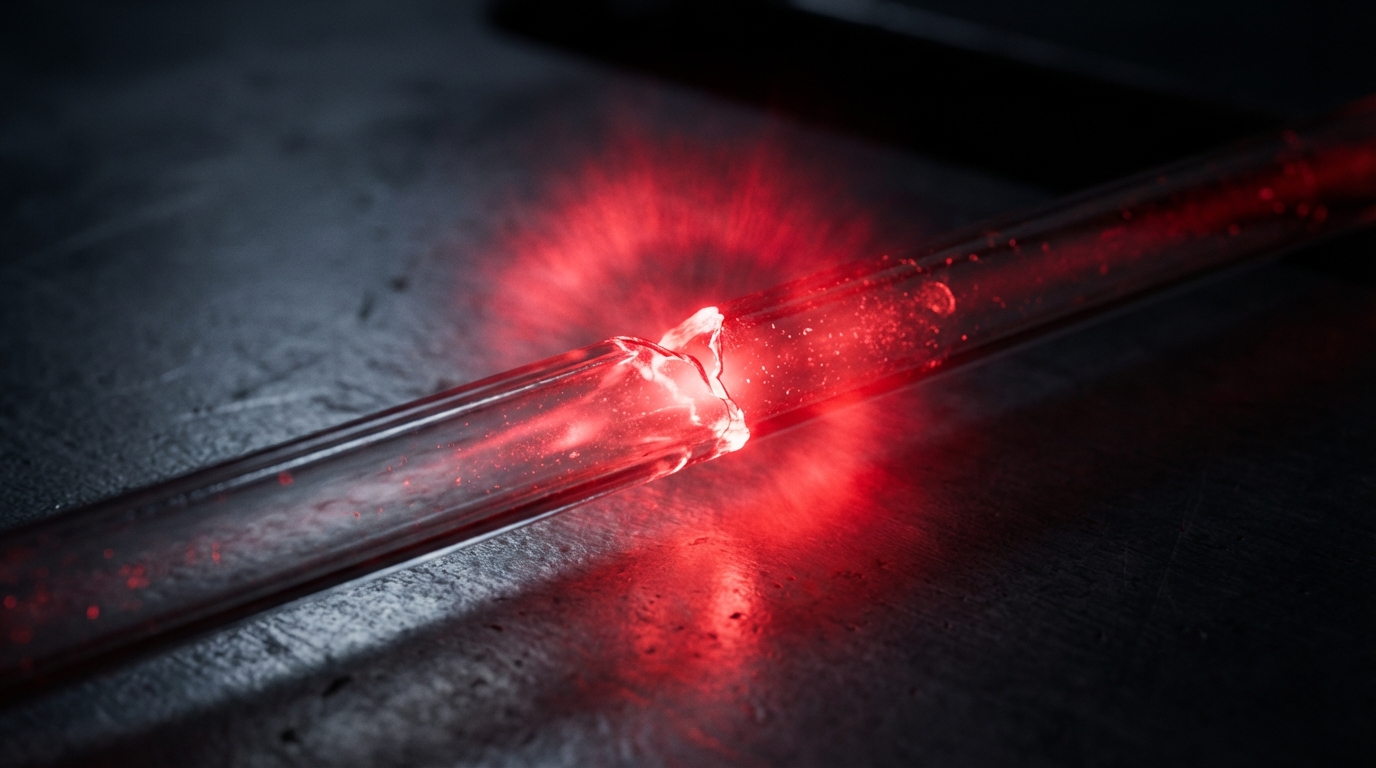
10.4.1 Mechanical Splice: The "Band-Aid"
Rookies think mechanical splices are magic—no power needed, just plug and play.
-
Core Tech: V-Groove alignment. It relies on two precise ceramic V-plates to clamp the fibers, using Index Matching Gel in between to bridge the light.
-
Fatal Flaws:
-
Huge Loss: Average insertion loss is 0.5dB. Splice twice, and you've burned through the signal margin for 10km of fiber.
-
Low-Temp Failure: That drop of matching gel becomes viscous or cloudy at -20°C. In a Ukrainian winter, this is a death sentence.
-
Vibration Intolerant: A nearby artillery blast can shift the fiber inside the V-groove, cutting the signal instantly.
-
10.4.2 Portable Fusion Splicer: The "Scalpel"
-
Core Tech: High-Voltage Arc Discharge. It melts the two glass ends and fuses them back into a single, solid glass rod.
-
Pros:
-
Near-Zero Loss: Typical loss is just 0.02dB. The light doesn't even "know" there was a break.
-
Permanent Strength: The splice point is nearly as strong as the original fiber.
-
-
Battlefield Limits:
-
Hates Dirt: A single speck of dust on the electrodes will cause the arc to deviate, failing the splice.
-
Hates Wind: A gust of wind will blow the arc away. You must operate inside a windproof tent or vehicle.
-
10.4.3 The Verdict
-
Frontline Infantry: Throw away the mechanical splices. Carry 5 spare pre-terminated patch cords. Break one? Swap it.
-
Logistics Tech: Use a handheld fusion splicer (like Sumitomo T-400S or generic clones) inside a bunker. NEVER try to splice in an open trench.
10.4.4 The Only Viable Solution: Modular Replacement
-
Swap It:
-
If the ground patch cord is bad, throw it away and plug in a new one (keep 5 spares in your bag).
-
If the spool on the drone is bad, grab a new drone.
-
Do Not Repair. Time is life.
-
10.5 Wreckage Recovery
If the drone crashes in friendly territory, be extremely careful when retrieving it.
-
Invisible Razor Wire: The transparent fiber lying in the grass is nearly invisible. It is tough and thin, easily tripping soldiers or cutting ankles/fingers.
-
Cleanup Procedure:
-
Cut It: Before walking out, cut the fiber at the ground station.
-
Abandon: Do not try to reel back kilometers of fiber. It is disposable.
-
Destroy: If the drone crashed in a sensitive area (risk of enemy capture), the fiber has no intel value, but the Flight Controller and SD card do. Smash them.
-
10.6 "Zombie Drone" Prevention: Failsafe Settings
When the fiber breaks, what does the drone do? It depends entirely on your pre-flight configuration.
-
Absolute Prohibition: NEVER enable Return to Home (RTH).
-
Reason 1: Most fiber drones don't have GPS to maintain stealth and avoid jamming.
-
Reason 2: Even with GPS, flying back while dragging a broken, kilometers-long fiber tail is dangerous. It will whip across trees, power lines, or friendly positions like a razor.
-
-
The Only Correct Setting: Land or Drop.
-
Drop (Recommended): Immediately stop motors and fall. While this risks destroying the airframe, it ensures the drone doesn't become an "uncontrolled missile".
-
Land: Slow descent. Suitable for flat terrain, but risks getting hung up in trees in complex environments.
-
-
Trigger Mechanism: In Betaflight, ensure Failsafe triggers IMMEDIATELY upon SBUS signal loss (fiber break). Do not set a "Stage 2" delay; set it to 0.1 seconds.
10.7 False Positives: It's Not the Fiber's Fault
Rookies often misdiagnose faults, blaming the fiber when the replacement drone fails just the same.
10.7.1 "Lag Due to Interference"
-
Truth: Fiber CANNOT be jammed.
-
Analysis: If the video lags, do not assume "Enemy EW jamming". Photons are not charged; electronic warfare equipment has zero effect on them.
-
Real Causes:
-
Power Sag: During aggressive maneuvers, motors draw huge current, causing voltage sag at the air unit's optical module.
-
Overheating: The video transmitter module is throttling due to heat buildup inside a sealed fuselage.
-
10.7.2 "Lost Signal at Long Range"
-
Truth: Fiber has no "Range Attenuation".
-
Analysis: Radio signals get weaker with distance (static increases). Fiber signals are digital (0 or 1). Over 10km, optical loss is negligible (<3dB).
-
Conclusion: As long as it's not broken, the video quality at 10km is identical to 10m. If quality drops, check your connectors, not the distance.
10.8 Topology Nightmare: Untangling the Knot
During rapid deployment or retraction, fiber often tangles like earphone cables. If handled incorrectly, pulling tightens the knot into a "Dead Knot," rendering the entire spool useless.
10.8.1 Why Does It Knot?
Fiber has "memory." When it comes loose from the spool without tension control, torsion stress causes it to coil into loops automatically.
-
Cloverleaf Knot: The most common knot form in fiber optics, resembling a clover shape.
-
Birth of a Dead Knot: When you pull on a loose loop, the radius (r ) shrinks dramatically. According to bending loss formulas, when r drops below the critical threshold (approx. 5mm), the glass core snaps or the coating cracks due to excessive bending.
10.8.2 Untangling SOP: Push, Don't Pull
If you see a knot, NEVER pull on the ends.
-
Stop: Cease all pulling immediately.
-
The Push Method:
-
Identify the core of the knot.
-
"Push" the fiber into the knot to expand the loop.
-
Principle: Increasing the radius of curvature ($r$) reduces stress.
-
-
Vibration Technique:
-
If it's a bird's nest of tangles, don't pick at every knot.
-
Hold one end of the mess and gently shake it up and down (amplitude approx. 10-20cm).
-
Principle: Vibration energy allows the fiber to use its own elastic potential energy to "spring" open the tangles.
-
-
Last Resort: If it's truly stuck and near the end, cut it. Don't waste 30 minutes untangling to save 5 meters of fiber.
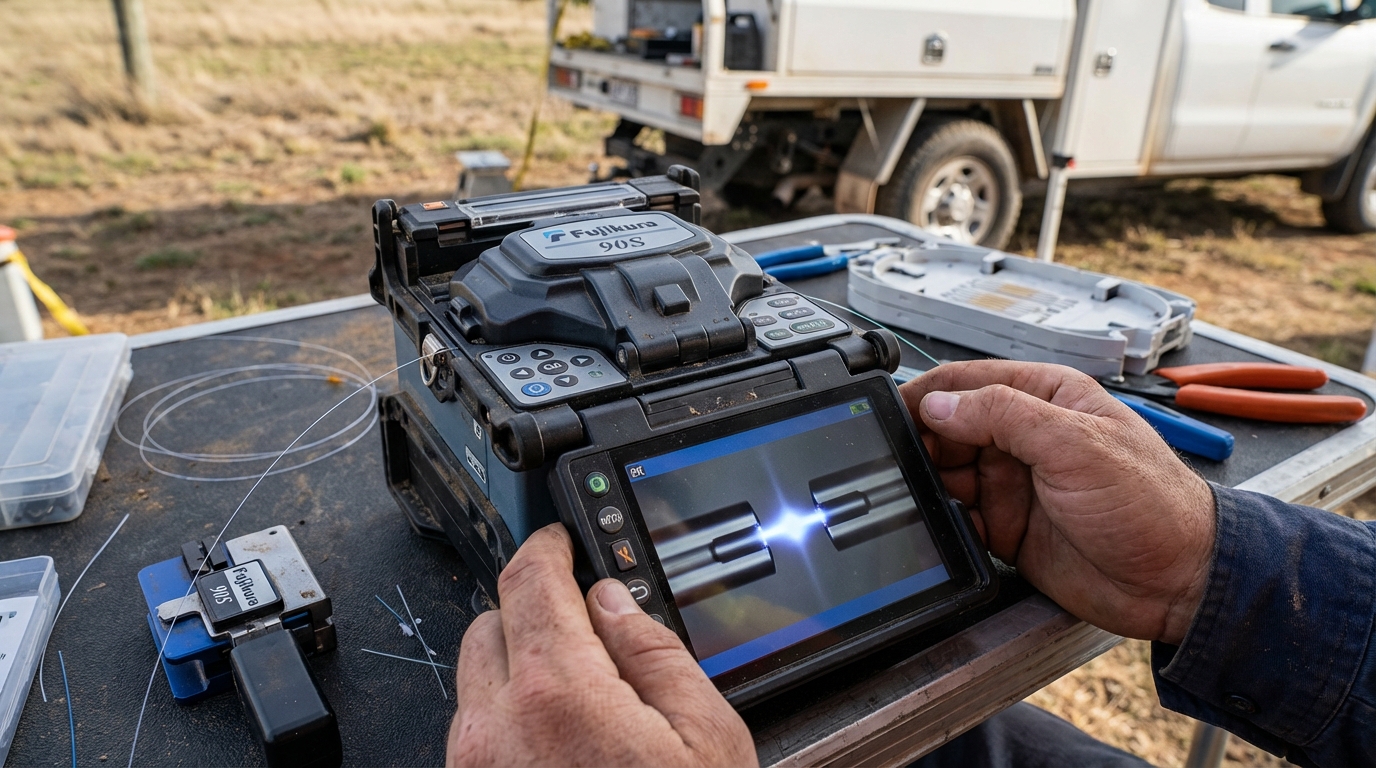
10.9 Survival Guide for Extreme Environments
10.9.1 Extreme Cold (Below -10°C)
-
Risk: Fiber coating becomes brittle.
-
Consequence: The jerk force at launch causes the coating to peel or crack, leading to micro-fractures in the glass.
-
Countermeasure: Keep the spool warm inside your jacket or vehicle until the last minute before launch.
10.9.2 Extreme Heat (Above +35°C)
-
Risk: Ground station optical module overheating.
-
Consequence: Optical modules have thermal protection; they will forcibly shut down the laser if they exceed 70°C.
-
Countermeasure: Install a cooling fan on the ground unit, or cover it with a wet towel (ensure it's waterproof).
Next Chapter Preview: We've covered how to use it and how to fix it. Now, let's flip the script. If you are the defender and see an enemy fiber drone coming, what do you do? Jamming guns are useless. So what works? Chapter 11: Hard Kill Interception.
Volume4:Defense&Countermeasures
Contact Now to Buy G.657.A2 Fiber
Chapter 11: Hard Kill Interception
Core Argument: Facing a fiber drone, turn off your multi-million dollar Electronic Warfare (EW) suite. It's less useful than a stick. Since you cannot "blind" it electronically, you can only try to "crush" it kinetically. But in this game, the defender's cost is astronomically high.
11.1 The Death of EW
Before discussing interception, we must reiterate the brutal reality:
-
Spectrum Analyzers: Silent. Fiber drones emit no radio signals; you see no spikes on the screen.
-
Full-Spectrum Jammers: Useless. You can crank the power to max, frying every friendly radio nearby, and the fiber drone will still fly towards your jamming truck with crystal-clear HD video.
-
GPS Spoofing: Ignored. It doesn't look at GPS. It looks at the video feed, corrected manually by a human pilot kilometers away.
Conclusion: This is a physical duel, returning to the logic of World War I.
11.2 Shotgun Ballistics: Birdshot vs. Buckshot
This is currently recognized as the most effective "Anti-Drone System" on the front lines. But many soldiers choose the wrong ammo, leading to failure. This isn't just about experience; it's a mathematical probability problem.
11.2.1 The Ammo Math: Poisson Distribution
This isn’t just shooting; it’s statistics. Our target has a core projected area (body + props) of only about 0.04 sq meters ().
At an engagement distance of 30 meters, a 12-gauge shotgun spread covers about 0.78 sq meters ().
We use the Poisson Distribution to calculate hit probability , where expected hits .
-
Option A: #00 Buckshot
- Data: 9 pellets ().
- Expected Hits (): .
- Miss Probability (): .
- Conclusion: You have a 63% chance of missing entirely. This is gambling with your life.
-
Option B: #7.5 Birdshot
- Data: ~350 pellets ().
- Expected Hits (): .
- Miss Probability (): .
- Conclusion: The probability of missing is effectively zero. Theoretically, you will land 17-18 hits. This is a mathematical certainty.
11.2.2 Effective Damage Cross-Section
Why can tiny birdshot bring down a drone? It's a geometric probability problem: Bowling Balls vs. Toothpicks.
-
Geometry of Fiber Severance:
-
The fiber is only 250 microns ($0.25mm$) thick. It seems hard to hit.
-
But a #7.5 pellet is 2.4mm (2400 microns) in diameter—10 times the thickness of the fiber.
-
It's like rolling bowling balls at a toothpick. When a cloud of 350 "bowling balls" sweeps through, the probability of snapping the "toothpick" is 100%. One graze cuts the signal instantly.
-
-
Prop Imbalance: Birdshot lacks mass, but it's enough to chip a high-speed plastic propeller. Centrifugal force will instantly tear the prop apart, causing a crash.
11.2.3 Physics Limitation: Velocity Retention
Birdshot is great, but it has a fatal flaw: Air Resistance.
-
Because the pellets are so light (~0.08g), they lose kinetic energy rapidly.
-
Beyond 50 meters, #7.5 birdshot loses the velocity needed to penetrate the drone's shell or even cut a reinforced fiber jacket.
-
Tactical Inference: The shotgunner is the "Last Line of Defense." When you fire, the enemy drone is less than 2 seconds from impact. This requires nerves of steel.
11.3 "The Meat Grinder": Physical Interception Nets
Since you can't see the fiber, can you blindly cut it?
11.3.1 Rotary Barbed Wire
Some positions are experimenting with deploying spinning steel wires or fishing nets over trenches.
-
Mechanism: A motor spins a wire at high speed, creating an "invisible cutter".
-
Target: Not the drone, but the fiber trailing behind it.
-
Effectiveness: Theoretically viable, but coverage is too small. You can't dome your entire sector.
11.3.2 Net Guns
-
Status: Most net guns have short range (10-20m) and slow muzzle velocity. They struggle to catch high-speed FPVs unless the drone is hovering for recon.
11.4 Tracing the Source?
Many think: "Since there's a wire, I'll just follow it to the pilot."
This is a suicide mission.
-
Invisible Line: Transparent fiber in grass is invisible to the naked eye. You need to crawl with a magnifying glass.
-
10km Long: Even if you find it, are you going to walk 10km under artillery fire?
-
Booby Traps: Experienced operators lay mines along the fiber path. When you trace the line, you won't meet the pilot; you'll meet a Claymore.
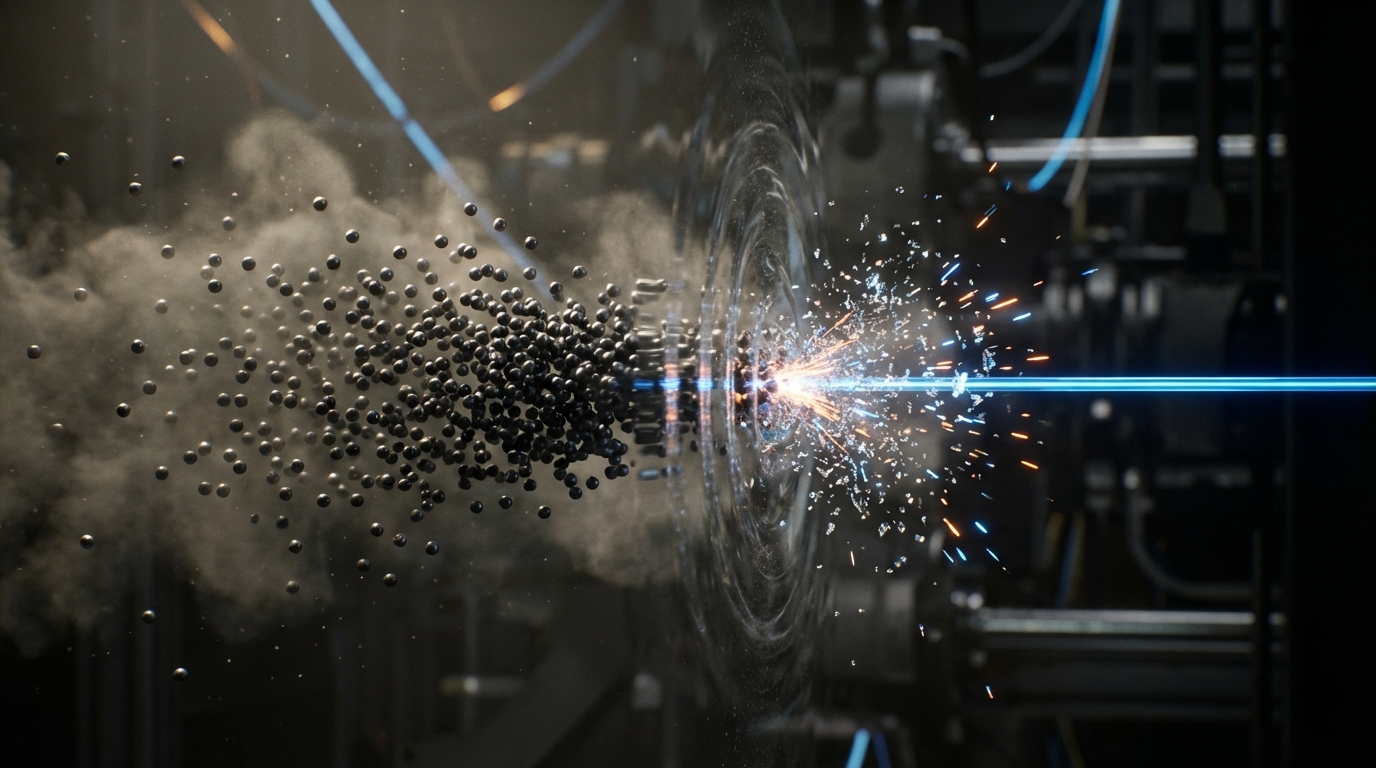
11.5 Laser Weapons: Future Hope?
High Energy Lasers (HEL) are theoretically the nemesis.
-
Pros: Speed of light engagement, precision.
-
Cons:
-
Detection: The laser system must first "see" the target. Fiber drones have tiny Radar Cross Sections (RCS) and emit no signals. Passive optical detection against complex backgrounds is difficult.
-
Weather: Fog and smoke (battlefield staples) attenuate laser energy significantly.
-
Cost: Trading a $5 million laser system for a $500 drone means the defender has already lost the economic war.
-
11.5.1 Light vs. Light: The Laser Defense Paradox
Although lasers are the nemesis, fiber drones are not defenseless.
-
Physical Confrontation: High Energy Lasers (HEL) can burn through fiber in milliseconds. If the beam sweeps across that thin line, it's game over.
-
Counter Tactic: "Rolling Airframe".
-
Principle: If you're afraid of being focused and burned, spin.
-
Like Rotisserie: The pilot (or flight controller) commands the drone to roll at 3-5 revolutions per second around its axis.
-
Effect: The laser energy cannot focus on a single point on the fuselage but is distributed across the entire cylindrical surface. This significantly extends the burn-through time (from 0.5s to 3s), buying the drone the final moments needed for impact.
-
Fiber Implication: Since the fiber is attached to the tail, rolling the body twists the fiber. The solution is a "Fiber Optic Slip Ring", allowing the fiber to rotate freely relative to the fuselage without knotting.
-
11.6 Microwave Weapons: The Only Electronic Solution?
If lasers are tricky, what high-tech option is left? The answer is High Power Microwave (HPM), like the Epirus Leonidas system.
-
Principle: While the fiber itself is an insulator and immune to EMP, the two ends connected by the fiber—the drone and the ground station—are full of sensitive electronics.
-
Kill Mechanism: HPM fires intense microwave beams that induce currents directly in the drone's circuit boards, instantly frying the flight controller and ESCs.
-
Pros:
-
Area Denial: Unlike lasers which need precise pointing, HPM is a sector weapon, great against swarms.
-
Ignores Camouflage: No matter the paint job, the metal in the circuits will couple with the microwaves.
-
-
Cons:
-
Range: Effective range is usually shorter than lasers.
-
Fratricide: If you accidentally sweep your own comms antenna, it's toast too.
-
11.7 Passive Defense: Bunkers & Camouflage
Since you can't stop it, don't let it see you, or don't let it penetrate.
-
Chain-link Fence: The cheapest, most effective defense.
-
Mechanism: FPV triggers are usually impact-based (two copper wires touching). If it hits a fence, the fuse might pass through the mesh without triggering, or detonate 1 meter away from the armor (degrading the shaped charge jet).
-
Deployment: Erect double-layer fences around tanks and artillery, at least 1 meter from the hull.
-
-
Thermal Smoke:
-
Fiber drones rely on optical/thermal cameras. Thick thermal smoke blocks the line of sight, turning the pilot blind. This is the only way to "jam" a fiber drone—not by jamming the signal, but by covering its eyes.
-
Next Chapter Preview: The war is over, but the trouble has just begun. Thousands of kilometers of fiber are left in fields, forests, and rivers. Will they degrade? Will they strangle wildlife? Chapter 12: Environmental Impact.
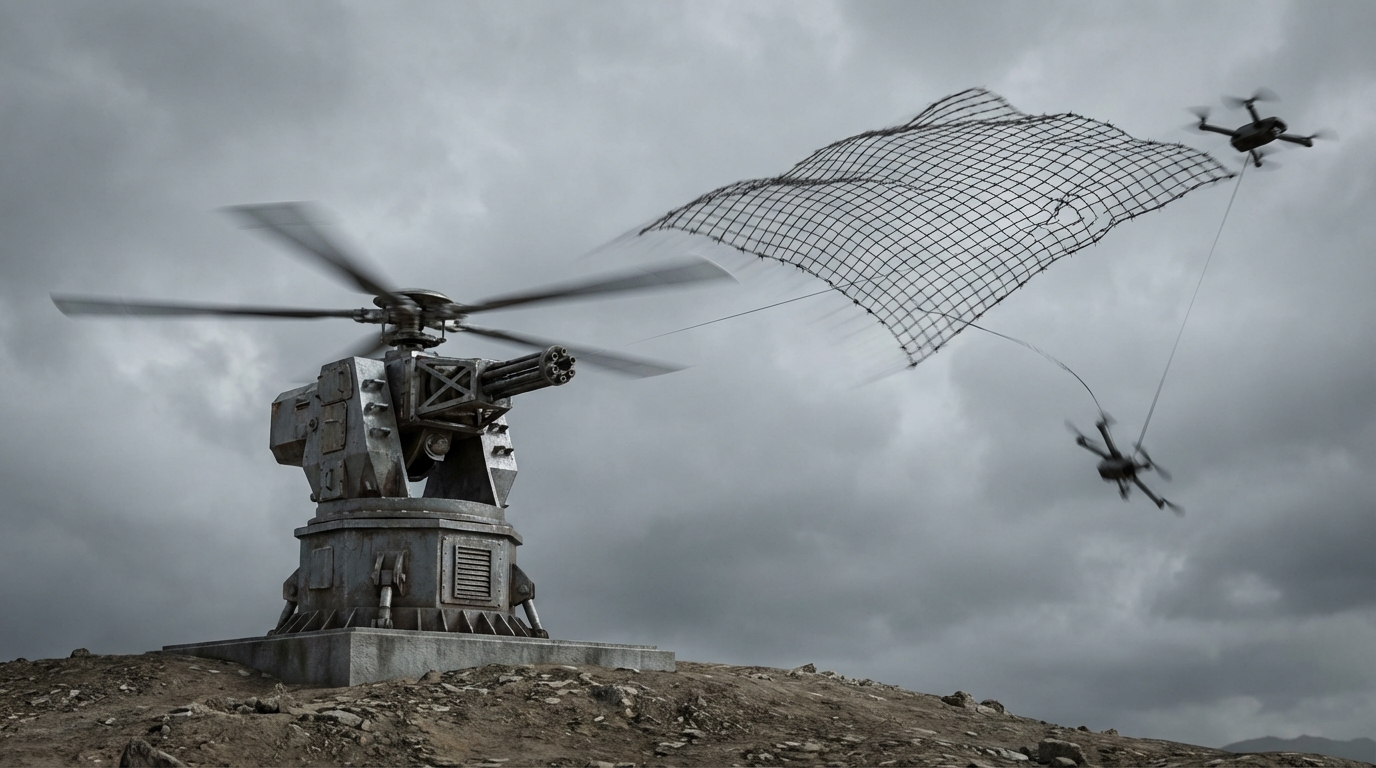
Volume 4: Defense & Countermeasures
Contact Now to Buy G.657.A2 Fiber
Chapter 12: Environmental Impact & Post-War Cleanup
Core Argument: Wars eventually end, but the legacy of fiber drones—thousands of kilometers of tough, transparent, non-degradable "glass threads"—will become a nightmare for post-war reconstruction for years. This is not just a litter problem; it is a novel ecological and agricultural disaster.
12.1 The Spiderweb Effect
Imagine a month of high-intensity trench warfare where both sides launch 1,000 fiber drones. Each drone drags 10km of fiber. This means 10,000 kilometers of fiber are densely packed into a few square kilometers of battlefield.
-
Invisible Traps: Most of this fiber lands in grass, tree canopies, rivers, and ruins. Being only 250 microns thin and transparent, it is invisible to the naked eye.
-
Persistence: The core is silica glass, and the coating is acrylic resin. Neither degrades easily in nature. Without intervention, they can persist for centuries.
12.2 The Agricultural Nightmare: Harvester Killer
When farmers try to return to this land, they will find fiber to be a bigger headache than mines.
-
Mechanical Killer: While fiber snaps easily under tension, the physics change when it gets wrapped into high-speed machinery (like combine harvester headers or rotary tiller shafts).
-
Accumulation: Kilometers of fiber instantly wrap into a tight, hard puck.
-
Friction Heat: High-speed friction melts the coating, fusing it to bearings or oil seals, causing mechanical failure or even fire.
-
-
Livestock Ingestion: Cattle and sheep grazing can easily ingest fiber mixed with grass. The glass threads can cause perforation or internal bleeding in the digestive tract.
12.3 Wildlife Calamity
The battlefield is also a habitat.
-
Birds: Fiber draped between tree canopies acts like an invisible mist net. Birds flying into it can have their wings sliced off or become entangled and die.
-
Small Mammals: Rabbits and foxes running through the brush can get their limbs snagged, leading to necrosis.
12.3.1 Bio-Entanglement Mechanics: When Fiber Meets Wings
This is not just about "getting tangled"; it is a brutal physics problem.
-
Tensile Strength vs. Contact Area:
-
Modern military fiber has extremely high tensile strength (exceeding steel of the same diameter).
-
Its diameter is only 250 microns.
-
According to the pressure formula P=F/A, when the contact area A is minuscule, the pressure P becomes immense.
-
-
The Guillotine Effect:
-
When a bird flying at 50 km/h hits a suspended fiber, the fiber does not snap like cotton thread, nor does it merely tangle like a nylon rope.
-
It becomes a saw.
-
The massive kinetic energy is focused on a 0.25 mm contact surface, generating astonishing Shear Force.
-
Consequence: The fiber instantly slices into the bird's muscle or even bone. For small flying animals like bats or swifts, this often means Amputation.
-
12.4 Cleanup: Mission Impossible
How do you clean this up?
-
Manual Recovery? Impossible. You cannot send people to reel back every hair-thin thread.
-
Burning? Only burns the coating; the glass thread remains.
-
The Only Solution: Biodegradable Technology.
-
This is why we mentioned in Chapter 7 that next-gen fiber drones must mandate PLA (Polylactic Acid) or photo-degradable coatings. This is not just environmentalism; it's to prevent post-war reconstruction from bogging down.
-
12.5 Water Pollution
If fiber drones are used in naval or river-crossing operations (like Ukraine's Dnipro actions):
-
Net Entanglement: Sunk fiber entangles with fishing nets, rendering gear useless.
-
Microplastics: As water currents break down the coating, it fragments into microplastics, entering the aquatic food chain.

12.6 Invisible Sparks: Triboelectric Effect & Lightning Paradox
The environment is not just a passive victim; it strikes back. Under specific meteorological conditions, the fiber itself becomes a lethal physical trigger.
12.6.1 Triboelectric Effect
When fiber peels off the spool at high speeds (20m/s - 50m/s), the acrylic coating rubs violently against the binding agent inside the spool.
-
Voltage Accumulation: Although fiber is an insulator, this high-speed peeling generates static voltage reaching tens of thousands of volts (similar to a Van de Graaff generator).
-
Consequences:
-
Ground Station Crash: If the ground station is not properly grounded, the accumulated charge seeks a discharge path, often arcing through the optical module or freezing the flight controller.
-
Dust Magnet: Charged fiber aggressively attracts airborne dust, which is fatal to precision optical interfaces.
-
12.6.2 The Lightning Paradox
People often say: "Fiber is non-conductive, so it's immune to lightning." This is FALSE, at least in the rain.
-
Water Film Conductor: In rain or high humidity, a continuous film of water adheres to the fiber surface.
-
Lightning Rod: While the glass core doesn't conduct, this kilometers-long water film acts as a perfect conductive path. When the drone flies under a charged cloud, the fiber becomes a "Lightning Rod" connecting sky and ground.
-
Tactical SOP:
-
No-Fly Zone in Thunderstorms: Not just because of wind, but because a lightning strike will send high voltage down the water film directly into the ground control station, exploding equipment or electrocuting the operator.
-
Emergency Cut: If caught in a sudden thunderstorm, cut the fiber immediately and move away from the severance point.
-
12.7 Physical States of Water: Capillary Lock & Low-Temp Micro-bending
The threat of rain to fiber drones is far more complex than just "getting wet."
12.7.1 Capillary Lock
If rain penetrates the spool canister, disaster strikes.
-
Physics: The gap between fiber layers is microscopic. Water entry forms a Capillary Bridge. Surface tension acts like glue, bonding multiple layers together.
-
Consequence: When the drone pulls the fiber, it doesn't get a single strand but a stuck "clump" of fibers. The sudden tension spike causes an immediate break.
-
Countermeasure: The spool must have a Hydrophobic Coating, and the payout exit must be sealed with a rubber gasket.
12.7.2 Micro-bending Loss from Ice
In cold, high-humidity environments (like flying through clouds), the water film on the fiber surface freezes.
-
Micro-bending Effect: Ice expansion exerts uneven pressure on the fiber. While G.657 fiber is bend-resistant, on a microscopic scale, the core suffers from countless stress points, causing light scattering loss.
-
Symptom: The video feed pixelates or freezes. This is often mistaken for range limits, but in reality, the ice is "choking" the light path.
12.8 The Aerodynamic Curse: Catenary & Drag Wall
Fiber drones cannot fly fast (usually < 100km/h). This is not just because of weak motors, but because of what they are dragging behind them.
12.8.1 The Catenary Effect
The fiber does not stretch in a straight line behind the drone; gravity pulls it into a sagging Catenary Curve.
-
Equation: $y = a \cosh(x/a)$.
-
Consequence: The weight of the fiber (though only 1kg/10km) creates a significant vertical component over long distances. The drone must lift not only itself but also the suspended weight of kilometers of fiber.
12.8.2 The Drag Wall
Even scarier is aerodynamic drag.
-
Parachute Effect:
-
Although the fiber diameter is only 0.25mm, at a length of 5000m, its theoretical maximum projected area is $5000 \times 0.00025 = 1.25 m^2$.
-
This is equivalent to dragging a drogue parachute with a 1.2m diameter!
-
While the fiber is mostly parallel to the airflow (skin friction dominates), in Crosswind conditions, it acts like a giant sail.
-
-
Crosswind Drift:
-
When a crosswind hits this 5km "sail," it generates massive lateral force.
-
The flight controller must constantly bank the drone into the wind to fight this "phantom force." This explains why fiber drones consume drastically more power in strong crosswinds.
-
Next Chapter Preview: The technology and tactics are covered. If you see a business opportunity and want to know where this gear comes from? Who makes it? Volume 5: Market & Future will unveil the global supply chain. Chapter 13: Who is Selling? Supply Chain Exposed.

Volume 5: Market & Future
Contact Now to Buy G.657.A2 Fiber
Chapter 13: Supply Chain Exposed
Core Argument: Behind the fiber drone war is not a game of high-tech chips, but a contest of basic industrial capacity. The winner of this war was decided in the industrial parks of Shenzhen and Wuhan long before the first drone took off.
13.1 Profiles of Key Players
In this opaque market, beyond the traditional raw material giants, a new breed of system integrators has emerged to define the battlefield.
13.1.1 The Universal Arsenal: Skywalker Technology (China)
-
Location: Wuhan, China
-
Role: The "Toyota Hilux" of the FPV world.
-
Product: They don't make the fiber, but they set the "Fiber Module" industry standard.
-
Best Sellers: 1km, 5km (0.59kg), 10km (~1.2kg), 20km and even 30km universal spool modules.
-
Strategy: Extremely pragmatic. Their modules mount on any quad or fixed-wing. Multiple teardown reports of the Russian "Prince Vandal" (KVN) drone indicate its core transmission module is identical to Skywalker's civilian export product.
-
Profiteering Revealed: A standard fiber module exports for about $2,000, but after rebranding and entering the Russian military procurement list, the price skyrockets to $17,000.
-
-
-
Status: Currently the world's largest "invisible" supplier.
13.1.2 The Western Counterattack: Neros Technologies (USA)
-
Location: Los Angeles / Israel
-
Flagship: Archer Fiber.
-
Differentiation:
-
Compliance: It is the first fiber drone to pass the US DoD NDAA compliance and make the BlueUAS list. This means it can be legally procured by the US and allies, free of restricted Chinese components.
-
Specs: 20km range, 2kg payload, ~$5,000 unit price.
-
Positioning: Filling the gap between "expensive missiles" and "jammable radio drones."
-
13.1.3 The European Precision: HighCat (Germany)
-
Location: Konstanz, Germany
-
Flagship: HCX.
-
Tech Style:
-
Cassette Spool: Uses a unique enclosed design, claiming to prevent tangles and theoretically support "rewinding" (though rarely used in combat).
-
Heavy Lift: HCX is a heavy lifter (5.5kg payload), carrying not just bombs but high-precision thermal cameras.
-
Bandwidth: Emphasizes a 1000 Mbps pure data link for lossless recon.
-
13.1.4 The Raw Material Kings: GL FIBER, Zion & The Big Three (China)
-
Role: The Source Factories.
-
Power: Located in China's fiber industrial belt, alongside active exporters like GL FIBER and Zion, global giants like YOFC, FiberHome, and Hengtong control the core capacity for G.657.A2 preform and drawing. Whether it's the Russian "Prince" or a Western startup, if you unwind the spool, the glass inside likely shares this lineage. They define the cost baseline of "$3 per km."
13.1.5 System Parameter Comparison Table
| System Name | Developer | Range | Payload | Key Feature | Status |
|---|---|---|---|---|---|
| Prince Vandal (KVN) | NPC Ushkuy (RU) | 10-20 km | ~3 kg | Core components from Skywalker, 10x markup | Active |
| Archer Fiber | Neros Tech (US) | 20 km | 2 kg | NDAA Compliant, BlueUAS, Made in USA | Production |
| HCX | HighCat (DE) | 20 km | 5.5 kg | Cassette Spool, Heavy Lift, Gigabit Link | Prototype |
| Skywalker Module | Skywalker (CN) | 1-30 km | Variable | Universal Export Component, 5km is just 0.6kg | Export |
| Anduril Bolt-M | Anduril (US) | Undisclosed | Undisclosed | AI/Fiber Hybrid Potential | In Dev |
13.2 The Suffocating Data Gap
Based on public customs import/export data (2023-2024), we see a staggering contrast that reveals the essential difference in logistical capabilities between the warring sides.
-
Russia (The Russian Sponge):
-
Import Volume: 328,000 miles (approx. 520,000 km).
-
Procurement Model: State-Level Centralized Procurement. Shell companies under the Ministry of Defense place massive orders directly, sometimes booking a factory's capacity for six months.
-
Result: Frontline Russian soldiers use fiber drones like "disposable chopsticks," with zero hesitation.
-
-
Ukraine (The Ukrainian Drip):
-
Import Volume: Directly recorded only 72 miles (approx. 115 km).
-
Procurement Model: Ant Colony Strategy. Reliance on thousands of volunteers, charity foundations, and small startups making fragmented purchases under the guise of "civilian communication equipment."
-
Result: Although the total volume is significant, there is no unified standard. Frontline units receive a chaotic mix of spool specs—some fly 10km, others snap at 2km—severely impacting tactical stability.
-

13.3 The "Razor and Blade" Business Model
Why are these manufacturers so keen on producing fiber drone accessories? Because it is a far more profitable business than selling the drones themselves.
-
The Drone is the Razor: A drone sells for $500, with maybe $50 profit. And the aircraft is recoverable (if it doesn't explode).
-
The Spool is the Blade: A 10km spool sells for $150, with a profit up to $100. More importantly, it is an absolute consumable.
-
Fly once, toss one spool.
-
Even if the flight isn't finished, the remaining fiber is cut and discarded (for safety).
-
-
Repeat Purchase Rate: An active drone operator team might consume 10-20 spools a day. For the factory, this means a continuous stream of cash flow. This is far more lucrative than selling durable "DJI" drones.
13.4 Grey Logistics: How to Ship 10,000km of Fiber?
Fiber is a dual-use item, subject to export controls in some countries. But in reality, due to its strong civilian nature, a blockade is nearly impossible.
13.4.1 Camouflage Techniques
-
Declared Names:
-
"Fishing Line": The most common disguise. High-strength fiber looks and feels shockingly similar to deep-sea fishing line.
-
"Optical Testing Spool": Consumables used for OTDR blind zone testing in telecom engineering. This is a completely legal industrial use.
-
"3D Printer Filament": Although the material is different, under an X-ray machine, the shape of the spools is hard to distinguish.
-
13.4.2 Circuitous Routing
-
Hubs: Kyrgyzstan, Kazakhstan, Turkey.
-
Modus Operandi: Goods are shipped from Shenzhen to Bishkek (Kyrgyzstan), take a "one-day tour" in a bonded warehouse there to get local labels, and then move by rail to Moscow. For Ukraine, it enters via thousands of civilian pickup trucks across the Polish border as "humanitarian aid."
13.5 The Price Black Box: The War Tax
For the exact same 10km spool of fiber:
-
Factory Price (Shenzhen): $25 - $30
-
Wholesale Price (Alibaba): $45 - $60
-
Retail Price (AliExpress/Amazon): $130 - $180
-
Gov Procurement Price (Western Defense Contract): $1,200+
Where did this 40x price difference go?
-
Compliance Costs: Western contractors need to pass tedious MIL-SPEC certifications (even if the item is identical).
-
Middlemen: Every layer of hands (logistics, customs, kickbacks) takes a cut.
-
Risk Premium: No one knows if policies will change tomorrow, so today's profit must cover tomorrow's risks.
13.6 The Invisible Bottleneck: FPGA Shortage & Ferrule Tolerance
Don't assume that having fiber is enough to fly. The real supply chain crisis lies in two seemingly insignificant details.
13.6.1 The Vanishing FPGA
Fiber itself is just a pipe. To run video signals through it, you need "Optical Transceivers" at both ends.
-
Core Component: Inside every pair of transceivers, there must be an FPGA chip (Field Programmable Gate Array) to handle high-speed video encoding/decoding (HDMI $\leftrightarrow$ Optical Signal).
-
Mainstream Models: Xilinx Spartan-6, Artix-7, or Lattice ECP5.
-
The Crisis: These chips are strictly controlled "dual-use items." Due to global wafer capacity tightness plus sanctions on Russia, these older, low-end FPGAs have become hard currency.
-
Black Market Price: A chip that used to cost $5 is now scalped at $40 in Moscow electronics markets—and is still out of stock.
-
The Choke Point: Many factories have mountains of spools, but because they can't buy FPGAs to make transceivers, they can't ship. Fiber isn't the bottleneck; the modem is.
-
13.6.2 The 0.5 Micron Trap of Ceramic Ferrules
The fiber connector looks like a cheap plastic part, but the core is the white Zirconia Ceramic Ferrule in the middle.
-
Civilian Standard (Telecom Grade): Concentricity error 1.0 - 1.4 µm. Yield 99%, cheap.
-
Military/Drone Standard (Elite Grade): Requires concentricity error $\le$ 0.5 µm.
-
Why: Under violent drone vibration, if the fiber cores (only 9 µm diameter) misalign by more than 1 µm, signal loss instantly increases by 3dB (signal power halved). At a limit distance of 20km, this 3dB is the difference between "clear video" and "snow."
-
Cost Curve: To achieve 0.5 µm, the yield of ceramic ferrules plummets from 99% to 30%. This means for every qualified high-end connector you buy, you are paying for two scraps.
-
The Pitfall: Many cheap suppliers pass off 1.0 µm civilian ferrules as military grade, causing drones to mysteriously lose video at 10km. Operators check every circuit but find nothing, never realizing the connector was off by 0.8 microns.
-
Next Chapter Preview: Now that you know who is selling, as a buyer (whether you are a reseller looking for business or a geek doing research), where do you buy to avoid getting scammed? How do you distinguish real G.657.A2 from fake? Chapter 14: Buyer's Guide & Anti-Scam Manual.
Volume 5: Market & Future
Contact Now to Buy G.657.A2 Fiber
Chapter 14: Buyer's Guide & Anti-Scam Manual
Core Argument: In this Wild West market, if you don't know the ropes, you might not be buying a "winning weapon" but a pile of expensive scrap glass. This chapter is your million-dollar "Anti-Pitfall Guide."
14.1 Sourcing Channels: Where to Find the Goods?
Depending on your volume, the procurement path differs drastically.
14.1.1 The Geek / Sample Testing (1-10 Spools)
-
Channel: AliExpress or eBay.
-
Search Keywords: Do NOT search for "Drone Fiber" (inflated prices).
-
Search "G.657.A2 bare fiber spool".
-
Search "FTTH drop cable repair spool".
-
-
Expected Price: $130 - $180 / spool (10km).
-
Risk: Slow shipping, high chance of getting old stock (brittle coating).
14.1.2 The Squad / Batch Procurement (100-500 Spools)
-
Channel: Alibaba (B2B).
-
Strategy: Contact factories in "Hunan" or "Shenzhen" directly. 80% of China's fiber capacity is in Wuhan and Hunan, while spool winding is mostly done in Shenzhen.
-
Expected Price: $45 - $60 / spool.
-
Negotiation Tactics:
-
Ask for OTDR Test Reports.
-
Require "Vibration Proof Packaging".
-
14.1.3 State-Level / Arms Dealer (10,000+ Spools)
-
Channel: Factory Direct.
-
Strategy: You need to set up an office in Shenzhen and station QC (Quality Control) agents on the production line.
-
Customization: Ask the factory to add specific Color Markers to the fiber coating (e.g., changing color every 1km) so pilots can visually judge remaining distance.
14.2 Fatal Traps: How Scammers Ruin Your Mission
14.2.1 The "G.652" Imposter
This is the most common scam.
-
Mechanism: G.652.D is the cheapest standard telecom fiber. It loses signal if bent slightly. G.657.A2 is special bend-insensitive fiber that works even when knotted.
-
Consequence: The moment the drone turns, the fiber forms a small bend at the tail, and the video feed goes black instantly.
-
Identification (The Pencil Test):
-
Wrap the fiber tightly around a pencil (7-8mm diameter) for 5 turns.
-
Shine a Visual Fault Locator (Red Laser).
-
G.652: Light leaks heavily from the bend; the other end is dim.
-
G.657.A2: Almost no light leakage; the other end remains bright red.
-
Advanced Trap: Some sellers sell G.657.B3 as A2. B3 has better bend resistance but a smaller Mode Field Diameter (MFD), which mismatches your optical module, causing high splice loss. Demand an MFD report: must be 8.6–9.2 µm.
14.2.2 The "Patch Cord" Trap
-
Trap: Some sellers sell 0.9mm Tight Buffer Fiber (with thick PVC jacket).
-
Consequence: Too heavy! A 10km spool of 0.9mm fiber weighs 8kg. No drone can drag that.
-
Solution: You MUST buy 250µm (0.25mm) Bare Fiber. 10km weighs only 1.1kg.
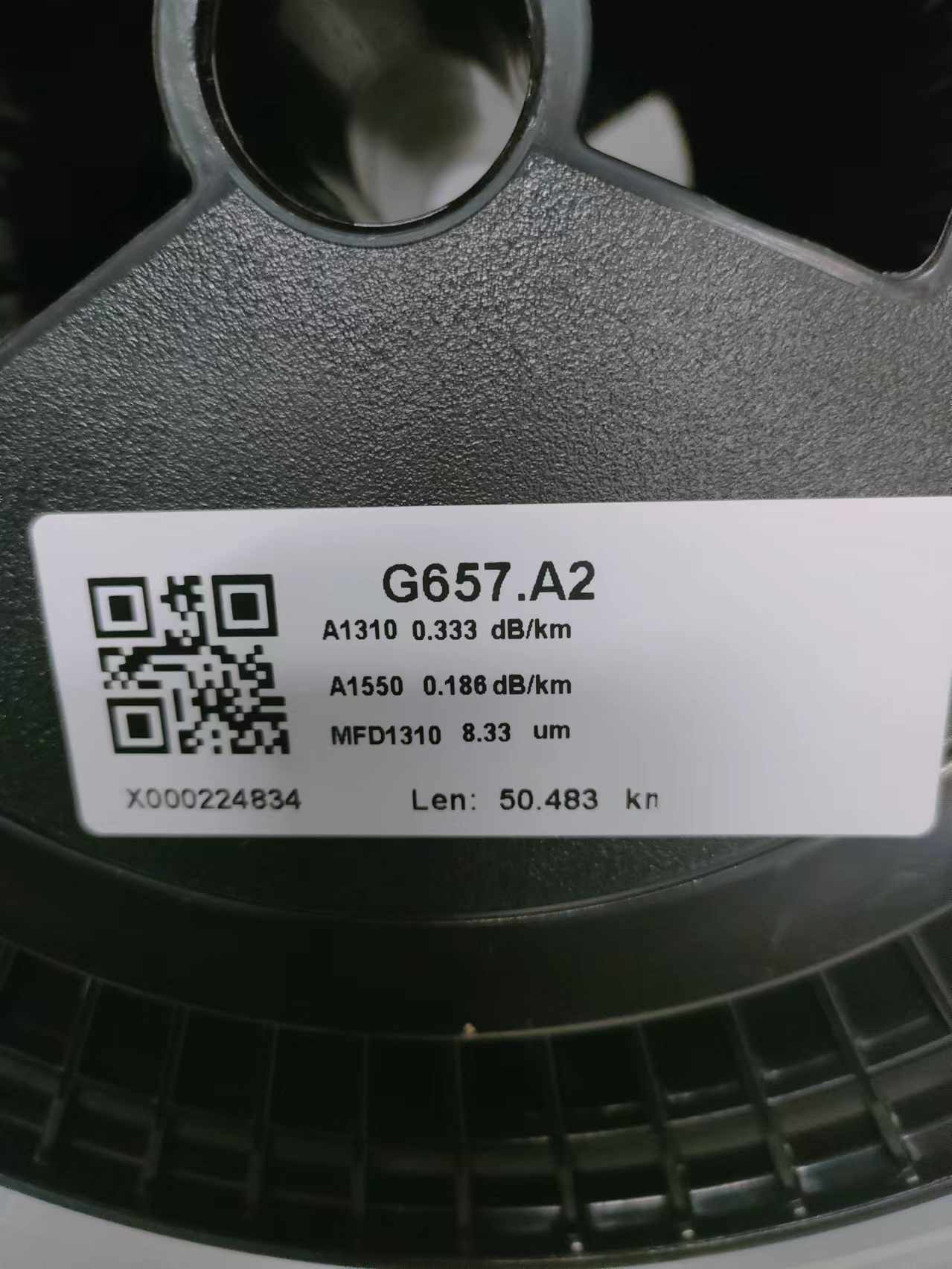
14.2.3 The "DIY Winding" Delusion
-
Myth: "Fiber is cheap, spools are expensive. Can I buy loose fiber and wind it with a drill?"
-
Answer: ABSOLUTELY NOT.
- Precision Cross Winding: Strict algorithms for tension and angle per layer to prevent embedding.
- Pre-Twist: This is the core secret. The factory winder twists the fiber backward for every loop. This ensures it doesn't knot when peeled from a static spool. Your DIY winding will snap due to Self-Spin Torque within 100 meters.
Consequence: 100% Crash. Do not challenge physics.
14.2.4 Destructive Testing: Unmasking the Fakes
The Pencil Test only distinguishes G.652 from G.657, but it cannot weed out "recycled materials" or "inferior coatings." You need a set of military-grade Destructive Testing Protocols.
Freezer Bending Test (-40°C):
Method: Freeze the fiber in a household freezer for 4 hours, then immediately wrap it around a 5mm diameter screwdriver.
Phenomenon: The acrylate coating of inferior fiber will shatter and flake off like potato chips, exposing the bare fiber to breakage. High-quality fiber coating remains tough.
Pressure Cooker Aging (PCT):
Principle: Simulates 20 years of damp-heat aging.
Method: Steam in a pressure cooker at 120°C for 1 hour.
Criteria: Test attenuation after removal. If loss increases by more than 0.05 dB/km, or the coating turns white/sticky, it is inferior glue from a small workshop.
Ultimate Tensile Test:
Pull a piece of fiber by hand. G.657.A2 bare fiber should withstand about 1kg (9N) of tension. If it snaps with a gentle tug, it is moisture-damaged old stock.
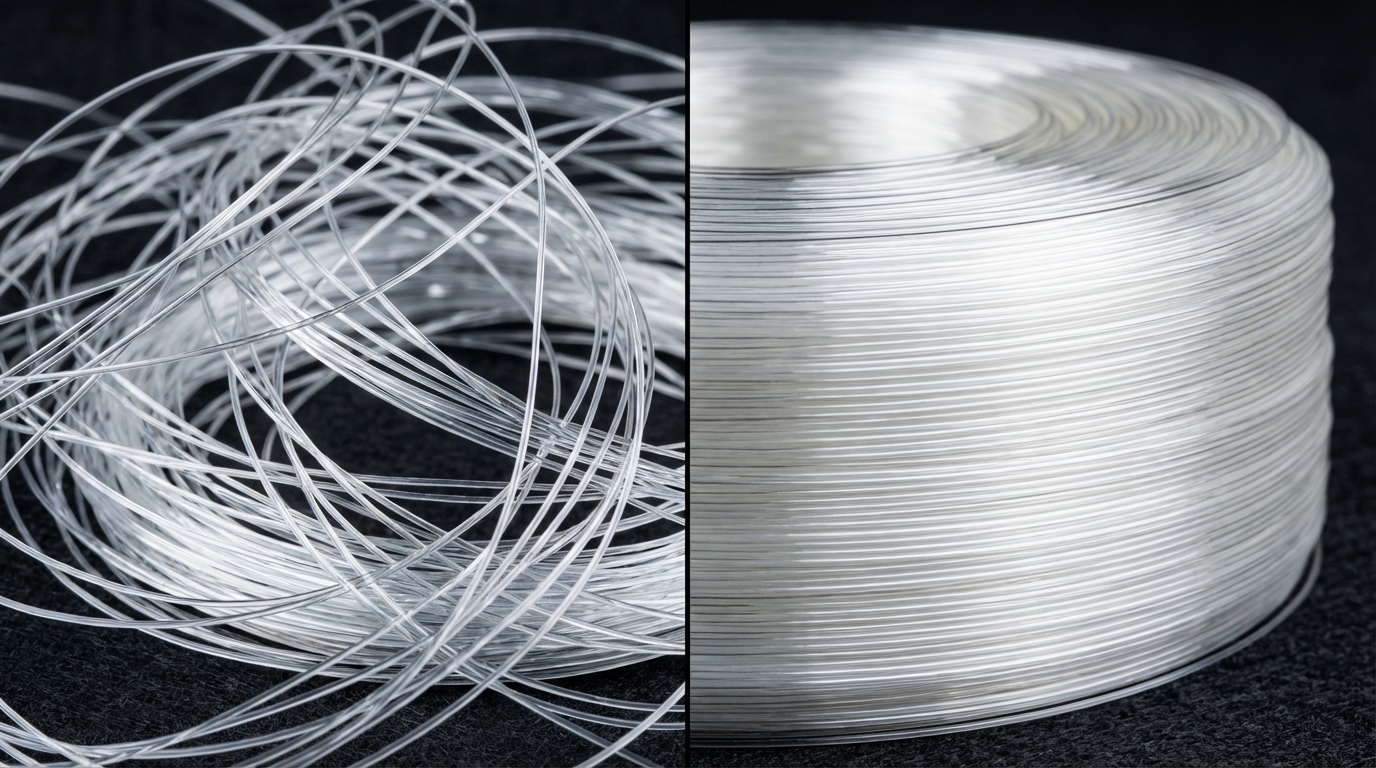
14.3 Spec Checklist
Check this list item by item before placing an order:
| Parameter | Recommended | Avoid | Notes |
|---|---|---|---|
| Fiber Type | G.657.A2 | G.652.D, OM3 | Must be Bend-Insensitive |
| Mode Field Dia. | 8.6 - 9.2 µm | < 8.0 µm | Critical for low loss |
| Coating Dia. | 245-255 µm | 900 µm | Thinner is lighter |
| Winding Tech | Pre-Twisted | Flat Winding | Verify with factory |
| Spool Weight | 1.3 kg (10km w/ shell) | > 2.0 kg | Heavy spools kill range |
| Connector | LC/APC (Green) | SC/UPC (Blue) | Green has lower return loss & tighter latch |
| Payout Tension | < 0.5 N | > 1.0 N | Also called "Release Force", lower is better |
14.4 Logistics & Customs Codes
HS Codes:
8544.70.00: Optical fiber cables (Standard, but flagged).
9001.10.00: Optical fibers, bundles (Optical equipment, different tax).
3916.90.90: Monofilament (Plastic thread, bypasses fiber checks, high risk).
Sensitive Labels:
DON'T: "Drone Part", "Military Grade", "Weapon Accessory".
DO: "Communication Repair Kit", "Fishing Line Spool", "Surveying Tool".
14.5 Price Wars: The Neros Case Study
The US DoD complains fiber drones are too expensive ($17,000+). But a US startup named Neros claims to push the cost under $2,000. How?
De-Militarization:
Traditional: Uses $500 FPGA chips for image processing.
Neros: Uses $1 Parking Meter Chips. Weak computing power, but enough for simple video streams.
Connector-less Design:
Traditional: Uses $50 aviation plugs.
Neros: Solders the fiber directly to the PCB and seals it with glue. It's disposable, who needs a plug?
Conclusion: A fiber drone is not a space shuttle; it is a flying artillery shell. Extreme cheapness is its core combat capability.
14.6 Connector Hygiene: The Physics of End-Face Contamination
Many teams spend a fortune on the best fiber, only to be ruined by a 1.25mm ceramic ferrule.
14.6.1 The Scale of Dust
Core Diameter: 9 µm.
Common Dust: 2-10 µm.
Consequence: A speck of dust on the fiber end-face is like a boulder blocking a tunnel. It’s not just about blocking the signal; the real killer is Fresnel Reflection.
Clean Contact: Return Loss < -60dB (APC).
Air/Dust Gap: Return Loss spikes to -14dB. The intense reflected light acts like a "backfire," overheating or even destroying the laser source.
14.6.2 The "Fiber Fuse" Effect
A terrifying and little-known physical phenomenon.
Trigger: If the end-face has contamination (like oil), high-power laser light is absorbed by the dirt and converted into heat.
Chain Reaction: Once the temperature exceeds 1000°C, the fiber core begins to melt. This melting propagates backward toward the laser at 1 meter/second, burning the entire link like a fuse.
Outcome: You think it's just dirty, but the whole cable is toast.
14.6.3 Battlefield Cleaning SOP
TABOO: NEVER wipe fiber connectors with your shirt or tissues! Fabric fibers act like steel wool on glass, scratching the end-face instantly.
Mandatory Gear:
One-Click Cleaner: Specifically for 1.25mm LC connectors.
Lint-Free Wipes + 99% Alcohol: For cleaning bare fiber.
Dust Caps: Cap it immediately after unplugging. This is battlefield discipline.
14.7 Negotiation Tactics: Hidden Clauses
Some traps aren't in the product, but in the contract and logistics.
14.7.1 The Air Freight Trap
The Trap: Fiber is light, but spools are bulky. If you don't specify packaging, factories ship in individual cardboard boxes.
The Consequence: Volumetric weight skyrockets. Air freight might cost more than the goods.
The Tactic: For bulk orders (>100 units), demand "Blister Tray Industrial Packing". 10 units per layer, tightly stacked. Saves 30% on shipping.
14.7.2 The "Golden Sample" Bait
The Trap: The sample you got was wound slowly by a master technician. Mass production is wound at high speed by shift workers.
The Consequence: Mass production suffers from "Edge Collapse," where fiber gets stuck in the spool edges, snapping after a few hundred meters.
The Tactic: Contract must specify "Winding Speed < 800m/min" and "Full refund if Edge Collapse rate > 1%".
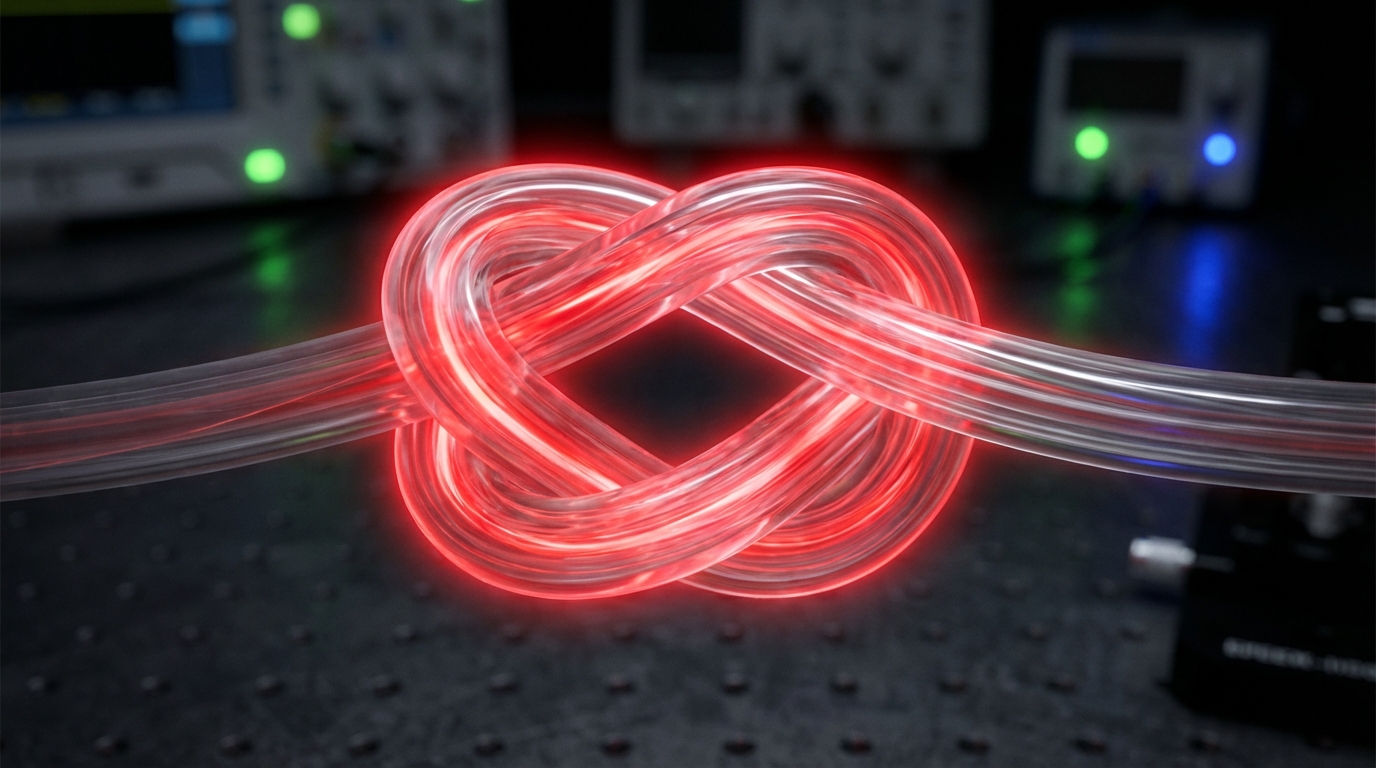
14.7.3 The Silent Substitution
The Trap: Batches 1 & 2 used premium glue. Batch 3 quietly switches to cheap glue.
The Tactic: Retain and Compare. Cut a sample from every batch and run PCT (Pressure Cooker Test) against the initial "Golden Sample".
Next Chapter Preview: Finally, let's look to the future. Can these spools be reused? If the fiber breaks, can AI take over to kill the target? Chapter 15: Future Trends & Final Form.
Volume 5: Market & Future
Contact Now to Buy G.657.A2 Fiber
Chapter 15: Future Trends & Final Form
Core Argument: The fiber drone is not a regression of history, but the starting point of an upward spiral. When physical connection meets Artificial Intelligence, we will welcome a "Flawless Assassin" that cannot be jammed and cannot be stopped.
15.1 Recycling: What to do with the used spool?
A frequently asked question: "After the mission, can I rewind that 10km of wire and use it again?"
The Brutal Answer: No.
Irreversible Deformation: The fiber undergoes immense stress during high-speed payout. Even if it didn't snap, micro-cracks have formed inside the glass structure.
Rewinding Cost: To re-spool 10km of fiber with precision requires a $50,000 industrial winding machine, and the success rate is low.
Conclusion: Fiber drones are typical "consumables". It's like a fired bullet; no one picks up the shell casing to reload it with gunpowder on the battlefield.
Future Direction: Biodegradable Fiber.
PLA (Polylactic Acid) coatings are being tested in labs. While they can't solve the non-degradable glass core issue, they can at least make the waste wire brittle and breakable after a few years, reducing harm to birds and harvesters.
15.2 The "Mothership" Tactic: Aerial Fiber Relay
Current fiber drones are limited by 10km of cable, only able to strike frontline targets. How to hit enemy logistics centers 20km or 50km away?
Concept: Aerial Spool Mothership.
Step 1: A large multi-rotor (Mothership) carrying 20km of fiber takes off and hovers 500m above friendly lines. It connects to the ground station via fiber.
Step 2: The Attack Drone (Child) is docked under the Mothership.
Step 3: The Mothership releases the Child. The Child itself carries another 10km of fiber.
Step 4: The Child flies to the target. The signal link is now: Ground -> Mothership Fiber -> Mothership Relay -> Child Fiber -> Child.
Advantages:
Range Doubled: Theoretical strike radius extends to 30km+.
Obstacle Crossing: The Mothership provides a high vantage point, helping the Child bypass mountains and forests, solving the issue of fiber snagging on trees.
15.3 AI Takeover: The "Last Three Seconds"
Currently, if the fiber breaks, the drone goes blind. But in the future, a break might just be the start of the attack.
Terminal Guidance:
The pilot selects a target (e.g., a tank) on the screen 10 seconds before the fiber breaks.
The onboard NPU (even a cheap parking meter chip) locks onto the pixel features of the target.
Moment of Breakage: The drone automatically switches to AI mode. Although the video feed is lost, it will lock onto that pixel box and ram into it at full speed.
Significance: This will completely eliminate the fiber drone's biggest weakness—vulnerability in the final phase.
15.4 The Final Form: Hybrid of Fiber and Swarm
If we look further ahead, what is the ultimate form of the fiber drone?
It is the "Tethered Swarm".
Scenario:
A truck launches 10 fiber drones.
They do not communicate via radio, but via Air-to-Air Photonic Links (Laser Comm) or physical fiber interconnections.
The ground commander possesses not 10 separate screens, but a real-time, zero-latency, unjammable 3D battlefield hologram.
Outcome:
Electronic Warfare equipment becomes scrap metal.
Warfare returns to the most primitive slaughter: Whoever has stronger industrial capacity, whoever produces more "glass threads," will drown the opponent.
15.5 Optical Fiber as Sensor: Distributed Acoustic Sensing (DAS)
Don't forget, fiber is not just a pipe for data; it is also a 10km long "stethoscope."
Principle: Rayleigh Backscattering.
As light travels through the fiber, some photons are scattered back by impurities.
If the fiber experiences tiny vibrations along its path (e.g., footsteps, tank engines), the fiber deforms at the nanometer scale, changing the phase of the backscattered light.
By analyzing these changes, we can pinpoint the location of the vibration source (with 1-meter accuracy).
Tactical Brainstorm: Trash to Treasure.
When the fiber drone completes its mission (or crashes), as long as the fiber is intact, it lies across enemy lines.
Now, unplug the modem at the ground station and plug in a DAS Interrogator.
Transformation: That 10km of "waste" fiber instantly becomes a Distributed Seismic Listening Network.
Intel Value: You can hear an enemy truck engine starting at 5km, or soldiers digging trenches at 8km. You can even distinguish between a T-72 tank and a Bradley IFV based on vibration frequencies.
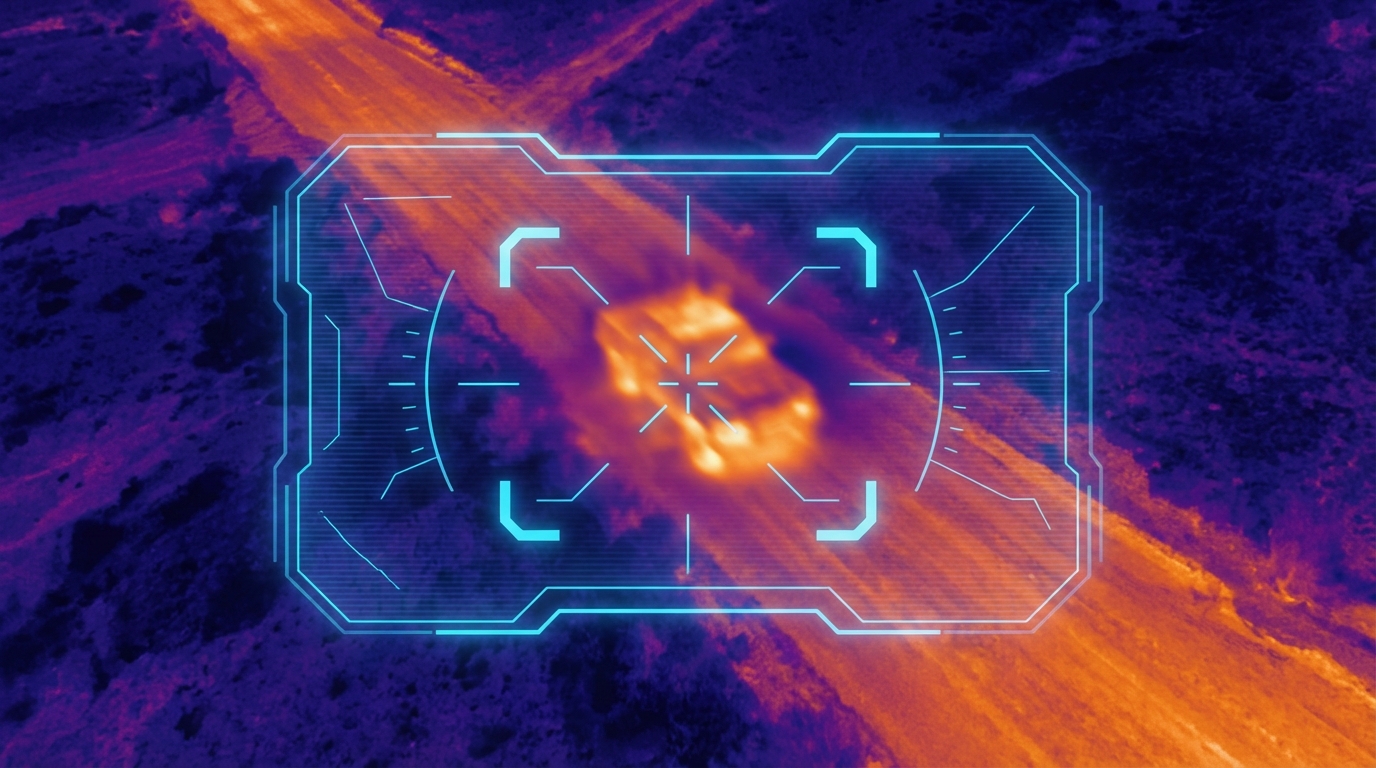
15.6 Energy Revolution: Power over Fiber (PoF)
The current bottleneck is the battery. The energy density of Li-ion (~250 Wh/kg) limits flight time.
Black Tech: PoF (Power over Fiber) technology.
Principle: The ground station uses a high-power laser (e.g., 500W) to shoot energy into the fiber.
Reception: The drone no longer carries a heavy Li-ion battery but installs a high-efficiency PV Converter Module (Photovoltaic Cell). It converts laser light directly back into electricity to drive the motors.
Tactical Significance:
Infinite Endurance: As long as the ground has power (generator/vehicle power), the drone can hover forever. This is crucial for acting as an "Aerial Relay" or "Persistent Surveillance Sentry."
Extreme Lightweighting: By removing the dead weight of the battery, the drone's thrust-to-weight ratio leaps forward.
Engineering Challenge: Heat dissipation. Current conversion efficiency is about 40%-50%. This means if 500W of laser power comes up, 250W turns into waste heat. How to dissipate heat equivalent to two high-performance gaming laptops on a small drone is the next engineering hurdle.
15.7 Trans-Medium Operations: From Sky to Deep Sea
Since fiber transmits data, why limit it to the sky?
Air-Sub Hybrid:
Scenario: The drone flies over an enemy harbor, shuts down its rotors, and dives directly into the water.
Transformation: Upon entry, the rotors fold and become propellers. The drone transforms into a UUV (Unmanned Underwater Vehicle) to attack docked warships.
Fiber Advantage: Radio waves attenuate instantly in water (making comms impossible), but fiber works just as well underwater as in the air.
Physics Challenges:
Refractive Index Matching: Air , Water . When light signals pass through connectors at the air-water interface, massive reflection loss occurs if not properly matched.
Buoyancy Control: Fiber density (Silica ) is heavier than water; it sinks. If the spool is too heavy, it will drag the UUV into the abyss. We must develop Neutral Buoyancy Fiber by embedding micro-bubbles in the coating.
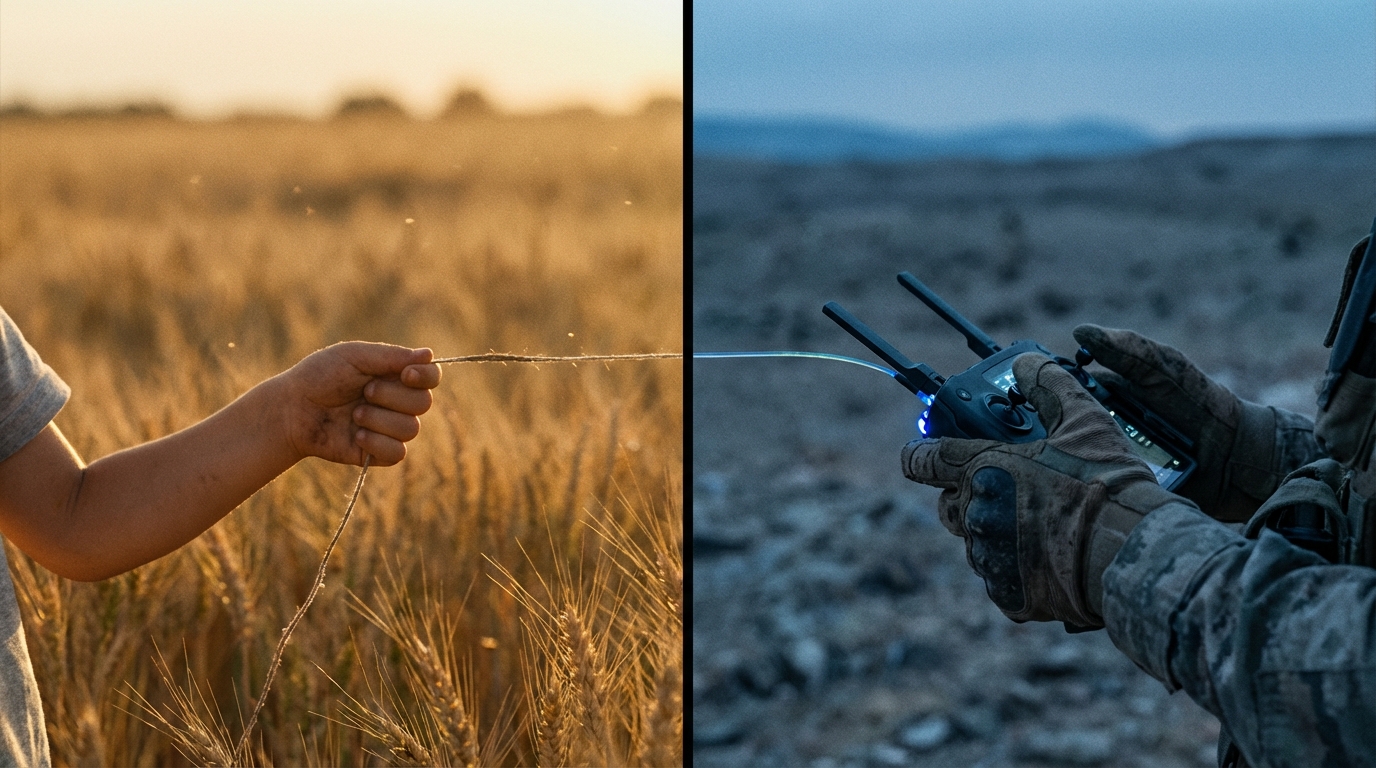
Epilogue
We started with a 250-micron glass thread and explored the counterattack of physics, the trade-offs of hardware, the game of tactics, and finally the competition of global supply chains.
The fiber drone, an invention that looks somewhat "retro" and "clumsy," has taught high-tech warfare a harsh lesson: Not all progress must be wireless, intelligent, and expensive. Sometimes, a visible, tangible wire is more reliable than all invisible waves.
May you finish this book not only learning how to build it, but also learning how to examine future technologies with this "First Principles" mindset.

Good luck. May the sky always be blue, and may the fiber never break.
Contact Now to Buy G.657.A2 Fiber
CONTACT US


FMUSER INTERNATIONAL GROUP LIMITED.
We are always providing our customers with reliable products and considerate services.
If you would like to keep touch with us directly, please go to contact us
-
![Home]()
Home
-
![Tel]()
Tel
-
![Email]()
Email
-
![Contact]()
Contact


